Haplogroup I2a1b1a

– 4 min read


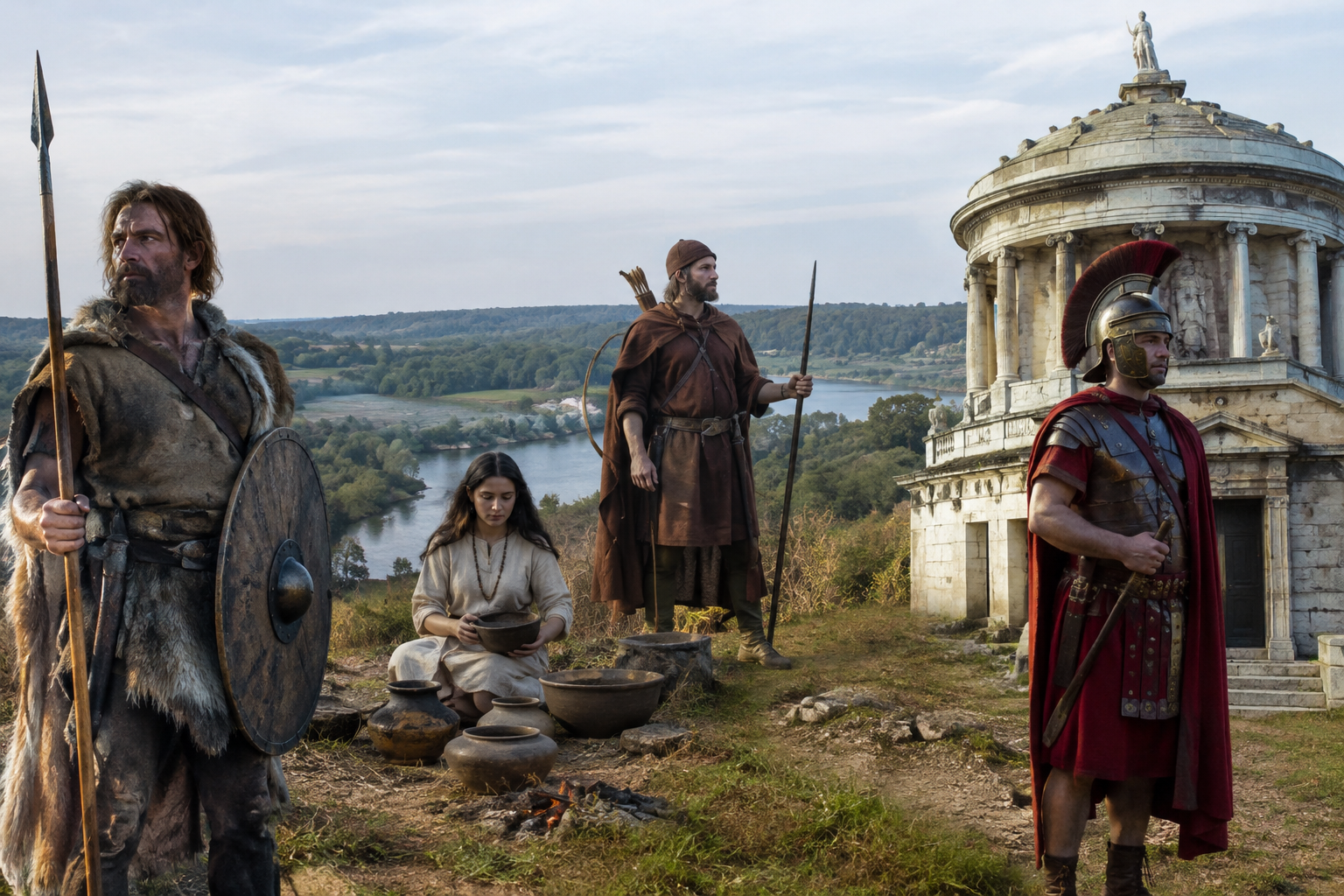
At Tollense in northeastern Germany, archaeologists uncovered one of Bronze Age Europe's starkest discoveries: a river-valley battlefield littered with the dead. Among the men caught up in that violence was sample WEZ48, dated to around 1250 BC. He matters here because he is one of the ancient individuals associated with I2a1b1a, a Y-DNA lineage that turns up not in a single tidy homeland story, but across very different moments of European prehistory and history.
That is worth pausing over. Y-DNA follows one direct paternal line only - father to son across generations - so it never describes a person's whole ancestry. But when the same branch appears in a Neolithic individual in France, in Bronze Age central and eastern Europe, and again in a Late Roman or early post-Roman burial at Rome, it gives us a narrow but revealing thread running through several quite different worlds.
The Tollense Valley site in Mecklenburg-Vorpommern is not famous because of one elite grave or a glittering treasure. It is famous because it looks like conflict on a large scale: injured bodies, scattered remains, and the unmistakable archaeological signature of a serious fight. Sample WEZ48, linked here with I2a1b1a, places this paternal line among the men present in that turbulent Late Bronze Age landscape.
That does not mean I2a1b1a was a "warrior haplogroup", nor that everyone at Tollense shared a close paternal origin. What it does show is that this branch was present in the populations of northern-central Europe by the later second millennium BC. Research on the battlefield has helped establish Tollense as evidence for organized violence and long-distance connections in Bronze Age Europe, rather than an isolated village skirmish.
A particularly relevant ancient-DNA study of the site and region is available here: https://www.sciencedirect.com/science/article/pii/S0960982220311878. For anyone carrying I2a1b1a today, the important point is not romance but placement: this lineage was part of the human background of Bronze Age societies involved in mobility, exchange, and, at times, catastrophic conflict.
A second ancient appearance comes from Poland: sample poz557 from Zubowice in the Lublin region, dated in the supplied record to around 2000 BC. Even with sparse contextual detail, this matters because it broadens the map. I2a1b1a is not appearing in only one corner of Europe or in only one famous site. It is present in eastern-central Europe as well, and at an earlier Bronze Age horizon than Tollense.
This sort of repetition is often more informative than a single spectacular find. One isolated sample can always be unusual. Two Bronze Age occurrences, in different regions, suggest that paternal lines within the wider I2 family remained established in European populations even after the major social and demographic changes that followed the Neolithic and Early Bronze Age transitions.
It is also a useful corrective to overly simple narratives. The wider haplogroup I2 has deep European roots, but a specific branch such as I2a1b1a should not be made to carry the whole history of I2 on its shoulders. The evidence here is narrower and more concrete: this branch is attested in Bronze Age individuals from both Germany and Poland, in different archaeological settings.
Central Europe and ancient DNA
The oldest sample in this set is LBR001, a Neolithic individual from France dated to around 3500 BC. That date places him in a Europe already transformed by farming, monument building, woodland clearance, and the long coexistence - and mixing - of incoming farming populations with earlier hunter-gatherer ancestry. If the association with I2a1b1a is correct at the reported level, it pushes this paternal line well back before the Bronze Age evidence from central Europe.
Neolithic France is especially interesting because it was not genetically uniform. Ancient DNA has repeatedly shown regional variation, different local histories of admixture, and the survival of lineages that do not fit any tidy "first farmers replaced everyone" model. A MyTrueAncestry article on Ancient DNA and Cerny Culture Ancestry in Neolithic France touches on exactly this wider problem: Neolithic communities were dynamic, and paternal lineages could persist, disappear, or expand very unevenly.
That is the proper significance of LBR001. He is not "the founder" of later Bronze Age men in Germany or Poland, and there is no direct genealogical bridge from one sample to another. But his presence shows that a lineage associated with I2a1b1a was already part of the paternal landscape in prehistoric western Europe long before the famous upheavals of the later third and second millennia BC.
The most historically surprising appearance in this group may be R32, from the Mausoleo Augusto in central Rome, dated in the supplied record to around AD 500. By that point we are a very long way from Neolithic France or the Bronze Age Tollense battlefield. Rome had been an imperial capital, a magnet for migrants, and then a city living through the political fragmentation of Late Antiquity.
A paternal line like I2a1b1a appearing in that setting should not be treated as shocking. Late Roman and post-Roman Italy was full of people with varied local and non-local ancestries, and ancient DNA has steadily reinforced that complexity. The point is not that one Y-lineage "explains" Rome, but that the city absorbed and contained men whose paternal origins reached into different parts of Europe.
Research on ancient Italian populations has repeatedly underscored how much movement and mixture shaped the peninsula. One useful study for that wider context is here: https://www.ncbi.nlm.nih.gov/pmc/articles/PMC10022790/. In that light, R32 is best read as evidence that this paternal branch did not remain confined to one prehistoric zone. It was still present in the human networks feeding into the Mediterranean world centuries later.
If we stand back from the individual finds, the pattern is rather striking. I2a1b1a appears here in a Neolithic French context, in Bronze Age Poland, in the violent Late Bronze Age world of Tollense, and in the Roman heart of Italy around AD 500. That is not a neat tale of one people marching across a map. It is something more historically realistic: a paternal lineage persisting through very different societies, economies, and identities.
For someone researching I2a1b1a today, that is the useful takeaway. This branch belongs within an old European paternal landscape, but its documented ancient appearances connect it especially to the continent's long continuity through change: farming communities, Bronze Age populations of central and eastern Europe, and the mixed human world of Late Antiquity. The lineage is narrow; the history around it is anything but.






Comments