Haplogroup I2a1a1b2

– 5 min read


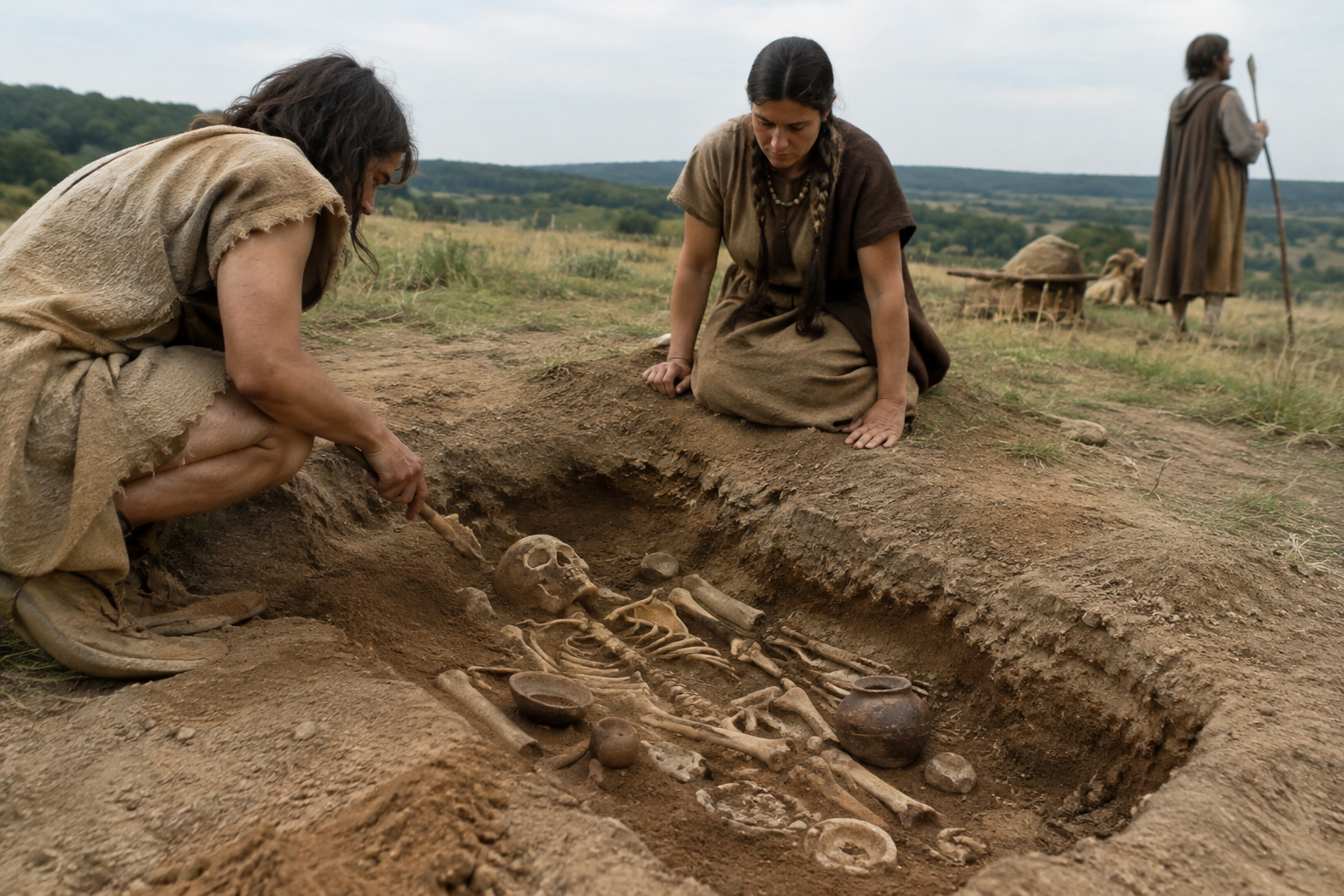
At Bury in the Oise region of northern France, a Neolithic gallery grave was not simply used and forgotten. It was revisited, reworked, and drawn back into ritual life over a very long span of prehistory. One of the men associated with that world, sample BUR297, dated here to around 2400 BC, is linked with the Y-DNA haplogroup I2a1a1b2. That matters because it places a specific paternal line inside one of the great archaeological questions of later Neolithic Europe: who was still there, in local terms, as older farming communities gave way to new social and genetic mixtures?
The Bury evidence is especially interesting because the site itself is not just a grave in the narrow sense. It belongs to the long life of a funerary monument, one whose meaning changed over centuries. Research on the sequence of use at the site, discussed in an archaeological study of the Bury gallery grave, makes clear that this was a place with a history even in prehistory. When a paternal lineage like I2a1a1b2 appears in that setting, the point is not that one man "represents a people", but that an ancient male line was still part of the human story in northern France at a moment of real transition.
Gallery graves in northern France belong to a broader Neolithic tradition of collective burial. They are architectural statements as much as burial places: communal, durable, and meant to be returned to. Bury stands out because its sequence stretches across the fourth to second millennia BC, reminding us that prehistoric monuments could accumulate meanings the way later churches or cemeteries did.
That long use-life helps frame BUR297. A date around 2400 BC places him late in the Neolithic, near the period when Bell Beaker influences were spreading across western Europe and when many regions were seeing substantial changes in ancestry, social practice, and burial custom. To find I2a1a1b2 in this context is to glimpse continuity within change: an old European paternal branch still present in a landscape being reshaped.
Haplogroup I2a1a1b2 is a narrow branch within the wider I2 family, one of the deep paternal lineages of Europe. On the Y chromosome, that means it tracks one direct male line only: father to son, back through time. It does not describe the total ancestry, language, or identity of the man who carried it.
Even so, Y-DNA can be historically revealing when tied to archaeology. In many parts of Neolithic and Copper Age Europe, branches of I2 appear among men connected to populations with strong farmer-forager mixtures or to local male-line persistence during periods of cultural change. That does not license sweeping claims about every sub-branch, and it would be wrong to turn the whole I2 story into the story of I2a1a1b2. But at Bury, the branch is a useful clue: this paternal line belonged to the local human fabric of northern France before the Bronze Age was fully under way.
The later Neolithic of northern France was not a quiet epilogue. It was a period when older monument traditions overlapped with new ways of burying the dead and with populations carrying different ancestry profiles. Across neighboring parts of northwestern Europe, ancient DNA has repeatedly shown that the centuries around 2500 BC were marked by movement, mixture, and sometimes sharp turnover in paternal lineages.
That is what makes BUR297 valuable. A man associated with I2a1a1b2 at roughly 2400 BC shows that older male lines had not simply vanished from the region. In archaeological terms, this is exactly the sort of evidence that keeps us from telling prehistory as a crude before-and-after tale. Some lineages expanded; some contracted; some persisted locally through major cultural shifts.
For readers with this haplogroup today, that point is worth dwelling on. A paternal line like I2a1a1b2 may connect not to one famous migration event or one named tribe, but to the stubborn continuity of men living through repeated transformations in prehistoric Europe. That is often how the deeper past really looks: less like a clean replacement of one world by another, and more like old lines surviving inside new social landscapes.
There is another reason Bury is a strong setting for this haplogroup. Collective tombs complicate easy stories about kinship. They can include relatives, but also broader communities, successive generations, and changing ritual choices. So the significance of BUR297 is not that he founded a dynasty we can map neatly through the whole monument. The significance is that his paternal line appears in a place where community memory was materially preserved.
This is a useful corrective to the way Y-DNA is sometimes discussed. A paternal lineage can be ancient without being socially dominant; it can persist without leaving a royal pedigree; and it can matter archaeologically because of where it appears, not because it can be inflated into legend. At Bury, I2a1a1b2 is anchored to a real place, a real monument, and a real horizon of social change.
That broader regional picture fits well with recent work on the Lower Rhine and surrounding zones, where researchers have explored how forager ancestry and later Bell Beaker expansions interacted rather than lining up into a simplistic opposition. One helpful comparison is the MyTrueAncestry discussion of the Lower Rhine-Meuse region and persistent forager ancestry, which captures the sort of complexity that also matters for northern France.
The wider family of I2 lineages turns up again and again in European ancient DNA, especially where archaeologists are dealing with deep local roots, Mesolithic survivals, or layered mixtures between incoming farmers and earlier populations. That does not mean every I2 branch has the same history. But it does explain why a northern French Neolithic sample such as BUR297 deserves attention: he sits within one of Europe's oldest paternal frameworks, yet at a date when that framework was being reshuffled.
If you step back from the single sample, the historical picture becomes rather good. The monument is old. Its use was extended. Its ritual significance endured. And in the middle of that long afterlife stands a man whose Y chromosome belongs to I2a1a1b2, a branch tied here not to mythic founders or later medieval identities, but to the lived reality of late prehistoric communities in the Paris Basin and beyond.
The most defensible lesson of I2a1a1b2 in this case is not grandeur but depth. Sample BUR297 shows this paternal branch in Neolithic northern France, associated with a monument that remained meaningful over centuries. For someone researching this haplogroup today, that suggests a line with roots in the old populations of prehistoric Europe, still present in regions undergoing major change around the end of the Neolithic. It is a modest claim, but a powerful one: your paternal story may belong to the men who persisted as Europe's ancient landscapes, burial customs, and communities were being remade.
Comments