Haplogroup I2a1a1a2a1a

– 5 min read


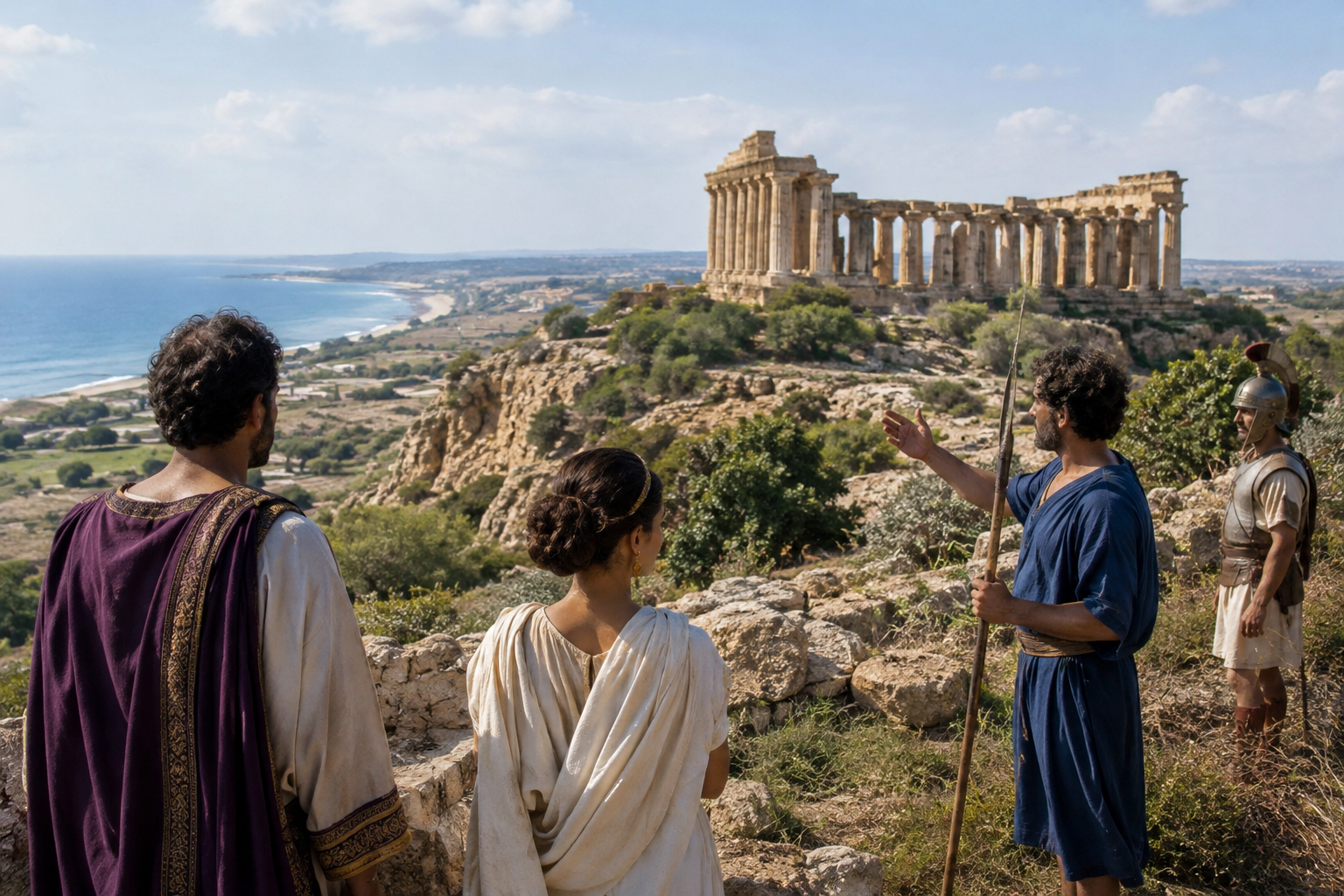
At Selinunte on the southwest coast of Sicily, one ancient man has become unexpectedly useful for thinking about a very old European paternal line. Sample I19194, dated to around 281 BC and described as Carthaginian Italy Sicily Selinunte Manuzza, connects the Y-DNA haplogroup I2a1a1a2a1a to one of the most contested landscapes in the ancient Mediterranean: a Greek-founded city later caught up in Punic power, war, and population movement.
That is precisely why he matters. A Y-chromosome lineage traces only one direct paternal line, not a person's whole ancestry or identity, but in a place like Selinunte even one paternal line can be illuminating. Haplogroup I is one of the deep-rooted branches of European Y-DNA, and narrower branches within it often appear in very different historical settings from their much older prehistoric background. In this case, I2a1a1a2a1a turns up not in some remote upland refuge, but in a cosmopolitan Sicilian town in the Hellenistic age.
Selinunte was founded as a Greek colony, flourished spectacularly, and then suffered one of the best-known disasters in Sicilian history when Carthaginian forces destroyed the city in the late fifth century BC. Yet destruction is not the end of the story. Parts of the site remained occupied, reused, and reworked under later Punic and Hellenistic conditions, which makes a third-century BC male from Manuzza especially interesting: he belonged to a world that had already been remade several times.
By around 281 BC, western Sicily was a zone of overlapping influences. Greek urban traditions survived, Carthaginian political and cultural power remained strong, and mobility across the central Mediterranean was entirely normal. So when a paternal lineage like I2a1a1a2a1a appears here, the point is not to label the individual simplistically as "Greek," "Punic," or "local," but to see that Sicilian communities were drawing men from a variety of family histories into the same urban landscape.
An ancient DNA study of Italian island populations has helped place sites like Selinunte into this broader picture of movement and mixture across Sicily and its neighboring islands; for readers following the wider regional context, that research can be found here.
The exact branch name matters. I2a1a1a2a1a is not the same thing as haplogroup I as a whole, nor even the same as all of I2. Those broader groupings reach far back into European prehistory and cover many separate lines that later followed very different paths. A narrow terminal branch tells a much more specific paternal story, but usually only when enough ancient and modern comparisons exist to map it securely.
With the evidence here, caution is essential. What we can say is that a man associated with this branch, or with a very close paternal placement relevant to this branch, was living in Punic-period Sicily in the early third century BC. What we cannot do is turn that into a neat ethnic badge or a single migration tale. Sicily almost never rewards that sort of tidy storytelling.
Still, the setting is revealing. Western Sicily in this period was not genetically sealed off behind political frontiers. It was a corridor of soldiers, farmers, traders, craftspeople, and families moving between North Africa, southern Italy, the Aegean, and local Sicilian communities. A paternal line with deep European roots appearing in a Carthaginian-associated context is therefore not anomalous; it is exactly the sort of complexity archaeogenetics keeps uncovering.
There is a persistent temptation to imagine Punic communities abroad as straightforward colonial transplants from Carthage. The archaeology has long suggested something more entangled, and genetics increasingly agrees. Punic settlements in Sicily were connected to North Africa, certainly, but they also incorporated people from the island itself and from the wider Mediterranean.
That makes I19194 valuable even as a single data point. He shows that a Carthaginian-period burial context in Sicily could include a paternal lineage associated with a deep European branch rather than something one might lazily expect from a narrow colonial stereotype. In other words, Punic Sicily was not a closed ethnic box. It was a working society made up of people whose family histories could have stretched in several directions at once.
This is one reason the genetics of ancient Sicily has become so compelling. Time and again, the island turns up as a place where cultural labels and biological ancestry intersect, but do not neatly overlap. A man may be buried in a Punic or Punic-influenced context without his direct paternal line telling a simple story of recent North African migration. Equally, a European-associated paternal line does not make him culturally less Punic if he lived and died within that world.
Selinunte is famous for its temples, but ancient DNA often pulls our attention away from monumental stone and back toward neighborhoods, cemeteries, and the less theatrical business of daily life. Manuzza, the urban hill of Selinunte, was part of the lived city. When a genetic sample comes from there, the result is often more historically useful than another grand story about imperial rivalry.
Why? Because paternal lineages survive through families, households, and local communities, not through the slogans of historians. A man buried at Selinunte around 281 BC belonged to the aftermath of conquest, recolonization, and adaptation. Whatever language he spoke, whatever cults he observed, and whatever political power ruled the district, his Y-DNA places one thread of his family line within a much longer European paternal history.
That is a point worth lingering over. Ancient Mediterranean history is often written from the top down: wars, generals, tyrants, colonies. Ancient DNA lets us do something rather different. It shows that beneath the labels "Greek Sicily" or "Punic Sicily" were actual populations whose lineages did not line up obediently with political maps.
Sicily's position between Italy, North Africa, and the wider sea made it one of the great contact zones of the ancient world. That is obvious from pottery, architecture, inscriptions, and trade. It is now becoming obvious in genetic terms as well. The island repeatedly shows continuity in some places, mixture in others, and local variation almost everywhere.
For haplogroup I2a1a1a2a1a, the Selinunte evidence is modest but meaningful. It situates the branch, or a very close reporting context for it, inside a historically mixed Hellenistic-Punic environment. That does not identify where the branch first arose, nor does it prove a specifically Sicilian origin for it. What it does show is that this paternal line was present in a population living through the complex social world of western Sicily after the age of classical Greek colonization and during the long shadow of Carthage.
If you belong to haplogroup I2a1a1a2a1a, the strongest ancient clue here is not a glamorous royal pedigree or a tidy ethnic label. It is something better and more historically honest: your direct paternal line can be placed, at least in one documented case, in the mixed and politically charged world of Selinunte in the early third century BC. That is a reminder that paternal ancestry in the Mediterranean often sits at the intersection of local continuity and constant movement, where family histories outlast regimes and refuse to fit simple categories.

Comments