Haplogroup I2a1a1a1a2c1a1a

– 5 min read


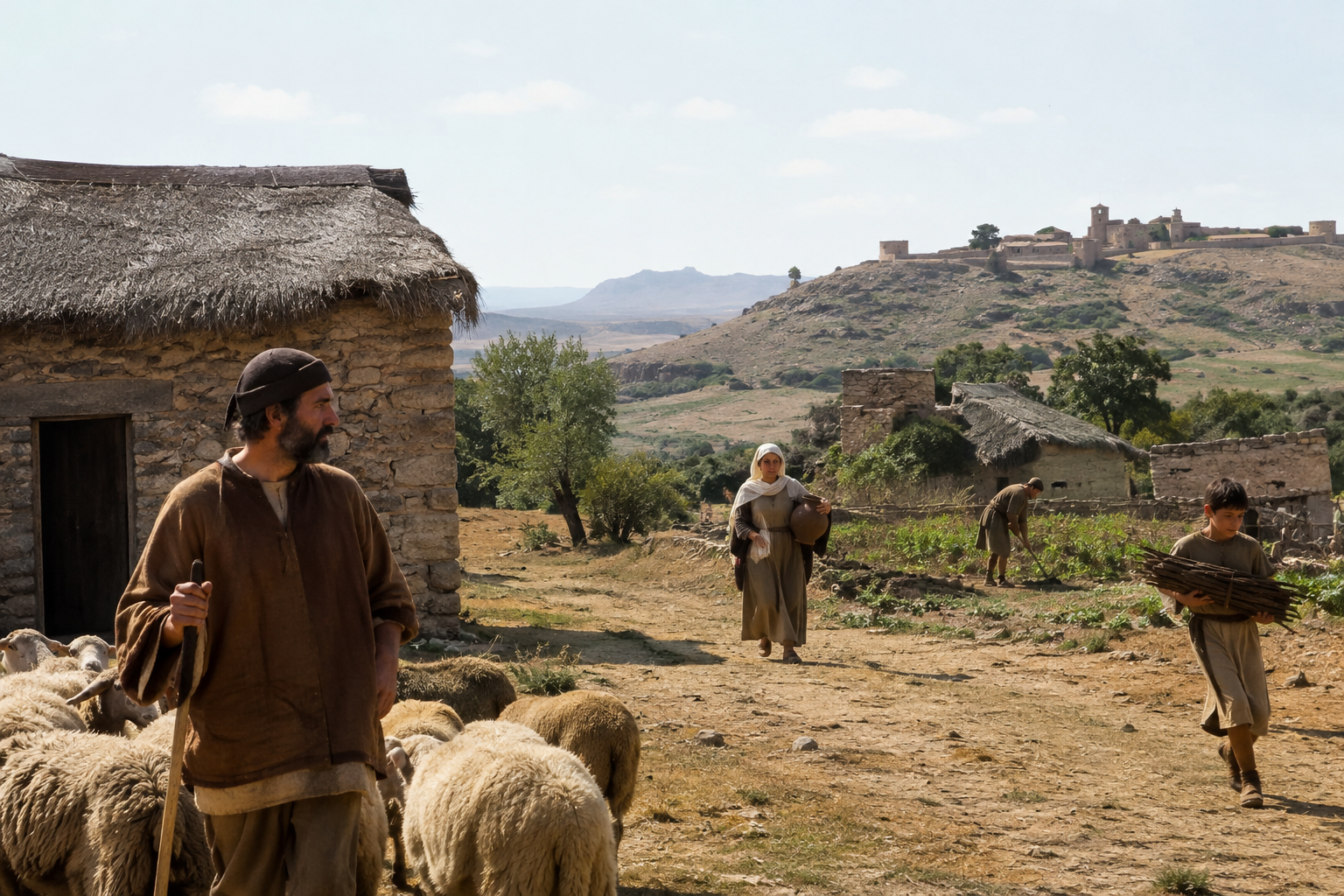
At Las Lomas del Molino in Epila, near Zaragoza, one man from post-Roman medieval Spain has become an unexpectedly useful guide to a very old paternal line. The individual identified as I30591, dated to about AD 600, is reported in connection with the Y-DNA haplogroup I2a1a1a1a2c1a1a. That is a formidable string of letters and numbers, but the human story is simpler: a direct paternal line turning up in the Ebro valley at a moment when Roman rule had long since faded, yet the people of Iberia were anything but isolated.
The interest of this sample lies not in royal glamour or a legendary founder, but in context. Around AD 600, northeastern Iberia stood in the long afterlife of the Roman world. Communities were living through political change, Christianization, shifting local elites, and the lingering effects of centuries of movement across the peninsula. A Y-chromosome line such as I2a1a1a1a2c1a1a traces only one narrow paternal thread, not a person's whole ancestry, but in archaeology even one thread can help show how continuity and change sat side by side.
Epila belongs to that fascinating period that used to be dismissed as merely "post-Roman," as if history had packed up and gone home with the legions. In fact, sixth- and seventh-century Iberia was full of local complexity. Settlement patterns, burial grounds, and regional identities did not simply reset when imperial administration weakened; many communities carried older habits forward while adapting to new political realities.
That is why I30591 matters. A paternal lineage assigned to I2a1a1a1a2c1a1a appearing at Epila suggests that this branch was part of the male landscape of early medieval Spain, at least in this region. We should be careful here: one individual does not define an entire town, province, or kingdom. But one securely placed individual can show that this lineage was present on the ground in Iberia during the centuries when Roman, local Iberian, and incoming influences were all still being worked out in everyday life.
A broader ancient DNA study of Iberia's late antique and early medieval populations has helped sharpen this picture of mixed continuity and mobility, even if any one fine-grained haplogroup assignment must still be treated with due caution at sample level. The relevant research can be found here: https://www.cell.com/cell/fulltext/S0092-8674(26)01199-2?_.
The first thing to say is that this exact branch is much narrower than the wider haplogroup I2. Haplogroup I as a whole has deep roots in Europe, and its various sub-branches appear in very different times and places. But it would be bad history to take everything ever said about broad I2 and pin it onto the much more specific I2a1a1a1a2c1a1a.
What the Epila sample gives us is not a grand migration map neatly labelled from prehistory to the Middle Ages. What it gives us is a fixed point: by around AD 600, a man linked to this paternal branch was living in northeastern Iberia. That anchors the lineage in a real archaeological setting rather than in the abstract world of phylogenetic trees.
For family historians, this is often the crucial distinction. A terminal or near-terminal branch can feel very personal, because it narrows the paternal story. Yet ancient DNA usually illuminates that story in glimpses. In this case, the glimpse is Iberian, early medieval, and rural or local rather than imperial or courtly.
The area around Zaragoza had been important under Rome and remained important afterwards. The Ebro corridor linked inland Iberia to wider Mediterranean and peninsular networks, which means that the presence of a lineage there can reflect many overlapping histories: long local survival, movement within Hispania, and the reshaping of communities during the Visigothic period.
That last phrase needs a little care. To say that I30591 lived in post-Roman or Visigothic-era Spain is not to say that a haplogroup is "Visigothic." Political labels, language, burial custom, and paternal line are not the same thing. A man living under Visigothic rule might descend from local Iberian ancestors, Roman-era settlers, migrants from elsewhere in Europe, or some combination of all three. Ancient DNA has been steadily teaching us that late antique identities were far less tidy than the old textbook categories suggested.
This makes a single Iberian I2a1a1a1a2c1a1a result especially interesting. It sits comfortably within a world where male lines could persist through major regime changes without those men becoming historical caricatures of "Romans," "Goths," or "natives." They were, quite simply, the inhabitants of early medieval Spain.
One of the most useful ways to read I30591 is alongside the now-familiar pattern from Iberian archaeogenetics: the peninsula was never a sealed box. Prehistoric ancestry streams, Roman-era mobility, and late antique population contacts all left marks that differ from region to region. So when a specific paternal branch appears in early medieval Aragon, the right question is not "which tribe did it belong to?" but "what does its presence add to the evidence for local male diversity?"
The answer, modestly but usefully, is that it adds another data point for continuity within change. Northeastern Spain was neither emptied nor replaced wholesale after Rome. Instead, its communities carried mixed ancestries and multiple male lines into the medieval period. I2a1a1a1a2c1a1a, as represented by I30591, belongs in that landscape.
That also helps explain why these early medieval Iberian finds matter to modern testers. Many people hope a Y-haplogroup will deliver a single ethnic label or a dramatic migration tale. Ancient evidence rarely works like that. What it more often provides is a historically grounded place where a direct paternal branch can be seen in action. Epila is one such place.
There is a temptation, when only one named ancient carrier is available, to apologise for the lack of a bigger cluster. That would be a mistake. Archaeology is often built from single stubborn facts. One skeleton, one burial ground, one inscription, one broken pot in the right layer. The value of I30591 is that he is not theoretical. He lived at a known site, in a known region, at a historically charged moment.
And there is a second value too. Fine-scale haplogroup labels such as I2a1a1a1a2c1a1a remind us how fast the field is changing. Twenty years ago, many lineages were discussed only at broad levels. Now, increasingly narrow branches can be linked to specific ancient individuals. That does not eliminate uncertainty, but it does allow paternal history to be written with much sharper archaeological edges than before.
For readers interested in how this same period in Iberia is revealing unexpectedly varied communities, another useful comparison is the growing evidence from other early medieval Spanish burials.
So what can responsibly be said about I2a1a1a1a2c1a1a from the present evidence? At minimum, this branch is represented in early medieval northeastern Spain by the man known as I30591 from Las Lomas del Molino, Epila, around AD 600. That places the lineage within the lived world of post-Roman Iberia: a world of survival, adaptation, and regional mixture rather than neat ethnic boxes.
If this is your paternal haplogroup, the most meaningful connection is not to a dynasty or a mythic conqueror, but to a real community in the Ebro region during a transformative century. It is a small but solid foothold in history, and sometimes that is the most valuable thing ancient DNA can offer.
Comments