Haplogroup I2a1a1a1a1b

– 5 min read


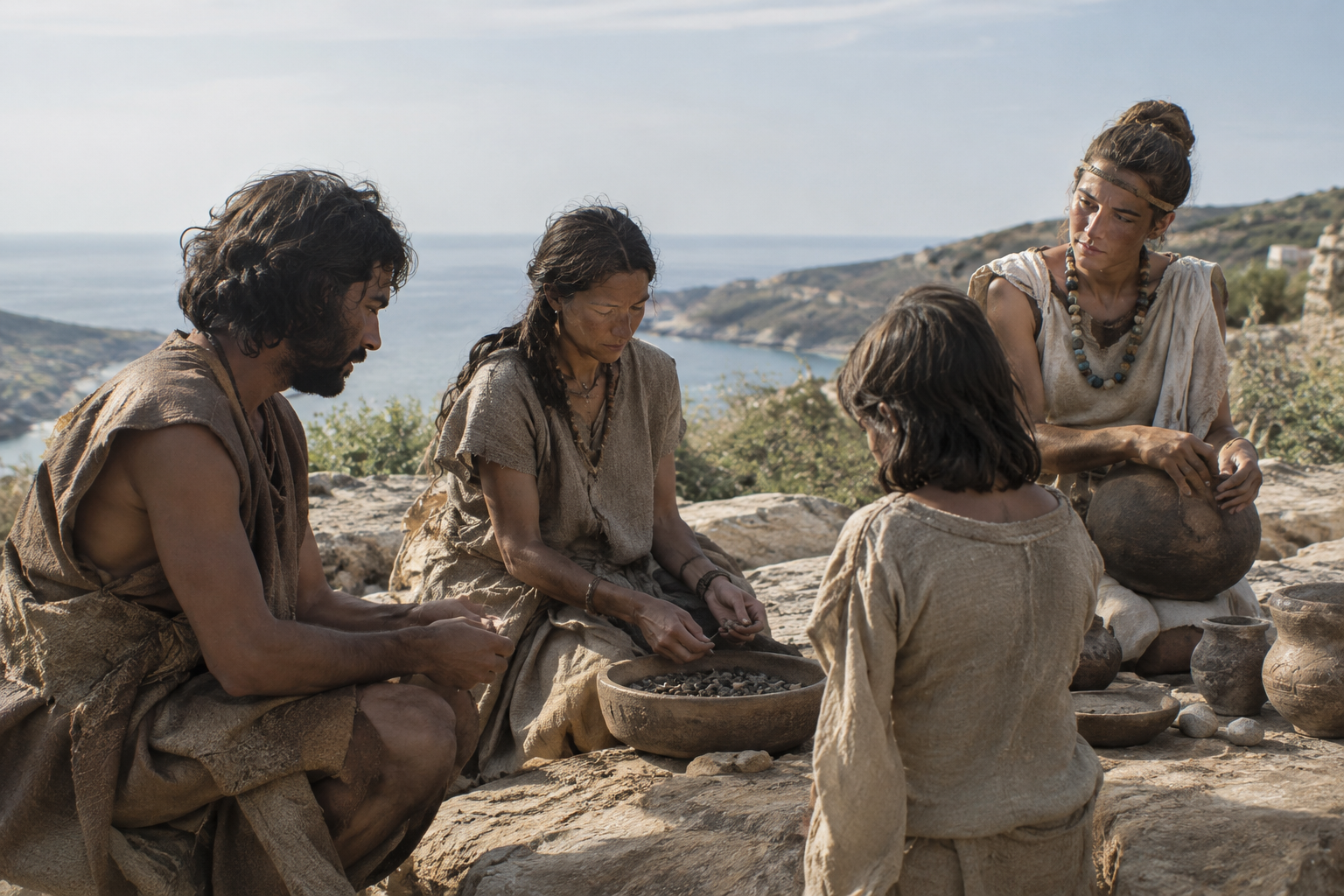
At Cova da Moura in Portugal, two Early Bronze Age male samples dated to around 2220 BC, I4229 and I4229x, place haplogroup I2a1a1a1a1b squarely in the western Iberian record. That is already interesting. It means this paternal line is not appearing here as a late historical arrival or a medieval curiosity, but as part of the deep male landscape of Atlantic Iberia in the Bronze Age.
The site matters because Bronze Age Portugal sat at a crossroads without looking like one. It faced the Atlantic, participated in wider exchange networks, and yet retained local continuities that ancient DNA is only now making easier to trace. In this case, the value of I4229 and I4229x is less in any imagined biography of two men and more in the fact that they anchor this branch in a real archaeological setting, at a real time, in western Europe.
The Cova da Moura samples are the clearest starting point because they are both from the same Portuguese Early Bronze Age context and share the same approximate date. That kind of repetition is useful. A single ancient Y-chromosome result can always be a stray thread; two closely placed results begin to look more like a local pattern, or at least a paternal presence established enough to show up twice in the same site record.
What can we say safely? These men belonged to a Bronze Age community in Portugal, and their reported association with I2a1a1a1a1b places this lineage within an Iberian setting more than four thousand years ago. What we cannot do is turn that into a full ethnic label, a language claim, or a neat migration story. Y-DNA follows one direct paternal line only, not the whole ancestry of a person or population.
Still, western Iberia is exactly the sort of place where these paternal signals matter. Bronze Age communities there were living after the great Neolithic transformations and during a period when older local lineages and newer ancestry streams were interacting in different ways across the peninsula. For readers interested in the broader picture, MyTrueAncestry's piece on The Genetic History of Portugal gives useful regional context.
A genetic study connected with ancient Iberian material, available through https://www.biorxiv.org/content/10.1101/134254v1, helped frame how prehistoric population change in the peninsula can be studied through ancient genomes. Even where the article-level story rests on a small number of Y-line assignments, that wider research backdrop is important: it reminds us that paternal lineages sit inside much larger population histories.
The name looks forbidding, but it tells a simple story of nesting. I2a1a1a1a1b is a very specific twig on the broader I haplogroup tree, and I itself is one of the classic old European Y-chromosome macro-lineages. The crucial point is that the deep history of haplogroup I as a whole is not automatically the same thing as the history of this exact sub-branch.
That distinction matters especially here. It would be easy, and wrong, to take everything ever said about I2 in Mesolithic or Neolithic Europe and paste it directly onto I2a1a1a1a1b. The responsible reading is narrower: this particular subclade is attested in the supplied evidence in Early Bronze Age Portugal and later in Iron Age Sardinia. That is enough to suggest a western Mediterranean story worth exploring, without pretending we can already draw every branch of the family tree in between.
The third ancient sample associated here with I2a1a1a1a1b is I16170 from the Balari settlement in Sardinia, dated to around 975 BC. This is a very different world from Early Bronze Age Portugal. By the late second and early first millennium BC, Sardinia was a busy island with its own long local development and constant contact with surrounding Mediterranean societies.
That contrast is what makes I16170 so valuable. The sample does not prove a direct line of descent from Cova da Moura, and it certainly does not mean Portugal and Sardinia formed a single biological block. But it does show that this paternal branch, or a line closely associated with it, appears in two western Mediterranean settings separated by more than a millennium.
Sardinia is often treated as though it were genetically frozen in amber. Ancient DNA has been steadily correcting that picture. The island preserved some old ancestry very well, yes, but it was also historically connected, internally varied, and changing over time. MyTrueAncestry's article on Paleogenomics of Ancient Italian Islands is especially relevant here because island histories are rarely as isolated as older stereotypes suggest.
Three ancient males are not an empire, a tribe, or a dynasty. But archaeology is often built from exactly this sort of modest, stubborn evidence. When the same narrow Y-DNA branch appears in both Early Bronze Age Portugal and Iron Age Sardinia, it invites a historical question about persistence and distribution along the western Mediterranean fringe.
There are several possible explanations, and the evidence does not yet let us choose among them with confidence. One is long-term survival of an older western European paternal line in multiple coastal and island populations. Another is movement, direct or indirect, through the maritime networks that linked Iberia, Sardinia, and other Mediterranean regions over centuries. Yet another is that broader parent-line diversity in these regions simply contained such branches all along, and ancient sampling is only now catching glimpses of them.
Research on ancient island populations, including material linked through https://www.biorxiv.org/content/10.1101/583104v1.full, has helped show how insular and coastal communities can preserve both continuity and contact at once. That combination is exactly why a lineage like I2a1a1a1a1b can be so historically interesting. It hints neither at pure isolation nor at simple replacement, but at a more granular human story.
For a wider Mediterranean comparison, the MyTrueAncestry discussion of Medieval Sicily's Multi-Faith Genetic History is a reminder that islands and coastlines repeatedly accumulated layers of movement rather than following a single linear descent.
The Cova da Moura evidence also fits a bigger theme in Iberian archaeogenetics: continuity and change can happen together. Bronze Age Iberia saw major social and demographic shifts, but not every local paternal line vanished under them. Some branches persisted regionally even as ancestry profiles, exchange systems, and material cultures changed around them.
That is one reason this haplogroup may interest people with roots in Iberia or the western Mediterranean. Not because it guarantees descent from a named prehistoric people, and not because it can identify a language spoken four thousand years ago, but because it belongs to a paternal history that was already established in the far west of Europe by the Bronze Age and remained visible later on a major Mediterranean island.
Readers who want to stay in Iberia but move forward in time may also find Roman Hispania's Lasting Genetic Legacy useful. The Roman period did not erase earlier local ancestry; rather, it added another historical layer onto an already complicated population landscape.
For I2a1a1a1a1b, the strongest current insight is not grandeur but placement. This branch is attested in the ancient record at Cova da Moura in Early Bronze Age Portugal and again at the Balari settlement in Iron Age Sardinia. That gives it a compact but evocative footprint in the western Mediterranean world, linking Atlantic Iberia and island Sardinia through direct paternal evidence across a long span of time.
If this is your haplogroup, the responsible takeaway is a good one: your direct paternal line belongs to a branch with ancient roots documented in real archaeological communities of western Europe and the western Mediterranean. As more ancient samples are published, that picture may sharpen. For now, these few men are enough to show that the line was already part of the human story there, long before written history began to name the peoples of those coasts.
Comments