Haplogroup I2a1a1a1a1a6

– 5 min read


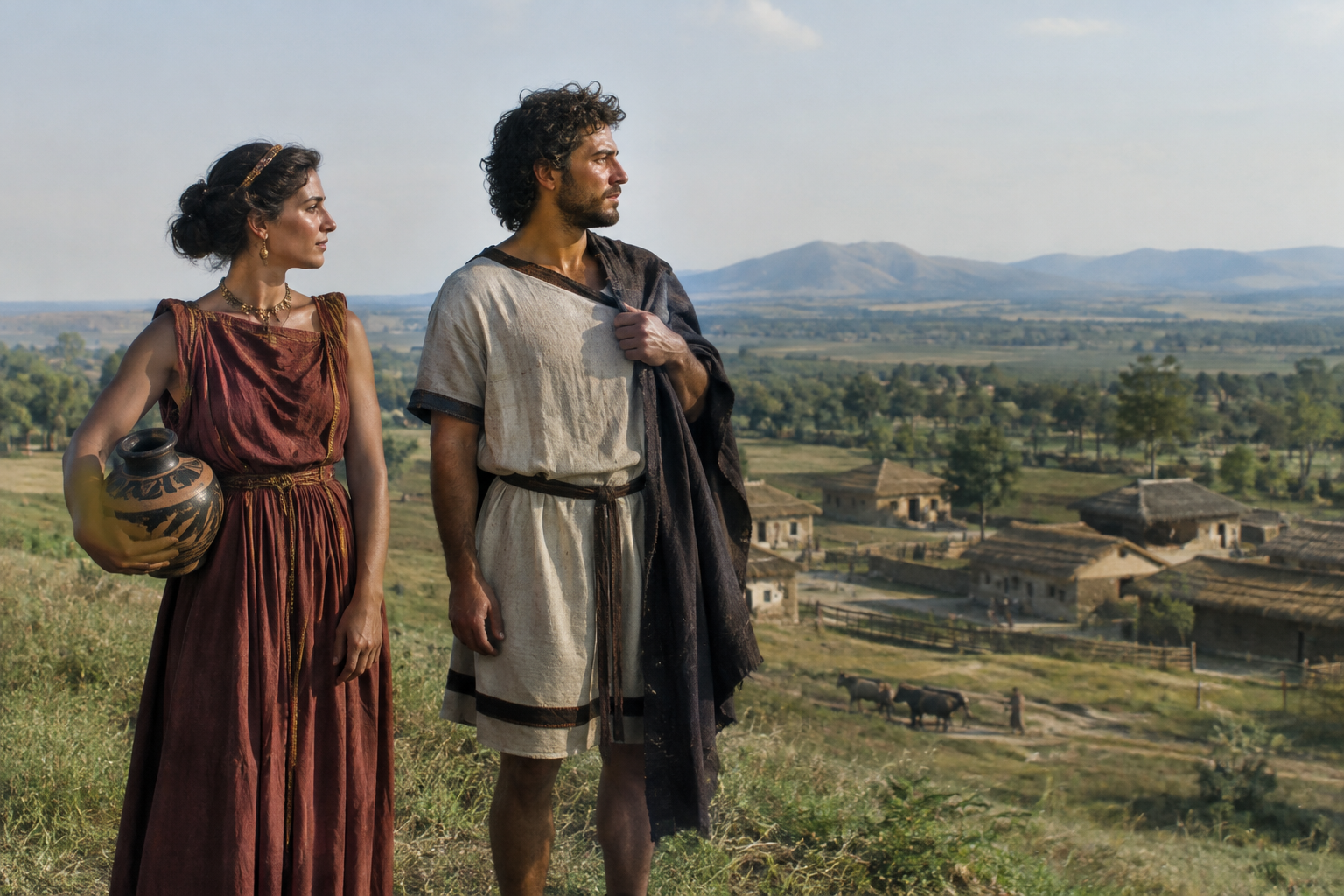
At Felsina, the ancient city beneath modern Bologna, two men dated to around 550 BC stand out for more than simply belonging to the Etruscan world. Their sample IDs, I31094 and I35909, come from the Po Valley in northern Italy, and both have been associated here with the Y-DNA haplogroup I2a1a1a1a1a6. That matters because Felsina was not a remote village on the edge of events. It was one of the great Etruscan centers of the north, a place where local traditions, trade, and wider Mediterranean connections all met.
Those two individuals do not let us reconstruct a dynasty, a household, or a complete population. But they do offer something more solid and more interesting: a glimpse of one paternal line within an urban Etruscan setting at a time when northern Italy was culturally vibrant and politically important. Y-DNA traces one direct male line only, not a person's whole ancestry, yet even that single line can be revealing when it turns up in a well-defined archaeological place.
Long before it became the Roman Bononia, Felsina was an Etruscan city with its own local character. Northern Etruria was never merely a pale copy of the better-known cities farther south. In the Po Valley, communities were plugged into networks of exchange running across the Apennines, along the Adriatic, and into the broader Italic and Mediterranean world.
The two Felsina males linked here to I2a1a1a1a1a6 belong to that Archaic phase. Their date, around 550 BC, places them in the centuries when Etruscan society in the north had already developed a recognizably urban form. That makes this haplogroup's appearance especially useful: it is not floating in abstraction, but anchored to a major Iron Age city.
For anyone following the archaeology of this exact setting, MyTrueAncestry has also explored the wider regional picture in Bologna here:
The first thing to say is that I2a1a1a1a1a6 is a very specific downstream branch, while haplogroup I2 as a whole is a much broader European paternal lineage with a very deep history. One should not lazily project the entire prehistory of I2 onto this exact subclade. What the Felsina evidence gives us securely is a branch reported in an Etruscan-period context in northern Italy, not a complete map of where every earlier ancestor of that branch lived.
Still, there is a larger historical point worth making. Iron Age Italy was not built from a single male lineage, nor from one neat ethnic package. Ancient DNA has increasingly shown that communities described by archaeologists and historians as Etruscan, Latin, Umbrian, or Roman could include considerable variation in paternal lines while still sharing local cultural worlds, burial traditions, and often overlapping ancestry profiles.
That is precisely why these two Bologna-area men matter. They remind us that an Etruscan city was a social and political community, not a genetic monoculture. A paternal lineage such as I2a1a1a1a1a6 could be fully part of that world without needing any melodramatic story of foreignness or isolation.
There is real value in repetition. A single ancient sample can always be a curiosity; two individuals from the same site and period begin to look more like a local pattern, even if only a modest one. With I31094 and I35909, we are not looking at a lone outlier but at a repeated paternal signature in Archaic Felsina.
That does not prove they were close relatives. It does not prove a ruling clan, a cemetery-wide male kindred, or continuity from some much earlier prehistoric community. But it does suggest that this lineage was established enough in the Felsina population to appear more than once in the surviving sample set.
In practical terms, that is exactly the sort of evidence descendants and surname researchers often find meaningful. Ancient DNA rarely hands us a family tree on a plate. More often, it shows that a lineage was present in a particular place and cultural setting, and present often enough to count as part of the human furniture of that community.
The Po Valley was one of the most dynamic regions of first-millennium BC Europe. It connected central Italy to Alpine zones and to routes reaching toward the eastern Adriatic and beyond. Any paternal lineage found in Felsina must be understood against that background of movement, exchange, and regional complexity.
That does not mean every man in the city was a recent migrant, nor that every lineage marks a dramatic population turnover. Quite the reverse: one of the lessons of ancient DNA is that culturally famous societies often rested on populations with mixed and layered roots accumulated over long periods. A line like I2a1a1a1a1a6 in Bologna fits that broader picture of continuity mixed with interaction.
Readers interested in how genetics illuminates other Italian communities across later periods may find a useful comparison in this study of central Italy from Roman into early medieval times:
Seen this way, the Felsina samples sit in a bigger Italian story. They belong to a peninsula where local populations changed, mixed, and persisted in uneven ways, while cities and identities rose and fell around them. The paternal line is only one thread, but it is a thread tied to a real place and date.
Quite a lot about context; much less about biography. We can say that I31094 and I35909 are identified as Archaic Etruscan individuals from Felsina in the Po Valley, dated around 550 BC, and associated here with I2a1a1a1a1a6. We can say that this places the lineage within a documented Etruscan urban landscape in northern Italy.
What we should not do is inflate that into a sweeping claim that this exact branch was the Etruscan lineage, or that anyone carrying it today descends specifically from these two men. Ancient Y-DNA works best when handled at the right scale. It can place a paternal line inside a known archaeological world; it cannot by itself assign language, status, or personal identity.
A wider ancient DNA discussion of the Bologna material is reflected in MyTrueAncestry's regional write-up on origins and change there, and the scientific context behind these ancient individuals is linked through research associated with the Bologna dataset at this Harvard Dataverse record. Used carefully, that kind of work helps turn named samples into part of a serious historical argument about who lived in northern Italy and how populations changed over time.
The most distinctive thing about I2a1a1a1a1a1a6 here is not that it can be made to fit a grand myth. It is that it appears, twice, in a specific Etruscan city at a specific moment in Iron Age history. For someone researching a paternal line, that is a grounded and valuable clue: this branch was present among men living in Archaic Felsina, a major center of northern Etruscan Italy.
That does not make every modern bearer of the haplogroup an "Etruscan" in any simple sense. But it does mean that one direct paternal thread now has a securely ancient foothold in the world of pre-Roman Bologna, where archaeology and genetics meet on unusually good terms.






Comments