Haplogroup I1c1c1a
– 5 min read


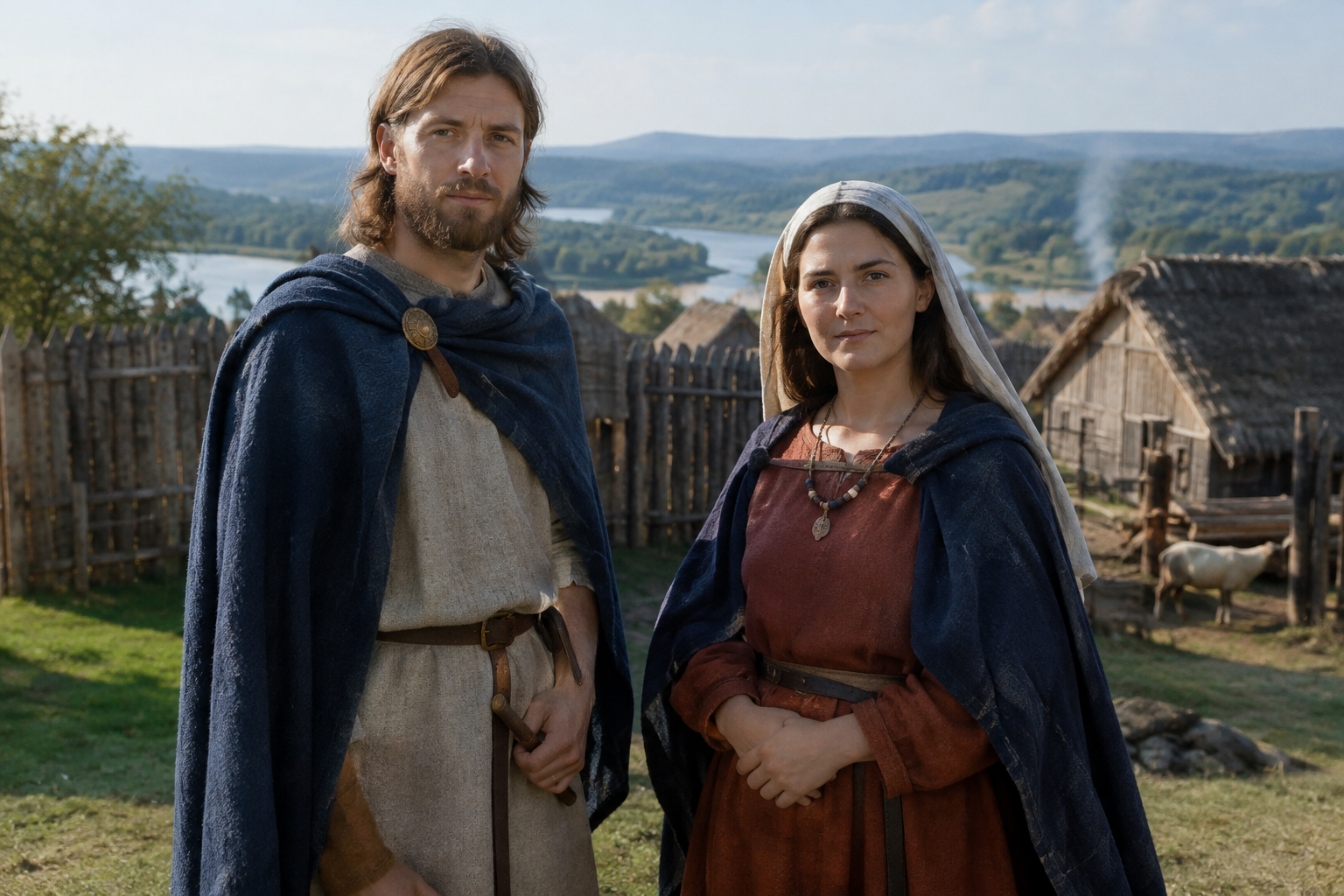
At Velim-Velistak in early medieval Croatia, two men dated to around AD 750 - VEM016 and VEM021 - carry the Y-DNA haplogroup I1c1c1a. That is a small detail on paper, but archaeologically it is rather useful. Instead of treating a haplogroup as an abstract label floating somewhere over northern Europe, we can pin this branch to a real community in the eastern Adriatic hinterland, at a moment when the post-Roman Balkans were being reshaped by new settlements, political realignments, and changing identities.
These two Croatian individuals matter because they show a paternal line usually discussed within the broader history of haplogroup I1 appearing in an early medieval Balkan context. Y-DNA traces one direct paternal line only, not a person's whole ancestry, but repeated finds at a site can still tell us something important about who was living there and how male-line lineages were distributed within a local population.
Velim-Velistak lies in Dalmatia, a region that had lived through the collapse of Roman administration, the survival of coastal urban centres, and the emergence of new early medieval polities inland. By the eighth century, this was a landscape of continuity and change at once: older Roman infrastructures still shaped movement and settlement, but burial grounds and village communities belonged to a very different political world.
The two individuals linked here to I1c1c1a, VEM016 and VEM021, come from that setting. With only two sample IDs and an approximate date, one must be careful not to build a dynasty out of a coincidence. Still, the duplication is notable. It suggests that this paternal branch was not an isolated one-off in the cemetery, but present in at least two men from the same early medieval community.
That matters because early medieval cemeteries often reveal population mixtures that written sources flatten into a single name. "Croat," "Slav," "Roman," or "Avar-era" are historical and archaeological labels with different meanings; a Y-chromosome lineage is something else again. What Velim-Velistak gives us is a glimpse of one paternal strand within that mixed and changing world.
Croatia's shifting paternal lineages
The haplogroup in this article is I1c1c1a, a downstream branch within the wider I1 paternal family. The larger I1 lineage is well known in European population history, especially in northern Europe, but it would be a mistake to pour all of that broad history straight into this narrower subclade. A deep branch and a terminal branch are not the same historical claim.
So the safest way to read these Croatian finds is this: by around AD 750, men associated with I1c1c1a were present in an early medieval Dalmatian cemetery. That alone does not prove when their paternal ancestors first arrived in the region, whether they came in one migration or several, or what language they spoke. But it does show that this branch had become part of the male-line landscape of early medieval Croatia.
In practical terms for family historians, that makes I1c1c1a in the Balkans something concrete rather than hypothetical. It is no longer merely a lineage mapped in modern testing projects; it is anchored to excavated individuals from a datable early medieval site.
Ancient DNA can tempt us into over-reading tiny numbers, yet two related-looking signals from one place are often more informative than a single glamorous outlier. VEM016 and VEM021 suggest recurrence. Even without claiming close kinship, the repeated appearance of the same paternal branch hints that the cemetery included a local or semi-local male lineage that had some staying power within the community.
That fits a broader archaeological picture seen across parts of early medieval Europe: cemeteries were not random collections of passers-by. They often represent communities with some continuity across generations, even when those communities themselves were formed from people of varied origins. A lineage like I1c1c1a could therefore have arrived earlier and become established locally, or have been part of the community-building processes of the sixth to eighth centuries.
Research connected to these Croatian burials is catalogued under https://www.ebi.ac.uk/ena/browser/view/PRJEB81250, which points to an ancient DNA project on the region's past populations. Without forcing more detail than the available evidence allows, that wider work is valuable because it places individual Y-line findings into a population framework rather than treating them as isolated curiosities.
Deep Balkan roots and medieval admixture
The eastern Adriatic is one of those regions where simple origin stories usually go to pieces. Roman provincial populations did not vanish. Nor were early medieval newcomers a single homogeneous bloc. Coastal towns, island networks, upland routes, and the old Roman road system all helped create a zone of contact between local survivors and incoming groups.
In that sort of setting, a paternal lineage associated with I1c1c1a does not need to be squeezed into a single ethnic label. It may have belonged to men whose wider ancestry was mixed, whose community had adopted new cultural forms, or whose descendants later identified with political groups unknown to their grandfathers. Archaeology is often awkward in exactly this productive way: it resists the tidy tribal maps that later chroniclers liked to draw.
That makes the Velim-Velistak evidence useful beyond one cemetery. It contributes to the growing picture that early medieval Balkan populations were genetically varied, and that some paternal lines with stronger modern associations farther north were already well embedded in the Adriatic hinterland by the eighth century.
Diverse origins in a 7th-century cemetery
One reason these Croatian samples are interesting is that they belong to the early medieval centuries when population history becomes both more visible and more contentious. Historians have long argued over migration, acculturation, frontier society, and the fate of Roman provincials. Ancient DNA does not settle all that by itself, but it does add stubborn facts on the ground - or rather, in the ground.
For I1c1c1a, the stubborn fact is modest but important: this branch appears in two men from Velim-Velistak around AD 750. That suggests local presence, not just distant theoretical ancestry. When such finds accumulate across cemeteries and regions, they help turn broad narratives about the early Middle Ages into something testable.
Comparable discussions appear elsewhere in Europe too, where post-Roman communities show mixtures of continuity and incoming ancestry rather than clean breaks. The Croatian case belongs in that wider conversation, particularly because the Balkans were never merely a passive receiving zone; they were an active crossroads between the Mediterranean, central Europe, and the steppe-facing interior.
Migrations around the Black Sea
If your paternal line falls under I1c1c1a, the best-supported lesson from the current ancient evidence is not a grand claim about a single tribe or heroic migration. It is something more grounded, and in some ways more interesting: this branch was present in an early medieval Croatian community at Velim-Velistak by around AD 750, represented by at least two men, VEM016 and VEM021. In other words, your lineage belongs to a paternal history that was already part of the lived human landscape of the post-Roman Balkans.


Comments