Haplogroup I1a3a1a2b

– 5 min read


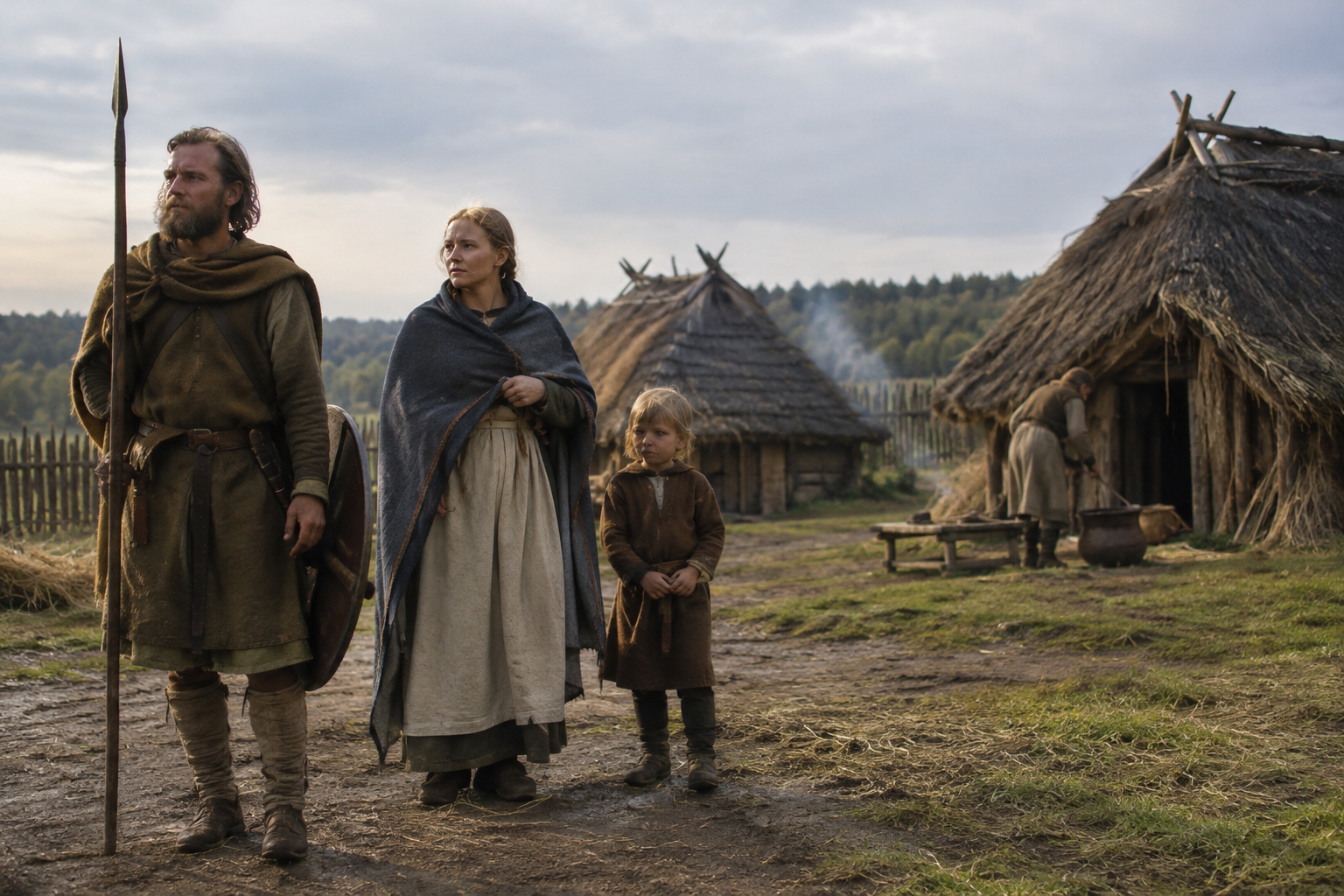
At Grodek in Poland, a third-century burial identified as PL048 places haplogroup I1a3a1a2b in a setting that is both archaeologically specific and historically charged: the Wielbark cultural world often linked with Gothic communities. Even with a short sample label and an approximate date of around AD 250, that is enough to make the find interesting. It anchors this paternal line not in a vague idea of "Germanic ancestry," but in one excavated landscape on the eastern side of the Roman world, where identities, alliances, and movements were still being worked out on the ground.
That matters because Y-DNA follows one direct paternal line only. It does not describe the total ancestry, language, or ethnicity of any one man. But when a branch like I1a3a1a2b appears in an ancient individual from a Gothic-associated cemetery zone in Poland, it becomes part of a much larger historical question: how northern and central European paternal lines became entangled with the communities that late Roman writers would eventually call Goths.
The ancient individual PL048 is described as Gothic Tribe Poland Grodek Wielbark, dated to about AD 250. That places him in the late Roman period, in a region where the Wielbark archaeological culture has long been central to debates about Gothic origins and expansion. Archaeologists have treated Wielbark sites with care, because material culture, burial custom, and later written labels do not always line up neatly. Still, Grodek sits within one of the key zones where those discussions have unfolded.
What makes this find especially useful is not that it proves every old migration story, but that it gives us a paternal lineage attached to a real burial context from this frontier world. A research lead associated with this region, published on a Gothic cemetery at Maslomecz in Lublin Province, reflects the sort of archaeological setting in which these communities are studied: burial grounds, local variation, and the uneasy fit between texts and graves.
Germanic languages and ancient genomics
The haplogroup name itself tells us that I1a3a1a2b is a narrow branch within the wider Y-DNA haplogroup I1. That broader I1 lineage is widely associated with northern Europe in both modern and ancient DNA discussions, especially in Scandinavian and Germanic contexts. But one must be careful here: the deep history of I1 as a whole is not automatically the history of this exact subclade.
For this article, the safest point is the clearest one. A branch reported here as I1a3a1a2b is represented by an ancient individual from a Wielbark-associated setting in Poland around AD 250. That does not mean the branch originated there, nor does it mean every Wielbark male carried it. What it does show is that this paternal line had reached, or was already established within, the communities occupying that Gothic-connected archaeological zone in the Roman period.
Poland is not just a pin on a map in this story. It is one of the crucial arenas in which archaeologists have tried to understand how communities north and northeast of the Roman Empire organized themselves before later Gothic groups appeared farther south, toward the Black Sea and the Balkans. The old habit was to draw a single arrow on the map and call it a migration. Ancient DNA has made that picture both more precise and more complicated.
Instead of one people moving in perfect formation, the evidence increasingly suggests mixed communities, shifting networks, and regional diversity. That wider point fits well with recent MyTrueAncestry coverage of Gothic-associated populations, especially the posts on mixed origins in late antique Bulgaria and the genetically diverse Masłomęcz community. A paternal line such as I1a3a1a2b fits neatly into that more grounded picture: one line among many inside a mobile and historically important population.
Gothic communities in Bulgaria
It is worth pausing over how much, and how little, a label such as "Gothic Tribe Poland Grodek Wielbark" can do. Archaeological classifications are useful shorthand, but they are not biographies. PL048 was a man with relatives, local ties, and a life lived in one community at one moment in late antiquity. His Y-DNA gives us one inherited thread from father to son, not a complete cultural passport.
Yet this is exactly why such finds are valuable. They strip away some of the grandiose language that has so often gathered around the Goths and bring us back to excavated humans in particular places. A lineage like I1a3a1a2b is not interesting because it flatters modern identity claims; it is interesting because it appears in a burial landscape tied to one of Europe's most argued-over archaeological cultures.
That same move from legend to evidence is visible in broader studies of the northern Black Sea and migration-period Europe, where genetics helps test older historical models rather than simply repeating them. The result is usually not a dramatic single answer, but a better map of how people were connected across regions.
Cosmopolitan Goths at Masłomęcz
Because I1 is so often discussed in relation to northern Europe, there is a temptation to turn every I1 result into a simple tale of Scandinavian expansion. History is rarely so tidy. What the Grodek sample shows is compatibility with a wider Germanic-connected horizon, but not a neat one-to-one ethnic equation. By the third century AD, the Baltic and east-central European world already contained communities with varied biological backgrounds and material traditions.
That is precisely where Y-DNA can help if used carefully. It can reveal continuity in male lines, suggest links between regions, and sometimes show whether a cemetery included multiple paternal backgrounds. But it works best when kept alongside archaeology rather than made to overrule it. In the case of I1a3a1a2b, the real strength of the evidence is that it places this branch within the lived social world of a Wielbark-associated burial community.
For readers following the larger background of how language and population movement intersect, the broader discussion of Germanic-language spread in ancient genomics is especially relevant. It shows why no single grave can stand in for an entire people, but also why a single grave can still matter enormously.
Tracing Germanic-language spread
For someone researching haplogroup I1a3a1a2b today, the most useful historical insight is not a promise of descent from famous Goths, but a firmer and more interesting possibility: this paternal branch is represented in at least one documented late Roman-period burial from the Wielbark sphere in Poland, a region central to debates about Gothic-associated populations. That places the lineage within a genuine archaeological context shaped by mobility, local community life, and the making of the post-Roman European world.
In other words, this is not merely a northern European Y-line in the abstract. It is a line that has surfaced in one of the key contact zones where archaeology and ancient DNA are reshaping how we understand the Goths.

Comments