Haplogroup I1a2b3

– 5 min read


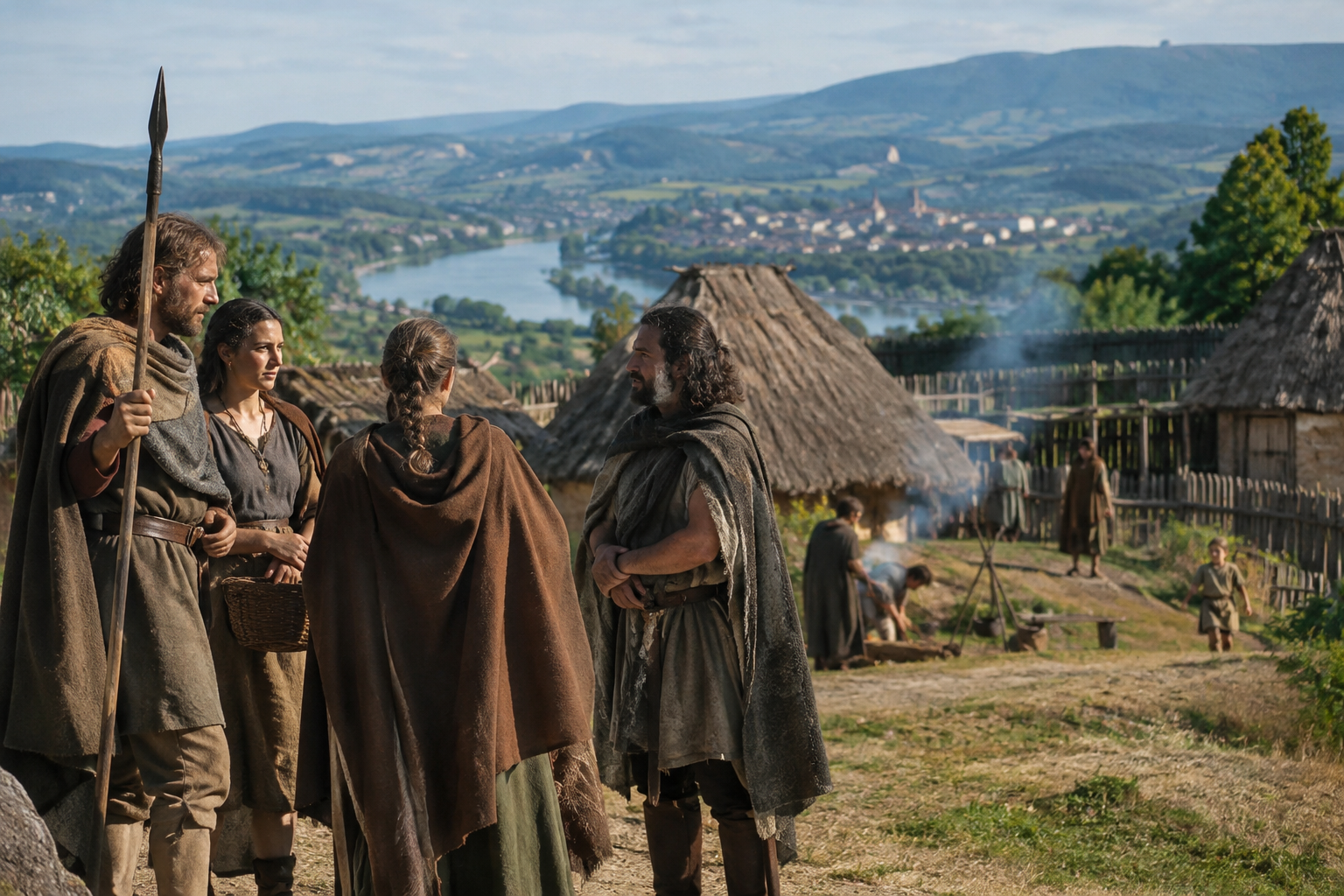
At Goxwiller in Alsace, not far from the Rhine corridor that has carried people, goods, and arguments across Europe for millennia, one Iron Age male identified as GOX287 offers a particularly useful glimpse into Y-DNA haplogroup I1a2b3. He is dated to around 500 BC and is associated here with the Gallic Triboci setting in what is now Bas-Rhin, in France's Grand Est. That combination is interesting at once, because it places a paternal line usually discussed in later northern and Germanic contexts inside an Iron Age frontier zone where Celtic and trans-Rhenish worlds were already in close contact.
That is the first thing worth saying about I1a2b3: a Y-DNA label traces one direct paternal line only. It does not define a person's whole ancestry, language, or political identity. But when a branch appears in an ancient burial from a place like Goxwiller, it becomes part of a larger archaeological question: how were communities along the Upper Rhine put together before Rome, before the medieval kingdoms, and before the neat ethnic maps that later writers liked to imagine?
The Goxwiller individual matters because the Upper Rhine was never a historical backwater. This was a zone of movement and mixture long before Roman legions fixed roads and frontiers across it. By the fifth century BC, communities in Alsace stood within a web of exchange linking eastern France, southwestern Germany, and the wider Hallstatt and La Tene worlds.
In that setting, GOX287 is not best treated as a mascot for a single tribe or a simple migration arrow on a map. Ancient labels such as "Gallic" and "Triboci" belong to historical interpretation, and the Triboci themselves are better documented in later classical sources than in 500 BC. What the sample genuinely gives us is a securely useful fact: a man from Iron Age Alsace carried a paternal line reported here as I1a2b3, showing that this lineage, or a very close branch within its paternal cluster, had reached the Rhine-adjacent world well before the Roman Empire.
That fits a broader archaeological picture in which the Rhine was less a hard boundary than a busy contact zone. Material culture, burial practice, and later historical identities do not always line up neatly with genetics, and that is precisely why a sample like GOX287 is so valuable. It reminds us that paternal lineages could circulate across cultural frontiers without waiting for the grand migrations of Late Antiquity.
Celtic language origins and DNA
I1a2b3 sits within the broader Y-DNA haplogroup I1, a paternal lineage best known today for its strong presence in parts of northern Europe. But one must be careful here. The deep history of I1 as a whole is not automatically the history of every narrow downstream branch, and a label as specific as I1a2b3 should not be made to carry claims that only belong to the wider parent haplogroup.
For this article, the sound approach is modest and useful. GOX287 shows that a paternal line associated with I1a2b3 appears in Iron Age northeastern France, in a region that connected temperate Europe to the Rhine basin. That does not mean all men in the area belonged to this branch, or that the branch "was Celtic" or "was Germanic." It means that one direct male line later recognizable in that haplogroup framework was already present in a historically important borderland around 500 BC.
This is where ancient DNA is at its most illuminating. It does not flatten the past into single peoples marching under single banners. Instead, it reveals that real communities were assembled from lineages with different older histories, often long before written ethnonyms catch up.
Modern maps can make Alsace look like an edge. Ancient history makes it look like a hinge. Rivers, valleys, and passes tied the region to the middle Rhine, the upper Danube routes, and the plains leading westward into Gaul. A lineage found here could have arrived through many generations of local continuity, marriage exchange, or gradual movement, rather than one dramatic event.
That matters for interpreting I1a2b3. Popular discussions often attach Y-chromosome branches to famous later populations as if the past came pre-sorted into modern categories. But Iron Age communities did not carry identity cards saying "Celtic" in one pocket and "Germanic" in the other. The archaeological reality is much messier, and therefore much more interesting. A paternal lineage associated today with northern Europe appearing in pre-Roman Alsace is exactly the sort of finding that warns against tidy ethnic storytelling.
A major ancient DNA study of European population history published in Nature helped reinforce this wider point: language spread, mobility, and ancestry shifts do not always move in lockstep, and regional histories often involve repeated episodes of contact rather than a single replacement.
Germanic languages and genomics
It is true that GOX287 is a single individual, and one burial cannot stand in for an entire people. Yet archaeology is full of such stubbornly important individuals. A single skeleton, if securely dated and genetically typed, can anchor a lineage in time and place far earlier than family tradition or surname history ever could.
For men researching I1a2b3 today, the importance of GOX287 is not that he can be turned into a named ancestor. He cannot. The importance is that he places this paternal branch in a concrete Iron Age landscape: upland and river-linked northeastern France, in a zone where communities interacted across what later became one of Europe's most famous cultural frontiers.
That has a second consequence as well. It suggests that the history of this haplogroup should not be imagined only through later Scandinavian, medieval, or early modern lenses. Whatever later concentrations I1 branches may have acquired, at least one line related to I1a2b3 was already part of the human mosaic west of the Rhine in pre-Roman centuries.
The Upper Rhine would, in later centuries, become a Roman military artery, a post-Roman political fault line, and a corridor for repeated reshaping of local populations. Seen against that long history, the Goxwiller find feels less like an anomaly than an early chapter. The region repeatedly drew in people from both sides of the river and from farther afield, while preserving local continuities beneath changing political labels.
That makes I1a2b3 a particularly evocative haplogroup for ancestry research. Its known ancient appearance here does not point to a single kingdom or dynasty; instead, it points to the older, more complicated reality of frontier societies. The men who carried such lines may have belonged to communities that were linguistically fluid, economically connected, and culturally mixed long before Roman authors or medieval chroniclers started sorting them into named groups.
If your paternal line falls under I1a2b3, the most responsible historical takeaway is not a grand claim to one tribe or one heroic migration. It is something subtler and better supported: this branch was present in the wider Upper Rhine world by the Iron Age, in a region where identities were formed through long contact between neighboring European populations. GOX287 does not give a complete biography of the haplogroup, but he does give it a real archaeological foothold, and that is where good history ought to begin.
Comments