Haplogroup I1a2a2a5

– 4 min read


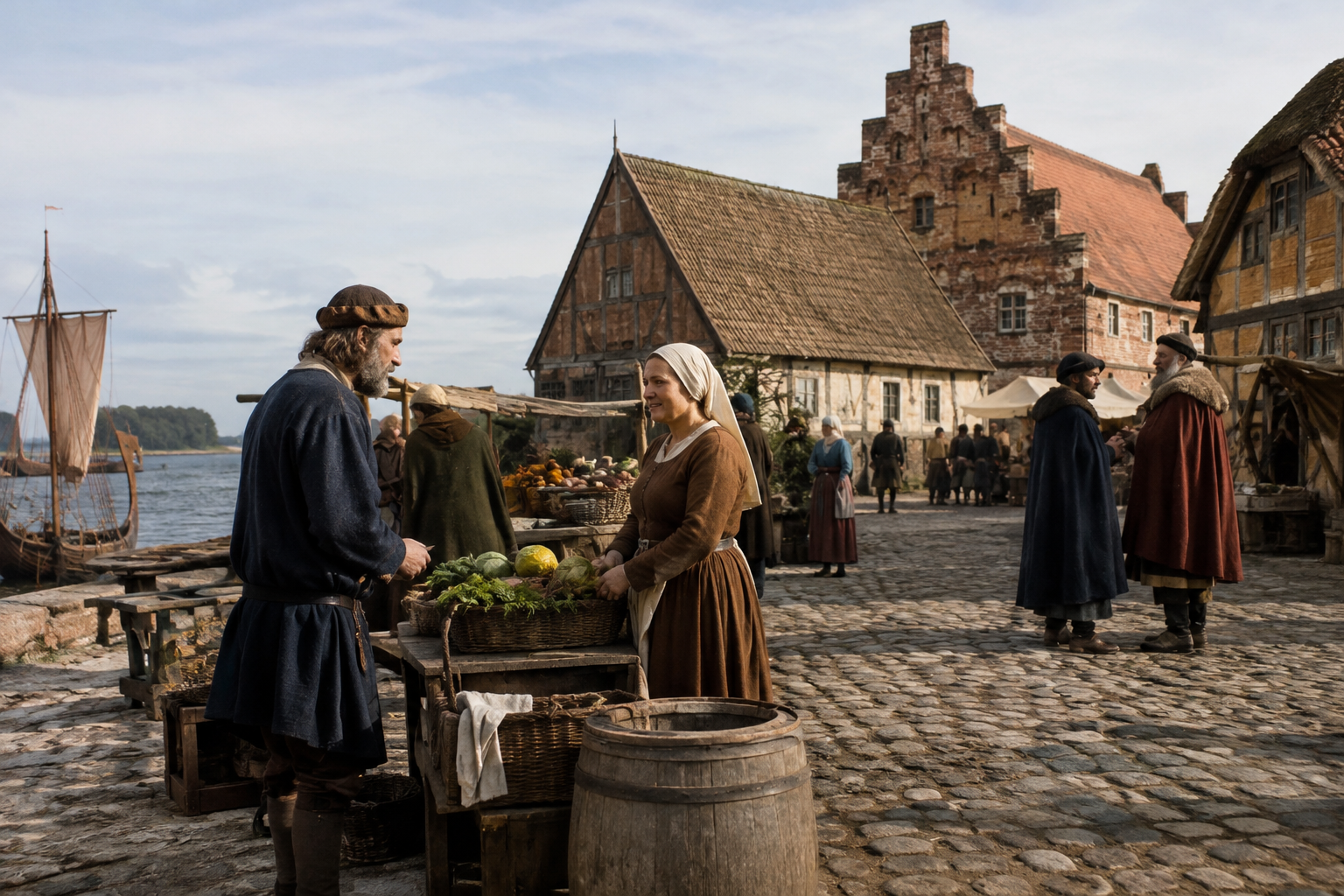
In about AD 1070, at Hedeby in southern Jutland, one man carried a paternal line that MyTrueAncestry associates with Y-DNA haplogroup I1a2a2a5. His sample, SWG004, comes from the post-Viking Age layers at Schleswig's Rathausmarkt, in the orbit of one of northern Europe's most famous trading towns. That matters because Hedeby was never just a Danish place on a map. It was a contact zone: merchants, craftspeople, travelers, Christians, and people shaped by the long afterlife of the Viking world all passed through it.
A few centuries later, another man from Ahlgade, Holbaek on Zealand, dated to about AD 1375 and identified as CGG101843, appears in the same paternal branch. With only two medieval samples, one must be cautious. But even this small pattern is interesting: not a heroic founder, not a saga king, but a lineage showing up in ordinary historical Scandinavia, in places tied to towns, exchange, and settled medieval society.
I1a2a2a5 is a narrow branch inside the wider haplogroup I1, a Y-chromosome lineage long associated with northern Europe, especially Scandinavia. Y-DNA follows one direct paternal line only: father to son to son, across generations. It does not describe a person's full ancestry, language, social identity, or legal status, which is why archaeologists have to keep the genetics beside the history, not in place of it.
That distinction is especially important here. The broad parent lineage I1 has a deep and complicated history in northern Europe, but these two medieval men do not by themselves map the whole story of I1, still less the whole story of Denmark. What they do offer is something more specific and more useful: evidence that this particular paternal branch was present in medieval Danish populations linked to two quite different settings, a major emporium in Jutland and a town on Zealand.
Denmark's Deep Genetic History
Hedeby tends to be imagined in its great Viking Age heyday, crowded with ships, goods, and languages. But the date attached to SWG004, around AD 1070, belongs to a slightly different moment: after the formal Viking Age, when old Scandinavian networks had not vanished but were being reorganized in a more openly Christian and increasingly medieval world. That is part of what makes the sample so valuable. It places I1a2a2a5 not in a romanticized age of raiders, but in the lived reality of transition.
Southern Jutland was a hinge region, facing the North Sea, the Baltic, and the German lands. A genetic signal there can reflect continuity, mobility, or both. One cannot say from a single Y-line that this man was a trader, a local townsman, or the descendant of migrants from elsewhere in Scandinavia. But the archaeological setting makes one thing plain: this was a world of movement, and paternal lines like I1a2a2a5 were part of the human fabric of that connected zone.
A major ancient DNA study of Viking and post-Viking populations, published in Nature, helped show just how mixed and regionally varied Scandinavian-related populations could be. That broader work is useful background here, not because it proves every detail about SWG004, but because it warns us away from crude ideas of a single, uniform "Viking genotype."
The later sample, CGG101843, comes from Ahlgade in Holbaek on Zealand and is dated to about AD 1375. By then Denmark was a thoroughly medieval kingdom of towns, parishes, landed estates, law, and maritime traffic. Holbaek sat in a strategic island setting, connected to internal Danish routes and the wider Baltic world.
That makes this second appearance of I1a2a2a5 revealing in a different way. Hedeby gives us the lineage in a borderland trading environment shaped by the fading Viking Age; Holbaek places it in a later urban Danish context. Together, the two samples suggest that this paternal branch was not an isolated curiosity. It was present across medieval Denmark in communities participating in the ordinary business of northern European life.
Post-Viking Christian Scandinavia
Two points make these samples more informative than they may first appear. The first is geography. Jutland and Zealand are not interchangeable. One faces the continental approaches and the old frontier spaces; the other sits at the political and maritime heart of the Danish islands. Finding the same narrow paternal branch in both settings hints at a lineage that was distributed within medieval Danish society rather than confined to one isolated district.
The second is chronology. SWG004 belongs around AD 1070; CGG101843 around AD 1375. That is three centuries apart, spanning a period in which Denmark saw state formation, ecclesiastical consolidation, urban growth, and deeper integration into Baltic and North Sea exchange. A lineage surviving across that interval need not belong to a grand dynasty to be historically meaningful. Quite the opposite: it can show the quiet persistence of male lines through enormous social change.
Research on early medieval northern European populations, including the study hosted at ResearchGate, has underscored how closely linked the North Sea world remained across migration-era and medieval centuries. That wider context matters for Danish lineages too. It reminds us that paternal branches found in Denmark may have histories entangled with Britain, Frisia, northern Germany, and the Scandinavian peninsula, even when a specific sample cannot be tied to one route.
There is a temptation, whenever a Scandinavian Y-line appears, to rush straight to Vikings, jarls, or royal houses. The evidence here points somewhere both humbler and, in its own way, more illuminating. These men are useful precisely because they anchor I1a2a2a5 in documented medieval contexts without requiring a legendary pedigree.
For family historians, that is often the more valuable lesson. Ancient DNA rarely hands us a named ancestor on a silver platter. What it can do is place a paternal line in real landscapes and periods. In this case, I1a2a2a5 is associated with medieval Denmark in two different centuries and two important regions, showing that the branch belonged to the historical population living through the transformation from the post-Viking world into the later Middle Ages.
Baltic Connections in the Early Middle Ages
If your paternal line falls under I1a2a2a5, these ancient matches do not prove descent from a particular medieval Dane, nor do they assign an ethnicity beyond question. What they do suggest, responsibly, is that this branch was present in the Scandinavian world of towns, exchange networks, and settled communities after the Viking Age and into the late medieval period. Hedeby and Holbaek show it not at the fringes of history, but squarely within the making of medieval Denmark.
That is a modest claim, but a good one. Real ancestry is often like that: not a single dazzling revelation, but the steady reappearance of a lineage in places where history can actually see it.






Comments