Haplogroup I1a2a1a1d2b

– 5 min read


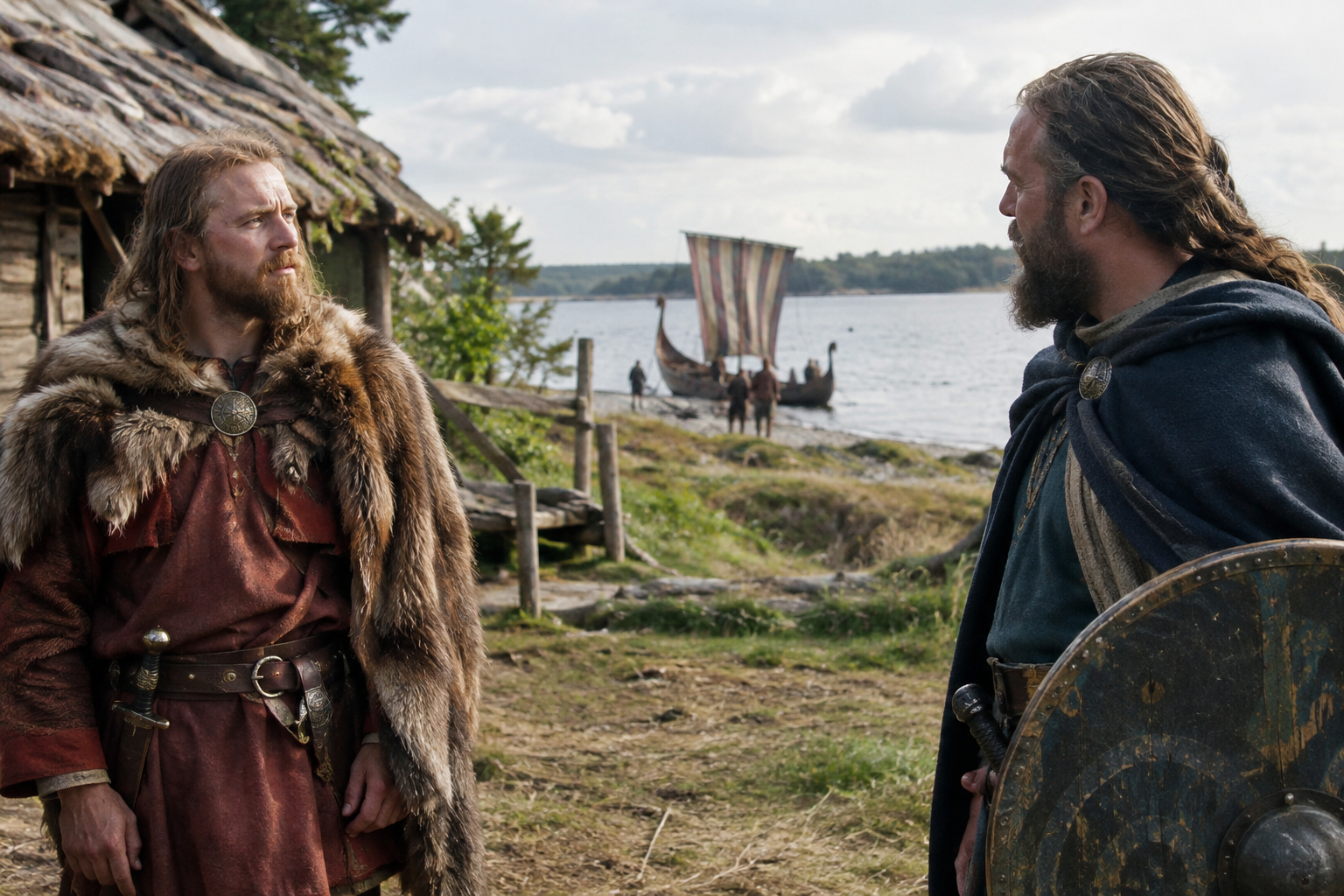
At Maslomecz in eastern Poland, archaeologists uncovered a cemetery tied to the Wielbark cultural horizon, a setting long discussed in connection with Gothic-era communities on the Roman world's northeastern edge. One individual from that landscape, sample PL065, dated here to around AD 250, is associated in MyTrueAncestry's records with the Y-DNA haplogroup I1a2a1a1d2b. That matters because it places this paternal line in a real archaeological context: not a legend about "the Goths," but a person buried in a late Iron Age community that stood between local continuity, long-distance contacts, and the shifting identities of Barbaricum.
The second striking appearance comes much later and farther north: VK443 from Oland Island, Sweden, dated to about AD 900. Taken together, these two men do not give us a neat tribal pedigree, and they certainly do not turn one haplogroup into an ethnicity. But they do show a paternal branch turning up in two historically resonant settings: one linked to the Gothic world in Poland, the other to the Viking Age Baltic sphere in Scandinavia.
Maslomecz has become one of the most discussed cemeteries for understanding late Iron Age communities east of the Vistula. The site is associated with the Wielbark cultural complex, often brought into wider debates about Goths, migration, and interaction with the Roman frontier. That should be handled carefully. Archaeology can identify cultural practices and regional links; it does not automatically prove the language, political loyalties, or self-identity of every person in every grave.
Still, PL065 is valuable precisely because he anchors haplogroup I1a2a1a1d2b in this milieu. A burial from around AD 250 belongs to a period when communities in this region were part of broad exchange networks reaching across the Baltic and toward southeastern Europe. Research on Maslomecz has emphasized that these were not isolated villages sitting outside history, but communities participating in large movements of people, objects, and ideas.
An archaeological discussion of an unusual Maslomecz burial can be found here. That paper is not a license to romanticize every grave as a saga in miniature, but it helps place the cemetery within the serious archaeological literature on Gothic-period Poland.
The exact label here, I1a2a1a1d2b, is a very narrow branch on the Y-chromosome tree. Y-DNA traces one direct paternal line only: father to son across many generations. That makes it powerful for studying male-line continuity, but limited as a description of a whole person. A man carrying this branch in Roman-period Poland and another carrying it in Viking Age Sweden might share an ancient paternal ancestor while differing greatly in language, local ancestry, and cultural world.
The broader parent haplogroup I1 is often associated with northern Europe, especially Scandinavia, in both ancient and modern discussions. But one must not lazily pour the whole history of I1 into this much narrower twig. The responsible point is simpler and stronger: this specific MyTrueAncestry branch appears in evidence linked to a Gothic-period burial in Poland and again in a Viking Age individual from Sweden, suggesting a northern and Baltic-facing historical footprint worth taking seriously.
Sample VK443, from Oland Island and dated here to around AD 900, shifts the story into the Viking Age. Oland was no remote fringe. It sat in the middle of Baltic traffic, close to routes connecting mainland Sweden with Gotland, the eastern Baltic, and the wider Scandinavian world. A paternal line found there belongs to a society shaped by seafaring, trade, raiding, settlement, and intense regional mobility.
We should be honest about the limits of the record: the information here does not justify inventing a ship burial, a warrior identity, or kinship ties for VK443. But the date and place alone are historically rich. Around AD 900, Oland was part of a Scandinavian world whose contacts stretched from the North Atlantic to river systems leading toward Byzantium and the Caliphate. A branch like I1a2a1a1d2b appearing there fits a wider picture in which paternal lines connected with northern Europe circulated within active Baltic networks.
A preprint on Viking Age population genomics that helps frame this Scandinavian setting is available here. It is most useful as broad context for the period rather than as a warrant for overconfident claims about one individual.
The tempting story would be to draw a straight arrow from southern Scandinavia to Gothic Poland and declare the matter settled. Historians and archaeologists have spent generations arguing over exactly such questions, and ancient DNA has made the arguments more interesting, not magically simpler. What the present evidence really offers is a more modest but more durable insight: this paternal branch turns up on both sides of the Baltic in periods when that sea linked communities rather than separating them.
Maslomecz belongs to a late Iron Age frontier world where people, styles, and perhaps family lines moved through broad interaction zones. Oland belongs to a Viking Age maritime world in which such connections had become, if anything, even more visible. The recurrence of I1a2a1a1d2b in those settings suggests that its history is plausibly entangled with northern European and Baltic movements over many centuries.
That does not mean every modern bearer descends from Goths, Vikings, or any named people in the historical sources. Ancient labels are slippery things. "Gothic" in Poland and "Viking" in Sweden describe historical and archaeological settings, not a biological essence. But when the same narrow paternal branch appears in both, the overlap is historically suggestive in exactly the right way: specific enough to be interesting, cautious enough to remain credible.
Mixed Origins of Gothic Communities
Of the two appearances, Maslomecz is the more surprising and in some ways the more revealing. Scandinavian-linked paternal lines are hardly shocking in Viking Age Sweden. But a line associated with I1a2a1a1d2b in a Gothic-period cemetery in Poland helps illuminate the old historical problem of how Baltic and Scandinavian connections were expressed in communities south of the sea itself.
Recent archaeogenetic discussion of Maslomecz has stressed diversity rather than purity. That is exactly the right frame. Communities associated with the Gothic world were not genetically uniform blocs marching across a map. They were mixed, connected, and historically dynamic. A paternal lineage such as this one is therefore most informative not as a badge of ethnic certainty, but as one thread in a larger pattern of mobility and male-line continuity around the Baltic.
If your Y-DNA falls under I1a2a1a1d2b, the most grounded historical takeaway is not a theatrical claim of descent from one famous people, but a more interesting reality. This branch is associated here with a man from the Gothic-period world of Maslomecz, Poland and another from Viking Age Oland, Sweden. In other words, your direct paternal line sits comfortably inside the old northern-Baltic sphere where Scandinavian, Polish, and wider eastern European histories repeatedly met.
Comments