Haplogroup I1a2a1a1a1a
– 5 min read


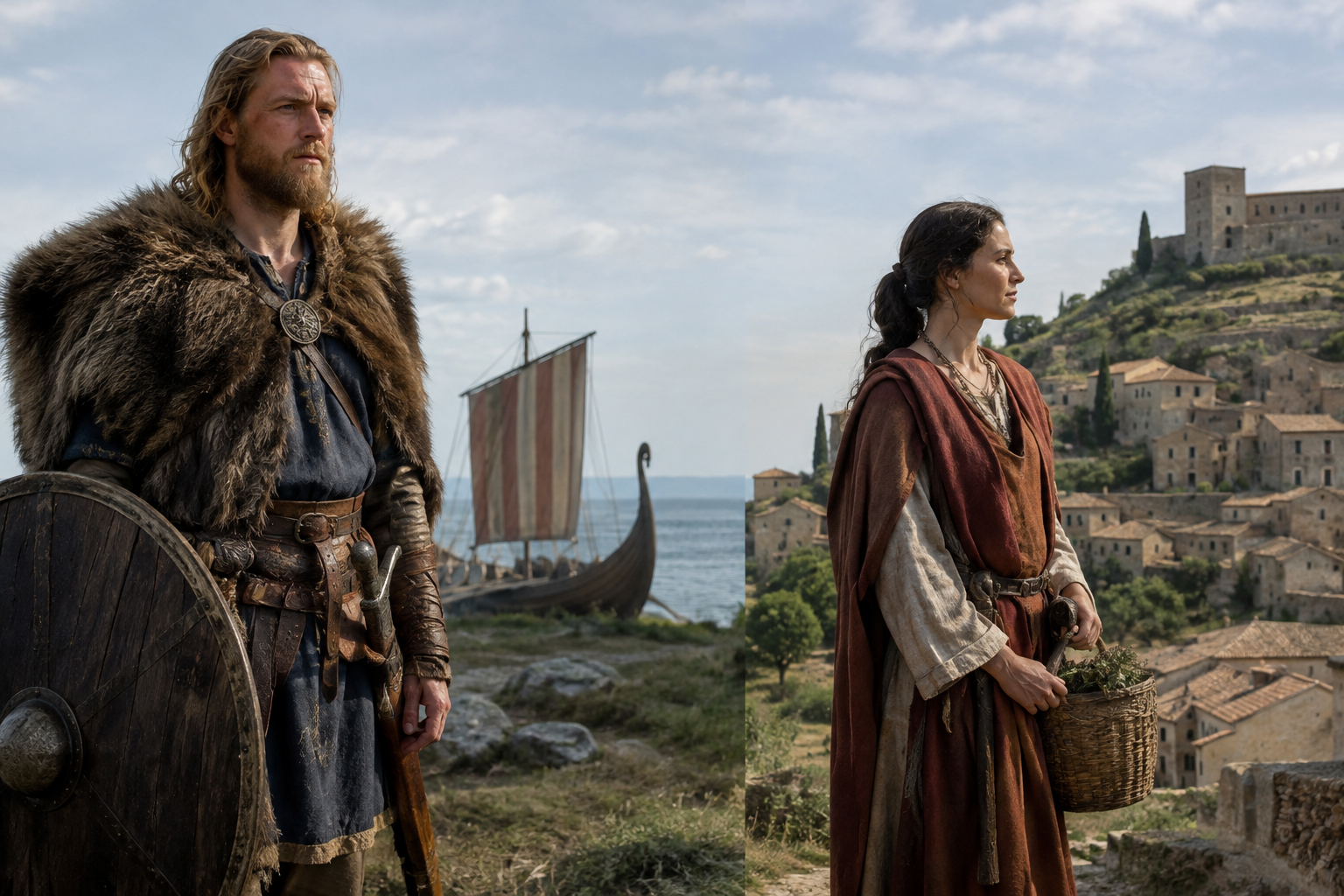
In about AD 975, a man buried at Bogovej in Denmark entered the ancient DNA record under the identifier CGG106777. He lived in the Viking Age, at a moment when Denmark was deeply entangled with the wider North Sea world and also being drawn into new Christian and royal frameworks. For the Y-DNA branch I1a2a1a1a1a, that matters because this is not a vague prehistoric signal: it is a paternal line appearing in a recognisably historical Scandinavian setting.
The second clue comes from much farther south. A man from medieval Tarquinia in Lazio, Italy, dated to about AD 960 and identified as TAQ009, is also associated here with the same branch. That pairing is the interesting part. Even with only two named ancient individuals, I1a2a1a1a1a is not appearing in one sealed-off pocket of Europe. It turns up in late 10th-century Denmark and in central Italy at almost the same time, which immediately raises a good historical question: what sort of male-line history could connect a Scandinavian world and a Tyrrhenian one in the same century?
The Danish sample is the firmer historical anchor. Haplogroup I1 in its broader sense is strongly associated with northern Europe, especially Scandinavia, and Viking-Age Denmark is exactly the sort of context in which one might expect some of its downstream branches to appear. The important caution is that I1a2a1a1a1a is a much narrower twig than the whole of I1, and we should not simply pour the entire history of I1 into this one subclade as though they were interchangeable.
Still, Bogovej gives the branch a tangible place in the late Viking Age. By the later 10th century, Denmark was not a cultural island. Its people were moving through trade, raiding, service, marriage, settlement, pilgrimage, and war. A paternal line found there could remain local for generations, or it could travel remarkably far within a few lifetimes.
That broader setting has been transformed by ancient DNA work on Viking-Age populations, including research published in Nature that examined the genetic diversity and mobility of people connected to the Viking world. One reason that work matters here is not that it proves anything specific about CGG106777 beyond the supplied identification, but that it established just how mixed, mobile, and socially varied Viking-Age communities could be.
Y-DNA follows one direct paternal line: father to son to son. That makes it unusually good for tracing the history of one male-line descent path, but it does not describe a person's whole ancestry, language, legal identity, or culture. A Danish Viking-Age man with this lineage and a medieval Italian man with the same lineage were not therefore members of the same "people" in any simple sense.
What it can suggest is continuity and movement at the level of paternal descent. If two men from different regions and nearly contemporary dates are associated with I1a2a1a1a1a, then the branch had either spread before the 10th century or was circulating through networks that connected those regions by then. In medieval Europe, that is not remotely far-fetched. Armies, merchants, clerics, enslaved people, migrants, mercenaries, and seafarers all carried family lines across political frontiers.
That is particularly worth remembering because the 10th century was an age of compression as well as expansion. Kingdoms were consolidating. Old Roman cities still mattered. The Baltic and the Mediterranean were not one world, exactly, but they were no longer worlds that never touched.
The Italian sample, TAQ009, comes from medieval Tarquinia in Lazio, dated to about AD 960. Tarquinia is one of those places where time stacks up in layers. Famous above all for its Etruscan past, it remained part of a busy and contested central Italian landscape through Late Antiquity and the Middle Ages. By the 10th century, this was a region shaped by the afterlives of Rome, the power of bishops and nobles, and the movements of soldiers and settlers through the Tyrrhenian corridor.
So what does it mean to find a branch associated here with I1a2a1a1a1a? First, it does not mean that Tarquinia had become Scandinavian, nor that one burial can stand in for all medieval Latium. But it does fit a larger pattern seen in early medieval and medieval Europe: paternal lines that may have deeper northern associations can appear in Italy within complex local populations. Sometimes that reflects long-range mobility; sometimes it reflects older movements already absorbed into local society generations earlier.
A recent ancient DNA study of medieval burials in northern Latium and nearby areas, available as a bioRxiv preprint, is relevant because it points to the value of looking at central Italian cemeteries not as static local communities but as windows onto a region shaped by repeated contact and demographic change. For I1a2a1a1a1a, TAQ009 is intriguing precisely because it places this paternal branch in that historically layered setting.
Put Bogovej and Tarquinia side by side and the picture becomes sharper. These are not two finds separated by millennia, where almost anything could have happened in between. They sit within roughly the same century, in two very different historical regions. That makes the branch feel historically alive rather than merely residual.
In the late 10th century, Scandinavians were active across western and eastern Europe, and Italy too had northern connections of many kinds. Some came by sea, some through imperial politics, some through ecclesiastical ties, some through warfare. We do not need to force TAQ009 into a Viking story to see the wider point: Europe's male-line history in this period was being written through movement as much as through rootedness.
There is also a useful methodological lesson here. Ancient DNA often tempts us into grand narratives on very thin evidence. But sometimes the most honest and interesting conclusion is the smaller one: this branch was present in at least two very different 10th-century environments, one clearly Scandinavian and one clearly central Italian. That alone makes I1a2a1a1a1a a lineage worth watching as more medieval samples are published.
The temptation with a haplogroup article is always to rush backwards into deep prehistory. Sometimes that is justified. Here, though, the supplied evidence is strongest in a narrower frame: the world around AD 960-975. That is a splendidly awkward moment in European history, when old provincial identities, emerging kingdoms, inherited Roman landscapes, and long-distance mobility were all colliding.
For a branch like I1a2a1a1a1a, the evidence does not yet define an origin story on its own. What it does offer is a snapshot of distribution at a time when dynasties, churches, ports, and warbands were all helping to move people and lineages around the continent. If your own paternal line falls on this branch, that does not make you "Viking" in any simple costume-drama sense. It does, however, place your direct male line within a family of lineages that is entirely at home in the documentary centuries of northern Europe and evidently capable of appearing well beyond Scandinavia.
At present, I1a2a1a1a1a is represented here by a small but suggestive pair of ancient men: CGG106777 from Viking Age Denmark and TAQ009 from medieval Tarquinia. That is enough to say something solid and modest. This paternal branch was present in the historical North, and by the later 10th century it also appears in central Italy, reminding us that medieval Europe was full of lineages crossing cultural and geographic boundaries long before modern nations tried to tidy the map.
For family historians, that is often the most useful kind of result: not a fantasy pedigree, but a real glimpse of where one direct male line was living in the past, and how unexpectedly wide its historical world may already have been.


Comments