Haplogroup I1a1b1a4a

– 5 min read


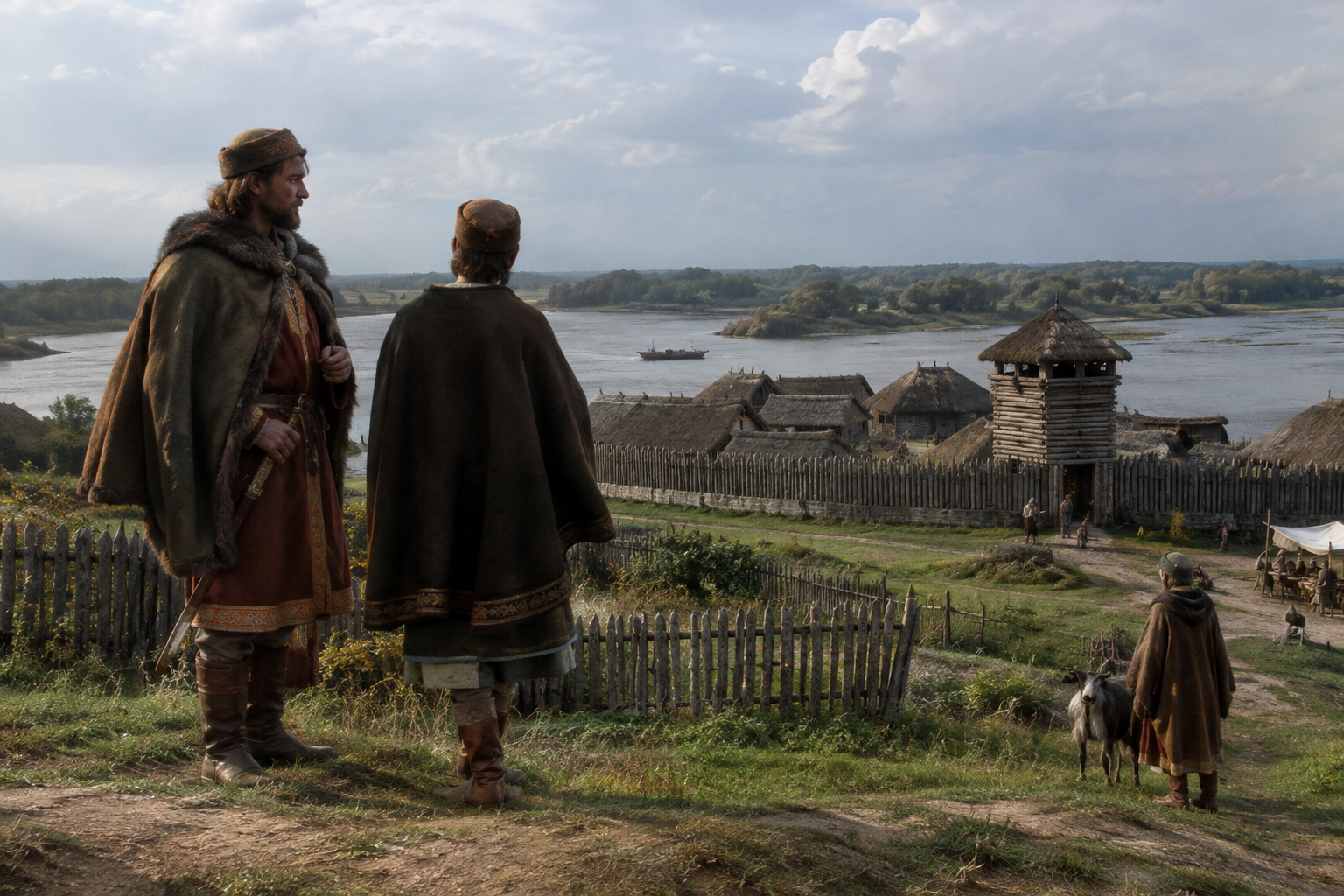
At Santok, on the Lubusz-Greater Poland border, archaeologists and geneticists recovered the remains of a young male linked to the Piast world of around AD 1100. In the ancient DNA record he appears as PCA0389, a medieval individual from one of the most contested frontier zones in early Polish history. That alone would make him interesting. But his reported paternal line, I1a1b1a4a, adds another layer, because it points toward a Y-chromosome branch more often associated with the wider northern European and Germanic sphere than with a simple, closed picture of medieval dynastic Poland.
This is the sort of finding that makes archaeogenetics so useful, and so awkward in the best way. A Y-DNA haplogroup tracks one direct paternal line only, not a whole ancestry or a ready-made ethnic label. Still, when a male line like I1a1b1a4a appears in a Piast-period context at Santok, it asks a proper historical question: what did rule, marriage, alliance, migration, and frontier life actually look like in the early medieval Polish realm?
Santok was no sleepy village on the edge of nowhere. In the early Middle Ages it stood in a strategically important zone where rivers, trade routes, and rival political interests met. Control of places like Santok mattered to the Piasts because frontier strongholds were where authority had to be enforced, negotiated, and displayed.
The individual PCA0389 is therefore valuable not because one skeleton can stand for an entire dynasty, but because he comes from exactly the kind of place where political history becomes biological history. Border regions attract soldiers, retainers, merchants, clergy, captives, spouses, and ambitious families. In such settings, paternal lineages can tell us less about tidy national origins and more about the human traffic of power.
A broader ancient DNA discussion of Piast-associated burials and dynastic questions can be found in this related MyTrueAncestry post:
The haplogroup named here, I1a1b1a4a, belongs within the wider Y-DNA haplogroup I1, a paternal lineage long associated with parts of northern Europe and especially with regions that later spoke Germanic languages. But one must be careful. The deep history of I1 is not the same thing as the specific history of every downstream branch, and it certainly does not allow us to turn one medieval man into a walking ethnic stereotype.
What we can say, more soberly, is that an I1-related paternal line in a Piast-period context fits a medieval world in which the Baltic and Central European zone was deeply entangled with Scandinavian, German, and Slavic networks. Dynasties married across linguistic boundaries. Elites recruited followers from different regions. Christian polities formed through alliance as much as conquest. A haplogroup like I1a1b1a4a sits quite comfortably inside that messier, more realistic picture.
For readers interested in the bigger genomic background to Germanic-speaking populations, this related article is especially useful:
Germanic languages and genomics
The Piast dynasty built the first durable Polish state in the 10th and 11th centuries, but it did not do so in isolation. Medieval rulership in this region depended on links westward into the Empire, northward toward the Baltic, and eastward into other Slavic lands. That means genetic surprises are not really surprises at all. They are reminders that dynasties were political machines before they were imagined as neatly bounded bloodlines.
PCA0389's importance lies in that historical setting. If his association with I1a1b1a4a is accepted, he becomes part of the growing evidence that Piast-period populations included paternal lines reflecting wider northern and central European connections. That does not prove a Scandinavian identity, a German identity, or a direct tie to any famous named ruler. It does, however, sit well with the documentary and archaeological reality of a medieval borderland where identities were layered and affiliations could shift.
One reason this matters is that older national histories often preferred clean origin stories. Ancient DNA keeps spoiling them. The early Polish state was Christian, dynastic, militarized, and connected to its neighbours; its people were unlikely to have been biologically uniform. Santok, poised on a frontier, is exactly where we should expect that complexity to show up.
It is easy to dismiss one sample as too little evidence. In one sense, that is true: PCA0389 cannot define the entire Piast dynasty, the whole population of Santok, or the full history of I1a1b1a4a. Yet archaeology rarely works by grand totals alone. Sometimes one well-placed individual matters because he sharpens the historical problem.
Here the problem is not simply "where did this haplogroup come from?" but "how were medieval frontier societies assembled?" A man buried around AD 1100 in a Piast-linked setting with a paternal lineage from the broader I1 family reminds us that medieval polities were built from mobile men, negotiated loyalties, and cross-border households. That is a more interesting historical point than any simplistic claim of purity or replacement.
A genetic study touching on this broader historical terrain appeared in research published in Scientific Reports, which helped bring ancient DNA evidence into discussions of medieval Polish dynastic origins and connections. Even where the historical interpretation remains cautious, the value of such work is clear: it gives us direct biological data from people who lived inside these early state-building processes.
By the 11th and 12th centuries, the southern Baltic was a zone of intense contact. Slavic-speaking communities, Scandinavian traders and warriors, German churchmen and settlers, and local ruling houses all had a stake in its river routes and strongholds. Santok belongs to that world. It was not a sealed ethnic capsule; it was a node.
That wider setting helps explain why a lineage from the broader I1 family is historically plausible here. The same northern networks that moved goods and political influence also moved families and paternal lines. Over generations, such movement could become invisible in the written record while remaining faintly legible in the Y chromosome.
Readers who want another case study in northern European medieval genetics may enjoy this related post:
Baltic connections in early medieval Finland
If your paternal line falls under I1a1b1a4a, PCA0389 offers a historically grounded glimpse of one setting in which that branch appears: a Piast-period frontier community in medieval Poland, around AD 1100. That does not make every present-day carrier "Piast" or "Polish" in any simple sense. What it does suggest is that this branch could have taken part in the dense web of northern and central European connections that shaped the medieval Baltic world.
In other words, the most distinctive lesson of I1a1b1a4a here is not a fairy-tale founder, but a frontier. Santok shows this paternal line in a place where dynastic ambition, border politics, and population mixing met on the ground. That is a finer, and frankly more historical, inheritance.
For a broader look at how ancient DNA is transforming such questions, this overview is worth exploring:

Comments