Haplogroup H2

– 6 min read


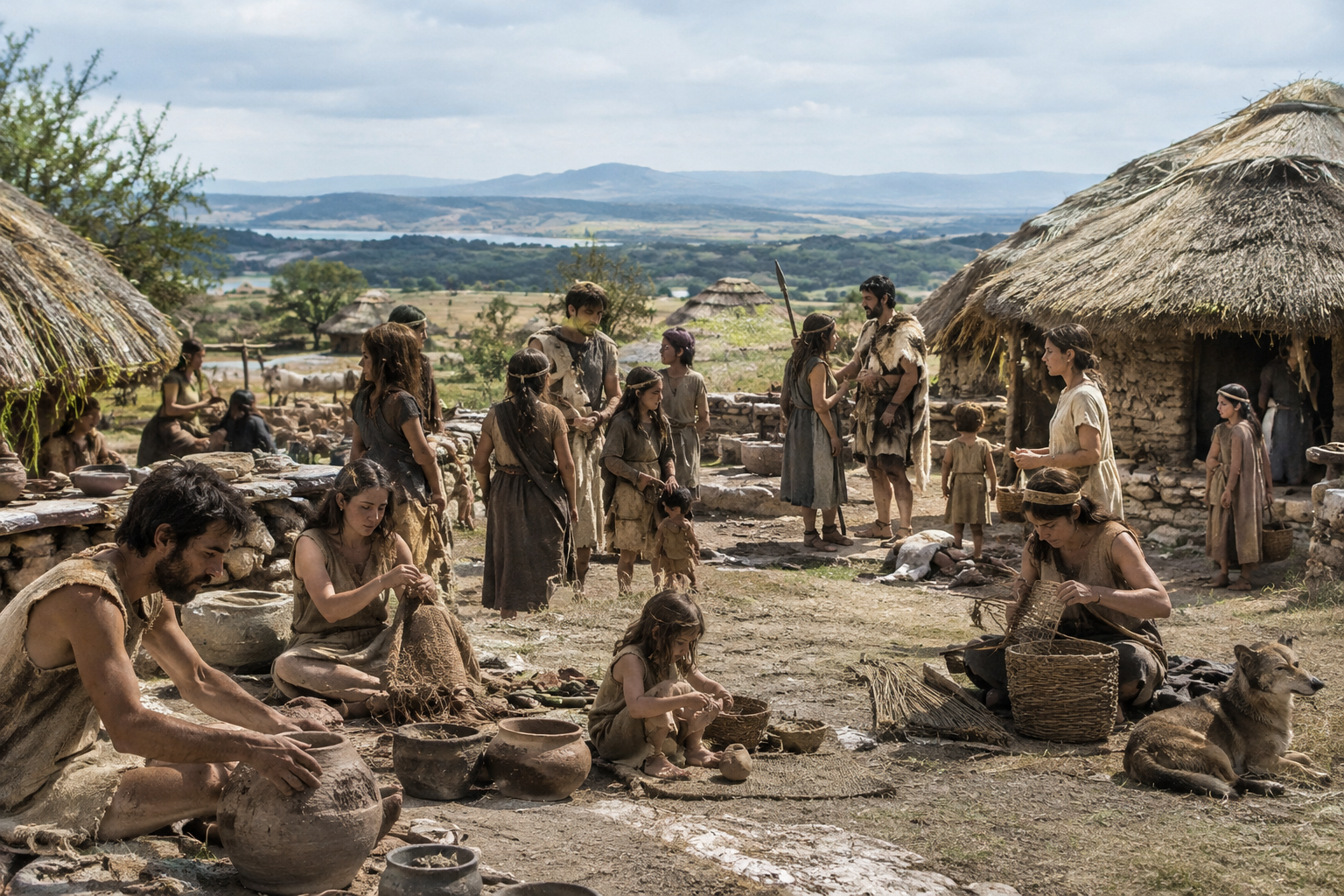
Haplogroup H2 is one of those Y-chromosome lineages that makes ancient DNA feel less like an abstract chart and more like a set of footprints across early farming Eurasia. It is not a dominant modern European paternal lineage, and that is precisely why it matters. H2 turns up repeatedly in some of the earliest farming contexts from the Levant, Anatolia, the Balkans, and Neolithic Europe, giving us a valuable glimpse of male lines carried by the first agricultural communities as they moved westward.
As always, a caution worth stating plainly: Y-DNA traces one direct paternal line only - father to father to father. It does not describe a person's whole ancestry, culture, language, or identity. Still, when a lineage like H2 appears again and again in early archaeological burials, it becomes a powerful tool for reconstructing population history. In broad terms, H2 belongs within haplogroup H, a wider Y-chromosome branch with deep roots in western Eurasia. What makes H2 historically interesting is that ancient DNA has linked it especially strongly with Neolithic farmers, including some of the communities that carried agriculture from Southwest Asia into Europe.
If you want to see H2 at work, look first not to medieval courts or heraldic pedigrees, but to the earliest villages. The pattern in the supplied samples is striking. We find H2-associated individuals in the Levant at Motza, in Jordan at Ain Ghazal, in Anatolia at Barcin Hoyuk, Tell Kurdu, and Catalhoyuk, and then across the great corridor into southeast and central Europe. This is exactly the sort of distribution that has made H2 important in archaeogenetics: it appears again and again in the world of early settled farming.
One especially early example is I1700, from Neolithic Ain Ghazal Jordan, dated 7900 BC. Ain Ghazal belongs to the formative world of early village life in the southern Levant. Another key data point is I0867 from Neolithic Levant Motza, dated 6700 BC. These are not "European" samples in any simple sense at all; they belong to the wider Near Eastern setting from which early farming lifeways emerged and spread.
From there the trail continues into Anatolia. I0709x from Neolithic Barcin Hoyuk Bursa Yenisehir Anatolia, dated 6135 BC, KRD001 from Neolithic Anatolia Hatay Tell Kurdu, dated 5662 BC, and cch279 from Late Neolithic Anatolia Catalhoyuk, dated 5000 BC, place H2 firmly in the agricultural heartlands that fed the expansion into Europe. This does not prove a single tidy migration wave of H2 men marching westward in lockstep. Real population history is messier than that. But the broad pattern is consistent with the movement of early farming communities and their paternal lines out of Southwest Asia.
Explore the Neolithic expansion
Once H2 appears in Europe, it shows up in an impressively wide arc. In Hungary, there is I0174 from Early Neolithic Starcevo Alsonyek Bataszek Hungary, dated 5620 BC, along with I1878 from Neolithic Hungary Alsonyek-Bataszek Mernoki telep, dated 5600 BC, and I2382 from Neolithic Hungary Mezokovesd-Mocsolyas, dated 5300 BC. These belong to the Carpathian Basin, one of the great crossroads of the European Neolithic.
Germany provides an even more vivid cluster. At Derenburg-Meerenstieg II, several individuals dated 6000 BC carry this lineage: DER020, DER032, DER026, DER030, DER004, DER009, DER011, and DER014. That concentration is historically revealing. It suggests that H2 was not a one-off arrival in central Europe but part of the paternal fabric of at least some early farming communities there. Another German case, TR96 from Neolithic Germany Trebur Grossgartach, dated 4800 BC, shows continuity of the lineage further into the developed Neolithic.
Move west, and H2 continues to appear. In France we have MDV248 from Neolithic Menneville France, dated 5050 BC; BUCH2 from Neolithic Bucheres France, dated 4300 BC; and a useful family context in Normandy with FLR002 from Middle Neolithic Calvados Normandy France Father A, dated 4400 BC, plus FLR008 from Middle Neolithic Calvados Normandy France Son A, dated 4380 BC. There is something rather wonderful about that pair: ancient DNA lets us see not only a haplogroup in the abstract, but a father and son in a real prehistoric family.
By the time we reach Iberia and the western islands, the picture is even more interesting. CDP006 from Late Neolithic Spain Cova d en Pardo, dated 2950 BC, and CLL011 from Bronze Age Iberia Cueva de las Lechuzas, dated 2200 BC, show H2 reaching deep into the western Mediterranean. So too does I15941 from Sardinia Anghelu Ruju Bell Beaker, dated 2243 BC, followed much later by I16168 from Balari Settlement Sardinia, dated 975 BC. That does not mean uninterrupted direct descent from one burial to the next, but it does suggest that branches of this paternal heritage remained present in island populations long after the first Neolithic spread.
H2 is often thought of as a Neolithic farmer lineage, and with good reason. But the sample list also shows it did not simply vanish once the first farming age ended. Urzi41 from Ancient Romania Urziceni, dated 4000 BC, and I2520 from Bronze Age Veliko Tanovo Dzulyunitsa Bulgaria, dated 3180 BC, place H2 in the Balkans during periods of major cultural change. ARO008 from Neolithic Georgia Arukhlo Shomutepe-Shulaveri, dated 5500 BC, widens the eastern horizon into the South Caucasus.
A particularly intriguing later sample is ALA008 from Amorite Alalakh, dated 1790 BC. That reminds us that H2 was not only a "European Neolithic" story. It remained part of the eastern Mediterranean and Near Eastern human landscape too. Likewise I2364, listed as Proto Etruscan Hungary and dated 2200 BC, is a useful warning against overly tidy labels. Archaeological and population histories overlap, interact, and blur; haplogroups rarely obey the categories later historians prefer.
Even the Irish samples deserve careful attention. JP14 from Mesolithic Jerpoint West Kilkenny Ireland, dated 3550 BC, and BG72 from Baunogenasraid Carlow Neolithic Ireland, dated 3539 BC, show that by the later prehistoric period this paternal line, or one of its branches, had reached the Atlantic edge. Whether through incoming farmers, local admixture, or more complicated regional dynamics, H2 had become part of a very broad western Eurasian story indeed.
Explore ancient Italian islands
In this case, the supplied field for associated noble families and castles is effectively empty, and that matters. It means we should resist the temptation to decorate the story with unsupported heraldry. There may well be later noble houses in regions where H2 once circulated, from the Balkans to Iberia, from France to Sardinia. But a broad haplogroup match is not evidence that a medieval dynasty descended in direct paternal line from a Neolithic burial.
That is one of the useful disciplines of genetic history. Written genealogy can make medieval and early modern families look permanent and self-contained. Ancient DNA does the opposite: it reminds us that the lands later dominated by noble houses were populated for millennia by farmers, herders, traders, and migrants whose names are lost but whose bones and chromosomes survive. Castles, where we have them, preserve the memory of power. Ancient DNA preserves the memory of population.
So for H2, the stronger and more responsible story is not about assigning the lineage to a famous coat of arms. It is about placing later historical regions on top of a much older map. Normandy, Hungary, Sardinia, Iberia, Anatolia, and the Levant were all connected long before medieval lordship. H2 helps us see that deep background with unusual clarity.
Learn how archaeogenetics works
The real importance of H2 lies in its timing and distribution. It appears again and again among early agricultural populations, especially those linked to the movement of farming from the Near East into Europe. It then persists, in smaller and more scattered form, into later prehistoric and Bronze Age settings from Bulgaria and Romania to Iberia and Sardinia. That makes it a particularly revealing lineage for anyone interested in the paternal side of Neolithic expansion.
It also shows why ancient DNA is so powerful. Traditional genealogy usually runs out in the late medieval or early modern period, and noble pedigrees only cover a tiny slice of humanity anyway. Ancient DNA gives us a different archive: not parchments in a chest, but chromosomes in bone. Yet the conclusions must stay proportionate. Sharing haplogroup H2 with one of these ancient men would mean your direct paternal line belongs to the same broad branch, not that you descend from a named individual such as DER020 or I1700, and certainly not that you inherit a castle by right.
If your Y-DNA falls within H2, you are touching a lineage that appears in some of the earliest settled communities from the Levant and Anatolia to Neolithic Europe. That is a remarkable historical position to occupy. And if it does not, the story is still yours in another sense, because these were among the peoples who helped build the worlds that later Europeans and Near Easterners inherited.
Upload your DNA to MyTrueAncestry to explore whether your results show connections to ancient individuals like I0867, I0709x, DER020, or I15941, and to discover how archaeology and genetics together can illuminate your past. These matches do not prove direct descent from a specific ancient person or later noble family, but they can open a fascinating window onto the populations that shaped your deeper ancestry.
Comments