Haplogroup H2

– 5 min read


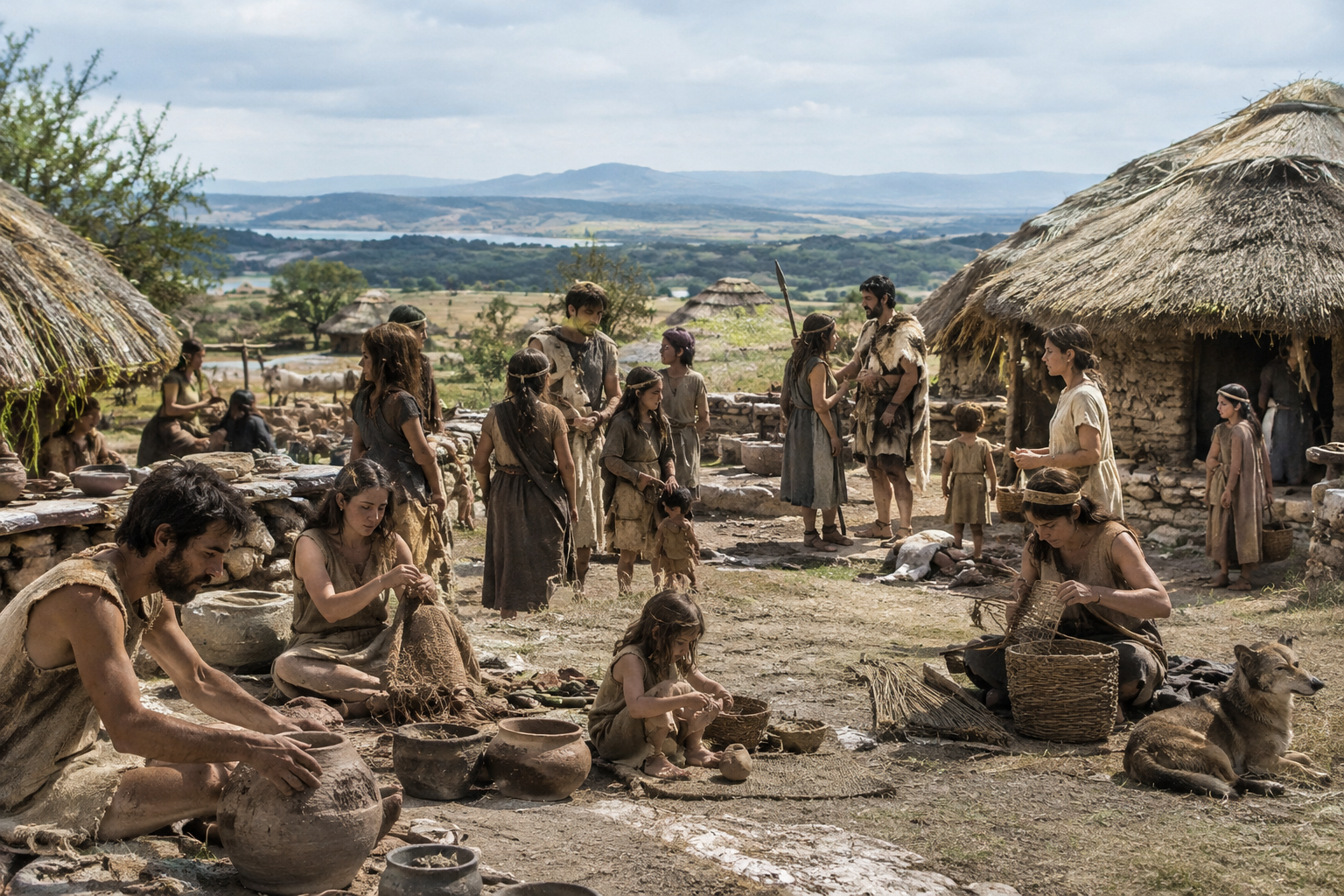
At Derenburg-Meerenstieg II in Neolithic Germany, the same paternal line turns up again and again. Several men from this early farming cemetery, dated around 6000 BC, including DER020, DER032, DER026, DER030, DER004, DER009, DER011, and DER014, are associated here with Y-DNA haplogroup H2. That is striking because ancient Y-chromosome lineages are often patchy and sporadic. Here, by contrast, H2 appears as part of a real community of Europe's first farmers.
That makes H2 historically interesting in a very specific way. Rather than being a lineage best known from later Bronze Age chiefs or medieval dynasties, it shows up strongly in the world of the early Neolithic: villages, fields, cattle, houses, and cemeteries linked to the spread of farming from Southwest Asia into Europe. Y-DNA traces one direct paternal line only, not a person's whole ancestry, but for H2 that line seems closely tied to the first agricultural horizons of western Eurasia.
The Derenburg-Meerenstieg II cluster matters because repeated occurrences are more informative than a solitary sample. When one cemetery contains numerous males associated with the same Y-chromosome branch, it suggests that this paternal line was genuinely established in that local population rather than appearing as an isolated outlier. For H2, Derenburg offers exactly that sort of anchor in central Europe.
Archaeologically, this is the age when farming communities were becoming rooted across the loess plains north of the Alps. Houses, crops, livestock, and burial grounds all speak to lives lived in settled communities. In this setting, H2 looks less like a wandering curiosity and more like one of the paternal lines carried by the people who helped establish the Neolithic way of life in Europe.
Other early and middle Neolithic finds strengthen the same picture. Trebur Grossgartach in Germany contributes TR96 around 4800 BC, while Hungary adds several early farming examples, including I0174 from Starcevo Alsonyek Bataszek around 5620 BC, I1878 from Alsonyek-Bataszek Mernoki telep around 5600 BC, and I2382 from Mezokovesd-Mocsolyas around 5300 BC. The distribution is not random: central Europe and the Carpathian Basin were core zones in the expansion and consolidation of early farming populations.
If Derenburg shows H2 flourishing in an early European farming community, the deeper background lies further southeast. One of the oldest listed examples is I1700 from Neolithic Ain Ghazal in Jordan, dated around 7900 BC. Another is I0867 from Motza in the Neolithic Levant, around 6700 BC. These are not marginal places in prehistory. They belong to the broad world in which farming economies first took shape and then spread.
Anatolia adds several more important appearances: I0709x from Barcin Hoyuk in Bursa Yenisehir around 6135 BC, KRD001 from Tell Kurdu in Hatay around 5662 BC, and cch279 from Catalhoyuk in Late Neolithic Anatolia around 5000 BC. That is a formidable sequence. H2 is appearing in regions long associated with the formation and transmission of farming lifeways into Europe, which fits the broader archaeological story rather well.
A genetic study of ancient Eurasian populations published in Nature helped establish just how central Anatolian and neighboring farming populations were to the ancestry of Europe's early Neolithic communities. H2 cannot be reduced to that one paper, and we should not pretend every sample listed here was analyzed in the same study, but the overall pattern is clear enough: this haplogroup sits comfortably inside the early farmer horizon linking the Levant, Anatolia, and Europe.
The sample ARO008 from Arukhlo Shomutepe-Shulaveri in Georgia, around 5500 BC, widens the map still further into the southern Caucasus. That does not mean one simple linear migration route. It does mean H2 belonged to the broad belt of early food-producing societies stretching from the Levant through Anatolia and into adjacent regions during the Neolithic.
By the fifth and fourth millennia BC, H2 is no longer just an eastern or central European story. In France, samples such as MDV248 from Menneville around 5050 BC, BUCH2 from Bucheres around 4300 BC, and a notable cluster from Calvados in Normandy, including FLR004, FLR008, FLR009, and FLR002, show the lineage present deep in Neolithic western Europe. GRG041, FLR001, and XN165, all listed simply as Neolithic France around 3500 BC, continue that pattern.
This western distribution matters because it shows persistence. H2 was not merely carried into southeastern Europe and then lost immediately. Instead, it appears across regions settled by farming communities over many centuries. One recent line of research on French Neolithic populations, including work associated with new archaeogenetic study, has focused on kinship, social structure, and population change in precisely the sort of communities where such paternal continuities can be tracked.
Iberia provides another revealing set of finds. CDP006 from Cova d en Pardo in Spain, dated around 2950 BC, places H2 in a Late Neolithic context on the peninsula. CLL011 from Cueva de las Lechuzas, around 2200 BC, carries it into Bronze Age Iberia. These are important not because they prove H2 was common everywhere, but because they show that the lineage survived locally even after later demographic changes began reshaping much of western Europe.
Two Irish cases are especially intriguing: JP14 from Jerpoint West, Kilkenny, dated around 3550 BC, and BG72 from Baunogenasraid, Carlow, around 3539 BC. Whether one calls JP14 "Mesolithic" as listed or sees the date itself as belonging to the Neolithic world of Ireland, the larger point is the same: H2 had reached the far western edge of Europe by the fourth millennium BC.
That is a remarkable geographical spread for a lineage so strongly associated with early farming populations. Ireland was never a passive backwater in prehistory; it was part of a connected Atlantic world, yet one reached only after generations of movement, adaptation, and settlement. H2 appearing there suggests that some paternal lines tied to the first farmers traveled astonishingly far.
For readers interested in the social side of these western Neolithic communities, the kinship evidence discussed in MyTrueAncestry's coverage of Irish burials is especially useful.
H2 does not vanish the moment the Bronze Age begins. I2520 from Dzulyunitsa in Bulgaria, dated around 3180 BC, shows the lineage still present in southeastern Europe during that transitional era. I2364, listed as Proto Etruscan Hungary around 2200 BC, suggests survival in the Carpathian region into later prehistory, though that cultural label should be treated cautiously and not confused with a straightforward ethnic identity.
Further south and east, ALA008 from Amorite Alalakh around 1790 BC places H2 in a Bronze Age urban and political world very different from the earliest village farmers. Sardinia adds I15941 from Anghelu Ruju Bell Beaker around 2243 BC and I16168 from a Balari settlement around 975 BC. Taken together, these samples suggest not one dramatic later expansion, but long-term persistence in scattered communities across the Mediterranean and Europe.
That persistence is perhaps the most historically revealing feature of H2. Many of the most famous later European paternal lineages are associated with Bronze Age and post-Bronze Age expansions. H2 instead seems to preserve an older layer: a lineage already present among early agricultural populations, surviving unevenly as new societies and new paternal lines rose around it.
The most distinctive thing about H2 is not royal glamour or later imperial conquest. It is its repeated appearance among Neolithic and early post-Neolithic males from the Levant, Anatolia, central Europe, France, Iberia, Ireland, and the Mediterranean. In plain historical terms, H2 looks like one of the paternal signatures carried by populations involved in the spread of early farming and then preserved, in places, for millennia afterward.
For someone researching H2 today, that does not identify a single tribe, language, or famous ancestor. What it does suggest, responsibly, is a deep paternal connection to one of the oldest archaeological transformations in western Eurasia: the making of the Neolithic world.
Comments