Haplogroup H1a1a1
– 4 min read


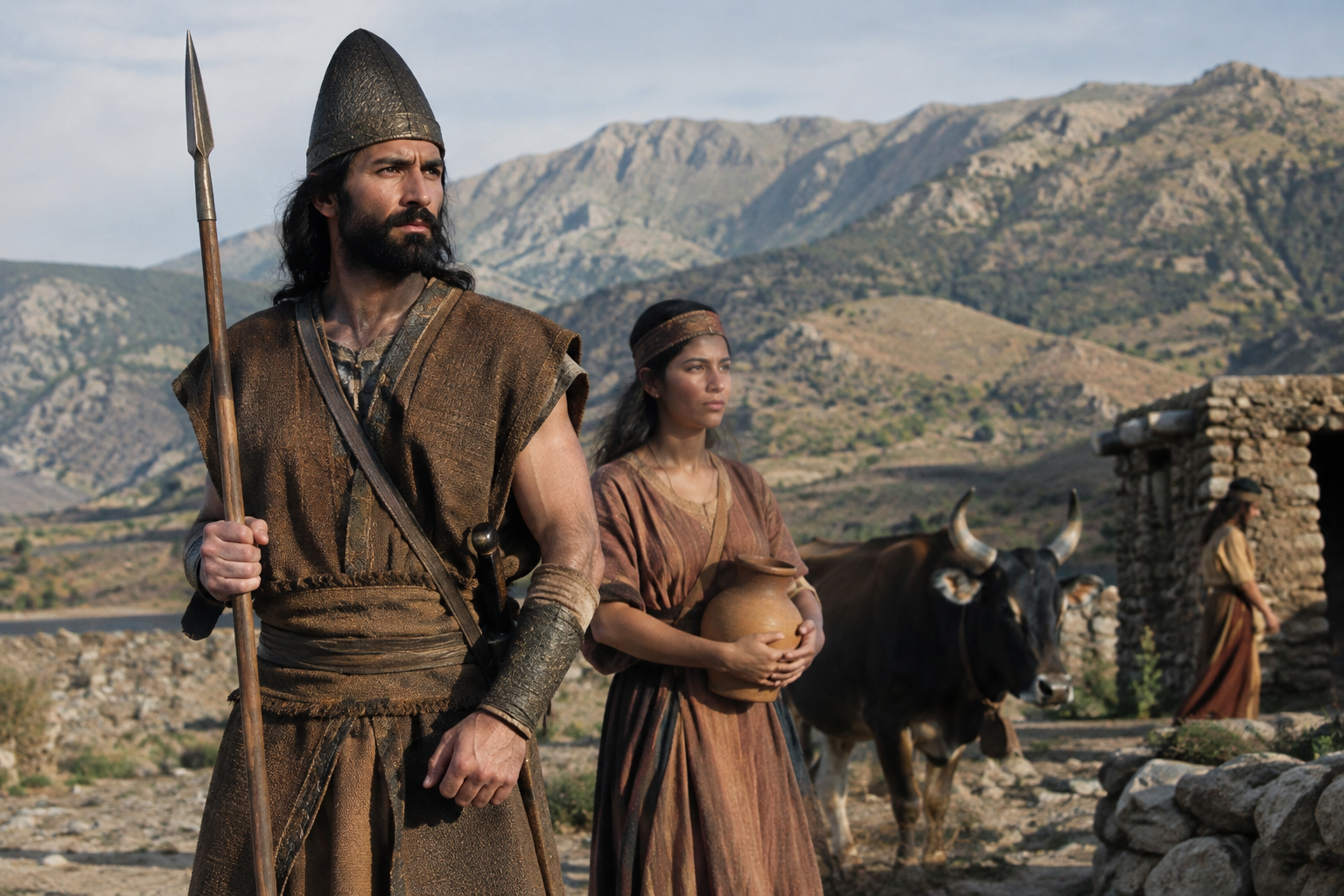
At Gogdara, in the mountains of what is now northern Pakistan, an Iron Age man labeled I8194 gives us a rare and quite specific glimpse of the paternal line H1a1a1. He is dated to around 1000 BC, and that matters because Gogdara sits in a region that has long been a corridor rather than a cul-de-sac: between the highlands of Central Asia, the Indus world to the south, and the routes that later fed the great networks of Gandhara.
That single ancient identification does not turn H1a1a1 into the signature of an entire people. But it does anchor the lineage in a real archaeological setting. Y-DNA follows one direct paternal line only, not a person's whole ancestry, yet even one securely placed ancient male can sharpen the historical picture enormously. Instead of speaking vaguely about "South Asian lineages," we can start with one man in one Iron Age landscape.
Gogdara is interesting precisely because it resists simple labels. The broader region of the Swat Valley and its uplands has yielded burials and settlements tied to major transitions in later prehistory and the early historic period: shifts in material culture, changing contacts with neighboring regions, and evidence for populations who were neither isolated nor uniform.
In that setting, I8194 matters less as a celebrity individual than as a fixed point. Around 1000 BC, communities in this wider zone were living through the Iron Age in a landscape already shaped by older Bronze Age movements and local continuities. A paternal lineage such as H1a1a1 appearing here reminds us that the human story of the northwest subcontinent was not composed only of the branches more often discussed in popular ancient-DNA summaries.
An ancient DNA study connected with this regional material can be consulted here: research on ancient individuals from the region. It is useful not because it turns one sample into a sweeping conclusion, but because it places sites like Gogdara within a broader genomic conversation about population history in the northwest of South Asia.
H1a1a1 belongs to Y-haplogroup H, a paternal macro-lineage with deep roots in South Asia. That broad statement is reasonably secure. But the article's branch is not the same thing as the whole of haplogroup H, and it would be careless to pour every claim about H into H1a1a1 specifically.
That distinction is worth making because ancient DNA often tempts us into overconfidence. A man assigned to H1a1a1 at Gogdara tells us that this paternal branch was present in an Iron Age community in the northwest subcontinent. He does not, by himself, prove where the branch first formed, how common it was in the valley, or which language his family spoke. Archaeology, language history, and genetics overlap, but they are not interchangeable.
Still, the appearance of H1a1a1 in this context is historically valuable. Popular discussions of the Iron Age in the mountains north of the Indus can become dominated by migration narratives that flatten local diversity. Sample I8194 is a useful corrective: whatever wider movements were under way, local and regionally rooted paternal lines were part of that world too.
One of the most striking things about ancient DNA from the greater frontier zone between South Asia, Iran, and Central Asia is variation. Even neighboring valleys may not tell the same story. Populations could share burial customs or trade connections without sharing identical paternal histories, and the reverse is also true.
That is why Gogdara deserves to be read as a mountain-crossroads site, not as a box to tick in some ethnic inventory. By 1000 BC, the northwest subcontinent was already a place of layered ancestry, where older local lineages, incoming influences, and mobile communities met in uneven ways. H1a1a1 fits comfortably into that more complicated model.
For readers interested in how ancient DNA is reshaping wider historical interpretation, MyTrueAncestry has also explored the broader field in Ancient DNA and the Rise of Archaeogenetics.
There is an understandable tendency to prefer large sample sets and grand charts. Fair enough. But archaeology often advances through stubbornly small pieces of evidence. A single Y-DNA assignment, when securely tied to a place and period, can establish presence earlier than historians once suspected, or in a region where modern distributions alone might mislead.
That is the real force of I8194. He does not give us a dynasty, a migration map, or a tribal badge. He gives us something better anchored than that: a documented Iron Age male from Gogdara whose paternal line falls within H1a1a1. For men today who carry this branch, that is a tangible point of contact with the ancient past of the northwestern subcontinent.
It also helps counter an old habit in history writing, where mountain regions are treated merely as passageways for more glamorous civilizations. Gogdara was indeed connected to wider worlds, but its inhabitants were not just traffic between elsewhere and elsewhere. Their own local population history matters, and lineages like H1a1a1 are part of it.
The date of around 1000 BC places I8194 well before the famous Buddhist and Hellenistic phases that later made Gandhara so visible in art and textual history. That earlier horizon is important. It reminds us that the demographic foundations of the region were being laid long before classical empires and long before foreign observers began naming the peoples of these valleys.
In practical terms, that means a haplogroup like H1a1a1 should be understood within a long local sequence, not only through later political labels. Paternal lines can persist through enormous cultural change: shifts in metal use, burial custom, language, religion, and imperial allegiance. The man from Gogdara may have lived in a world very different from later Gandharan towns, yet he belonged to an ancestry landscape that helped make those later worlds possible.
South Caucasus Genomic History
For someone researching H1a1a1, the Gogdara individual I8194 offers one clear and responsible takeaway: this paternal branch was present in an Iron Age population of the northwestern subcontinent around 1000 BC. That does not reduce your ancestry to one ancient man, nor does it hand you a neat ethnic label. But it does place your direct paternal line in a real historical landscape of mountain communities, regional continuity, and long-distance contact.
That is, in its way, the best kind of ancient DNA result: modest in claim, firm in context, and rich in historical implication.



Comments