Haplogroup G2b2a

– 5 min read


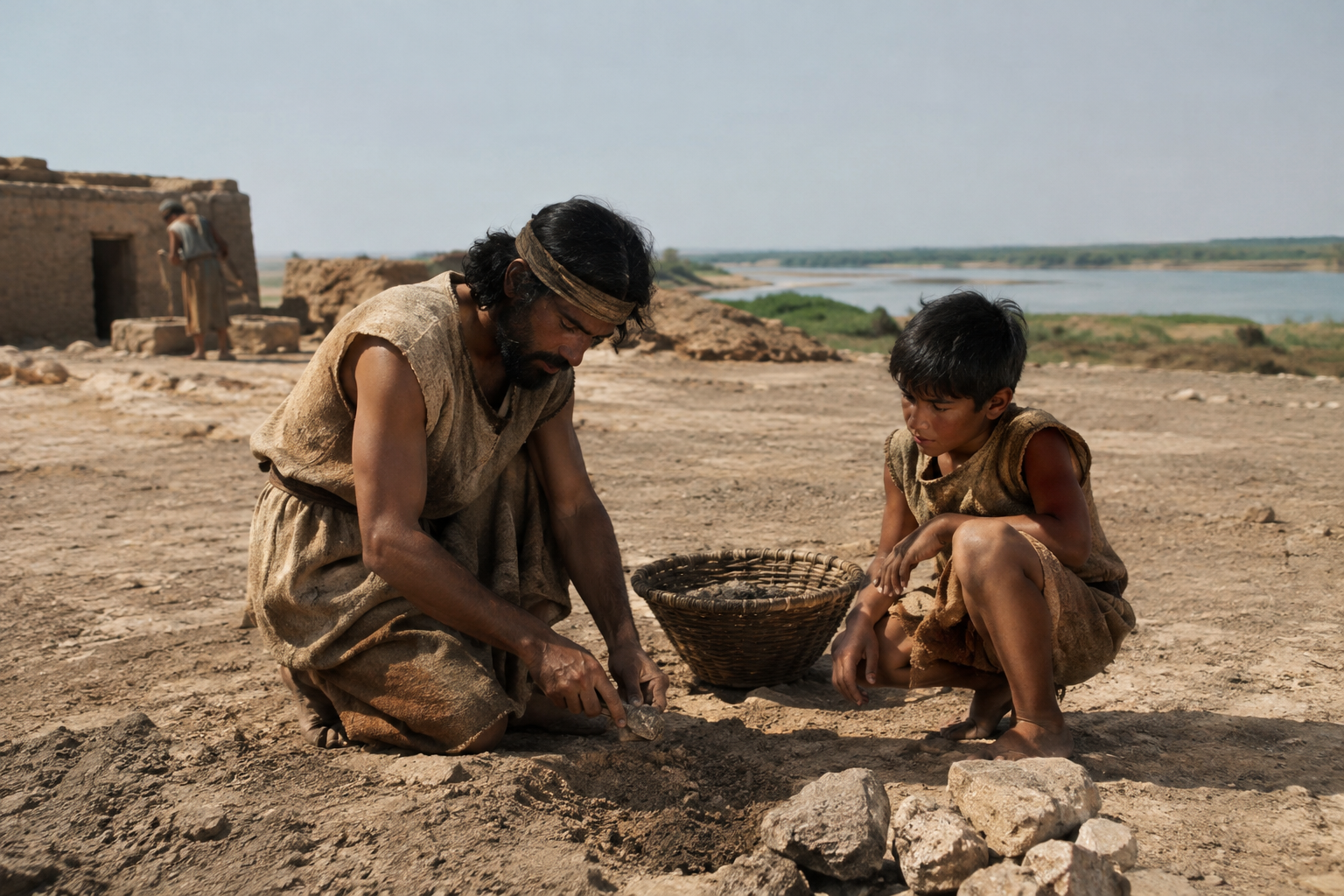
At Bakr Awa in Iraqi Kurdistan, one ancient male identified as A20578 offers a small but arresting glimpse into the paternal history of Bronze Age Upper Mesopotamia. He is dated to around 2114 BC, in the transition between the Late Early Bronze Age and the Early Middle Bronze Age, and is associated here with the Y-DNA haplogroup G2b2a. That may sound like a dry genetic label, but set against the archaeology of Mesopotamia, it becomes rather more interesting: this was a world of cities, trade routes, shifting kingdoms, and local continuities that do not always fit tidy historical slogans.
G2b2a is a paternal-line marker, tracing one direct male line only, not a person's whole ancestry. Even so, when a branch like this turns up in a dated archaeological context, it anchors that paternal line in a real place and time. In this case, the anchor is Bakr Awa, a long-occupied mound in the Zagros foothill zone, a region that linked lowland Mesopotamia with the Iranian plateau and the highland corridors beyond.
Bakr Awa matters because it was not an isolated village but part of a busy and strategic landscape. Sites in this belt sat between major cultural spheres, absorbing influences from southern Mesopotamian states while also participating in eastern and upland networks. That makes a sample like A20578 valuable beyond the individual himself: he belongs to a frontier zone where populations were rarely static, yet neither were they endlessly replaced.
An ancient DNA study focused on the site has helped illuminate precisely that long-term question of continuity and change at Bakr Awa, connecting genetic evidence to the archaeology of Bronze and Iron Age Mesopotamia. For readers who want the site-specific context, MyTrueAncestry has also covered it directly here:
The period around 2114 BC is itself historically suggestive. In broader Mesopotamian chronology, this was an age close to the end of the Akkadian aftermath and the rise of new political formations, including the Ur III period farther south. But archaeology repeatedly reminds us that people living in northern and northeastern Mesopotamia were not simply passive recipients of imperial events. Their settlements had their own rhythms, and their biological history may preserve local lineages through moments that texts describe as dramatic rupture.
The haplogroup in this article is G2b2a, a downstream branch within the wider haplogroup G family. That broader family is well known in the ancient DNA record of West Eurasia, particularly in populations tied to early farming and to regions stretching through the Caucasus, Anatolia, Iran, and the Near East. But one must be careful here: the history of the wider G haplogroup is not automatically the history of this narrower branch.
What A20578 gives us is not a grand universal map of G2b2a, but one securely dated appearance of a paternal line in Bronze Age northern Mesopotamia. That is useful in a very practical way. It shows that this branch, or at least a lineage reported within it, was present among the men living in or around Bakr Awa during a period of urban interaction and regional complexity.
That is the sort of finding that matters to personal ancestry research. It does not identify language, ethnicity, or social rank. It does, however, place one paternal branch within a real archaeological setting shaped by settlement continuity, exchange, and the political cross-currents of the ancient Near East.
There is a temptation, when looking at Mesopotamian history, to let the famous lowland cities dominate the picture. Yet Upper Mesopotamia and the Zagros piedmont were never peripheral in any simple sense. These were zones where merchants moved, armies passed, marriage networks formed, and local communities persisted across centuries of changing rule.
That makes paternal diversity especially worth watching. A single Y-lineage in one man cannot stand for a whole population, but it can show that Bronze Age communities in this region were carrying lineages with deeper roots in the western Asian world. In that respect, G2b2a at Bakr Awa fits a larger archaeological truth: Mesopotamia was built not by one homogeneous people, but by populations connected across valleys, plains, and mountain margins.
For a wider look at how ancient DNA is reshaping the history of Iranian and adjacent populations, this related article provides useful background:
The location of Bakr Awa is crucial here. It lies in a zone that could mediate contact between Mesopotamia proper and regions farther east. So although it would be reckless to assign A20578 a specific migration story from one sample alone, the site itself belongs to a landscape where such movements were perfectly plausible and, indeed, historically ordinary. Archaeology often works like this: not by proving a dramatic journey for one person, but by setting an individual inside a well-documented corridor of human contact.
Readers sometimes expect ancient DNA to produce sweeping certainty. In reality, one of its great strengths is more modest and more useful. It can pin a lineage to a place where written evidence is thin, biased, or absent. For Bakr Awa, that matters because Bronze Age northern Mesopotamia sits at the meeting point of textual empires and local archaeological realities.
The verified research trail for this material is linked through this ancient DNA project record, which is associated with the Bakr Awa material discussed here. Even without overclaiming from a single accession link, the existence of such work reflects an important shift in Near Eastern archaeology: tells and cemeteries are no longer studied only through pottery, architecture, and inscriptions, but through genomes as well.
That does not make the old evidence obsolete. Quite the opposite. Genetics is most revealing when it sits beside excavation and chronology. A20578 is interesting because he was not recovered from nowhere in particular; he belongs to a stratified archaeological world with its own periods, local sequences, and regional historical importance.
If your own Y-DNA falls within G2b2a, Bakr Awa offers something more grounded than myth. It places this paternal branch in the Bronze Age Near East, specifically in Upper Mesopotamia's eastern borderlands, during a time when towns and regional powers were reorganising after earlier upheavals. That is not a claim of direct descent from A20578, still less a claim about elite status. It is a historical foothold.
And it is a foothold in exactly the sort of place where lineages could endure while cultures and states changed around them. Anyone interested in the deeper backdrop of ancient DNA method and why finds like this matter may also enjoy this broader overview:
There is also a wider regional lesson. Mesopotamian history is too often narrated through kings and conquests alone. A20578 reminds us that the men who carried paternal lines like G2b2a lived in enduring local communities, not just in the margins of imperial chronicles. Their DNA does not replace archaeology; it restores some of the people who are otherwise nearly invisible.
The most distinctive thing we can responsibly say about haplogroup G2b2a here is simple but important: it is represented in a documented Bronze Age individual from Bakr Awa, in the Mesopotamian-Zagros contact zone, around 2114 BC. That makes this lineage part of the human story of a region shaped by both continuity and connection. For someone researching a G2b2a paternal line today, that is the real value of ancient DNA - not fantasy pedigrees, but a firmer sense of where one branch of the male line was living in the ancient world.
Comments