Haplogroup G2a2b2a1a1b2

– 5 min read


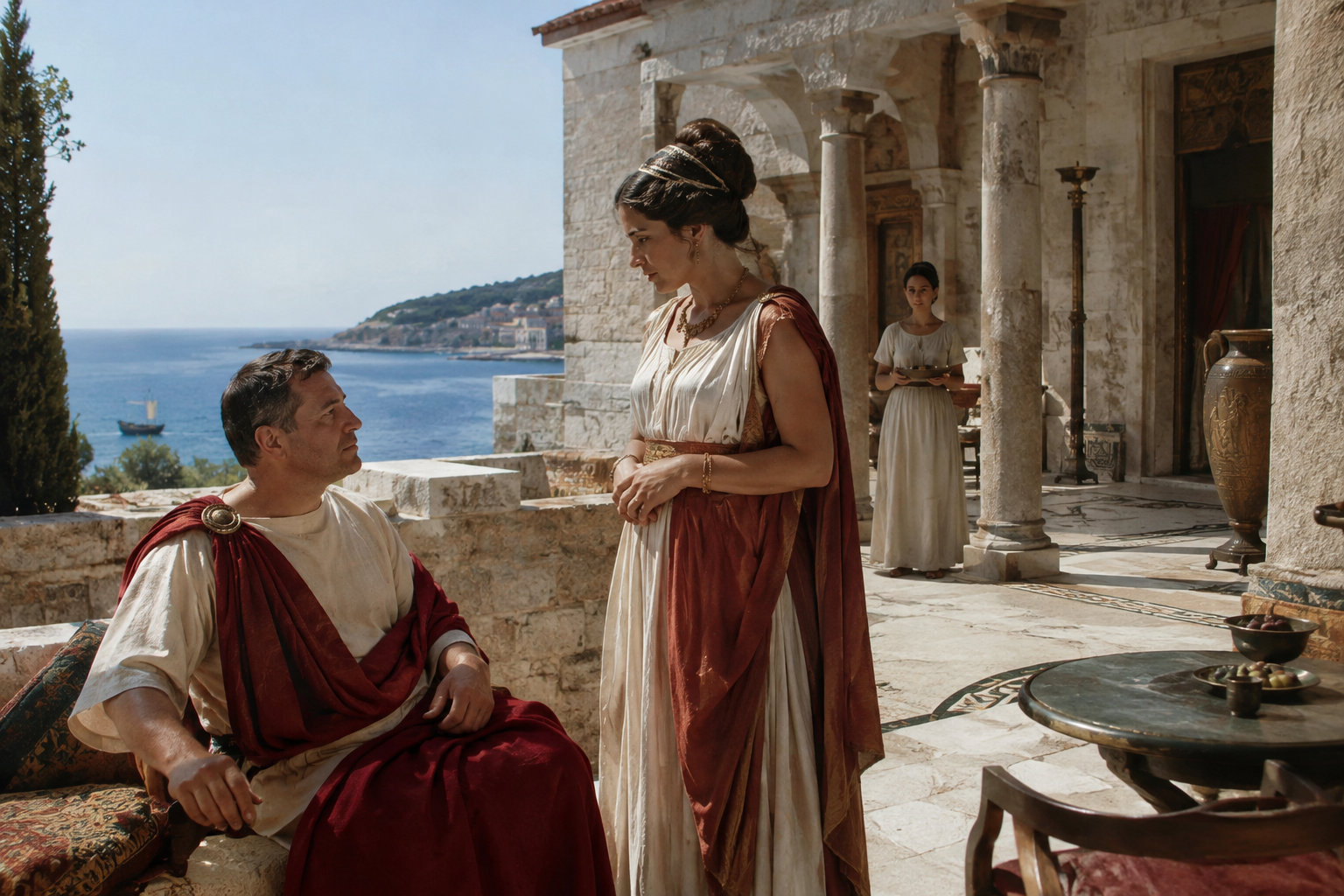
At Hvar-Radošević Palace on the Croatian island of Hvar, one late Roman man has become an unexpectedly useful guide to a much larger story. The individual identified as I33890, dated to around AD 400, carried the Y-DNA haplogroup G2a2b2a1a1b2 - a very specific paternal branch found here in the closing centuries of Roman rule on the eastern Adriatic.
That matters because Hvar was no remote backwater. Late Imperial Dalmatia sat inside a busy maritime world of soldiers, traders, administrators, local families, and migrants moving between islands, ports, and inland towns. A Y-chromosome lineage tracks only one direct male line, not a person's whole ancestry, but in a place like Hvar even a single paternal branch can illuminate how varied Roman-era communities could be.
The sample I33890 comes from Late Imperial Roman Croatia, specifically Hvar-Radošević Palace, and is dated to about AD 400. Even with that spare description, the setting is historically rich. By this point the Roman Empire was under strain, but the Adriatic remained threaded together by sea routes, military obligations, and long-established local settlements.
What makes G2a2b2a1a1b2 interesting here is not that it lets us pin this man to a named tribe, language, or elite house - it does not - but that it shows a paternal line often associated, at broader levels, with deep European and Mediterranean history persisting within a late Roman island population. In other words, this is not the DNA of a caricatured "Roman" in the old textbook sense. It is the DNA of a real man living in a mixed imperial world, where local continuity and wider mobility coexisted.
A recent archaeological and genetic discussion of the Hvar material has helped bring this site into clearer view, even if not every detail of sample-level interpretation is publicly accessible in summary form. The research context for the site can be found in this study of the Hvar-Radošević burial evidence, which situates the remains within the wider late antique landscape of Dalmatia.
The long string of letters and numbers matters because each step narrows the paternal line further. G2a2b2a1a1b2 is not the same thing as all of haplogroup G, nor even all of G2a. The broader G family is well known in ancient DNA because branches of it appear among some of Europe's early farmers and in later Mediterranean and Balkan populations. But one must be careful: the deeper history of haplogroup G cannot simply be pasted wholesale onto this exact subclade.
For the Hvar individual, the safest statement is the useful one. By late antiquity, a branch within G2a2b2a1a1b2 was present in Dalmatia, embedded in a Roman provincial context. That does not tell us whether this man's paternal ancestors had arrived generations earlier or represented more recent movement across the Adriatic or eastern Mediterranean. What it does show is that such paternal lines formed part of the real human texture of the late Roman Balkans.
Roman Dalmatia is often imagined through inscriptions, villas, roads, and military logistics. Ancient DNA complicates that picture in the best possible way. It shows that the province was populated not by a single homogeneous "Roman people" but by communities shaped by older Balkan roots, Mediterranean contacts, and the normal churn of imperial life.
That is especially plausible for an island setting like Hvar. Islands preserve local habits, of course, but they also receive traffic relentlessly. Merchants dock, officials arrive, soldiers pass through, families marry across coastal zones, and children inherit lineages whose older histories may be impossible to reconstruct from archaeology alone. A lineage such as G2a2b2a1a1b2 fits neatly into that kind of environment: not exotic, not necessarily dominant, but entirely at home in a world of layered ancestry.
Croatia's changing paternal lines
This is one reason late antique burials from the Adriatic are so valuable. They catch the Roman world in transition. Around AD 400, administrative structures still existed, Christian institutions were growing, and older provincial populations were meeting new political realities. A single Y-line from this period cannot narrate the whole transformation, but it can anchor it in an individual life.
There is a temptation, when facing a late Roman sample from the Balkans, to rush straight into stories of Goths, Slavs, or collapsing frontiers. Yet the most responsible historical reading begins with continuity. Large parts of the eastern Adriatic retained settled populations with long local histories, even as imperial power changed form and external groups entered the region.
That is where I33890 becomes especially suggestive. His haplogroup does not point automatically to one of the dramatic migration-period labels beloved of older history writing. Instead, it reminds us that the late Roman Balkans were full of people whose paternal lines may have been in the region, or moving through connected nearby regions, long before and long after the headline invasions. Archaeology often reveals change in pottery, architecture, and burial custom; genetics adds the awkward but useful fact that people themselves rarely sort into tidy historical boxes.
The wider Roman world offers many parallels. Across imperial territories, genomes repeatedly show that provinces were populated by mixtures of local descendants and incomers of varied origin. Dalmatia was no exception. Its importance lay precisely in being a corridor: Balkan, Adriatic, Mediterranean, and imperial all at once.
Readers sometimes assume that one ancient individual is too little to say anything meaningful. Sometimes that is true. But sometimes one well-placed sample does something rather important: it proves presence. In this case, it proves that G2a2b2a1a1b2 was present in a documented late Roman context on Hvar around AD 400.
Presence matters because ancient Y-DNA is unevenly preserved and unevenly published. Every securely placed lineage helps refine the historical map. For a paternal branch like this one, the Hvar evidence places it within the lived population history of the eastern Adriatic at the end of antiquity, not merely in abstract modern frequency maps or speculative origin stories.
It also helps correct the modern instinct to treat islands as isolated genetic capsules. Hvar was connected - politically to Rome, geographically to Dalmatia, and commercially to the Adriatic sea lanes. The man behind sample I33890 belonged to that connected world, whatever his family's more distant paternal history may have been.
Roman genetic legacy elsewhere
For someone researching G2a2b2a1a1b2 today, the most solid insight is not a fantasy pedigree but a historical setting: this paternal branch is attested in late Roman Dalmatia, in the burial of an individual from Hvar-Radošević Palace around AD 400. That places the lineage within a real Mediterranean-Balkan community shaped by both local continuity and imperial-era movement. It is a small clue, certainly, but a good one - the sort that turns a bare haplogroup label into a human presence in a specific place and time.



Comments