Haplogroup G2a2b2a1a1b1b

– 5 min read


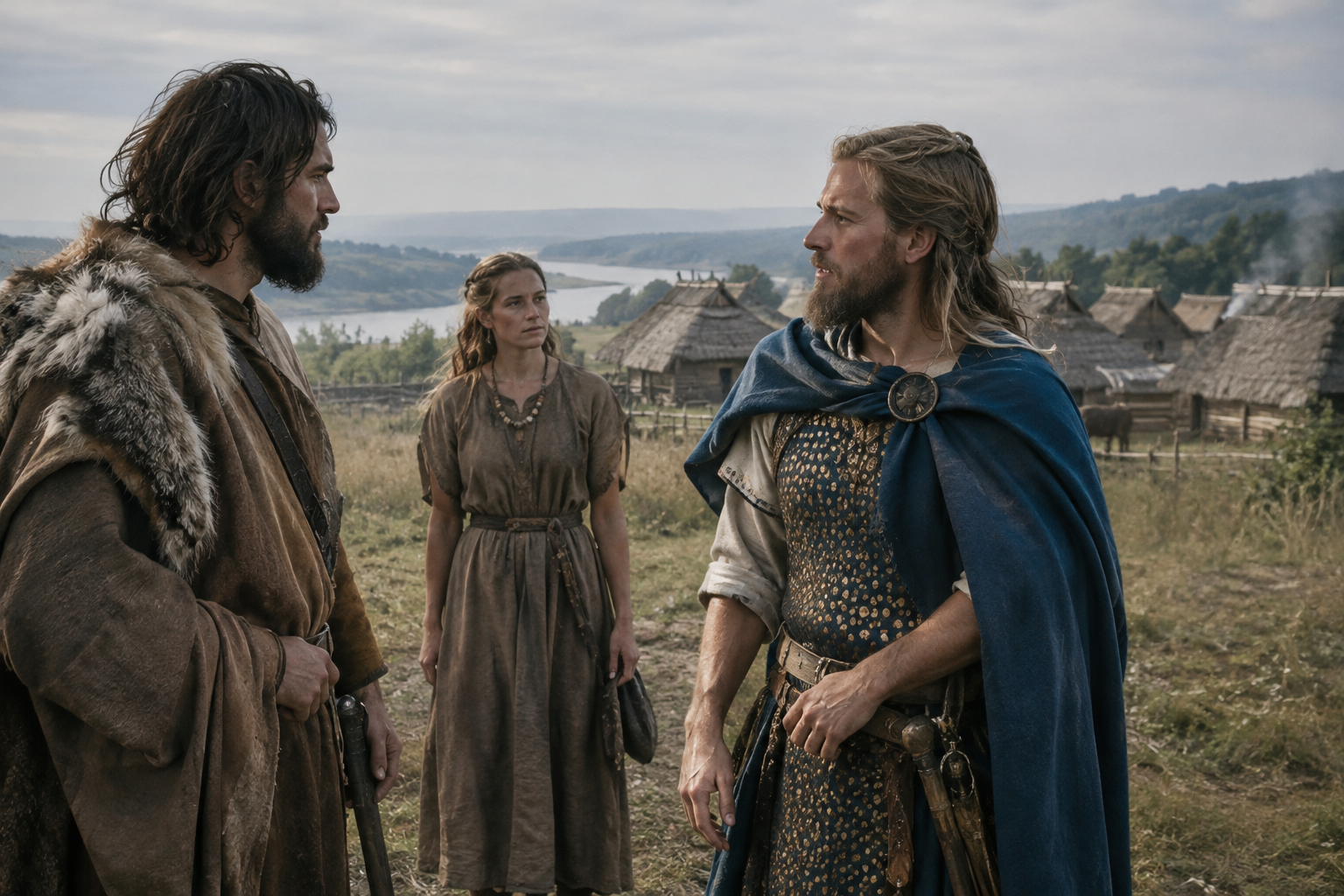
At Obrezje in present-day Slovenia, one Iron Age man, identified as I23974 and dated to around 650 BC, offers a particularly useful glimpse into the paternal line G2a2b2a1a1b1b. He does not come to us as a legendary chieftain or a named figure from the classical authors, but as something archaeologically better: a real person from a real burial horizon in the southeastern Alpine world, living in a region where communities sat between the Adriatic, the Pannonian plain, and the routes leading deeper into central Europe.
That matters because G2 is an old and important European Y-chromosome family, often associated in broad terms with early farming expansions. But this article's branch, G2a2b2a1a1b1b, is much narrower than that wider umbrella. The evidence here does not let us turn one Iron Age burial into a grand claim about all Celts, all Balkans, or all Alpine peoples. What it does show is that this paternal line was present among Iron Age populations in the eastern and central European world, including at least one man in Slovenia and another in Iron Age Hungary.
Obrezje lies in a landscape that was never culturally isolated. In the first millennium BC, this was a contact zone: not a blank margin between "civilizations", but a lived-in corridor of exchange, movement, and local continuity. The man labeled I23974 belongs to that world. Even with minimal biographical detail, his value is considerable, because Y-DNA pinpoints one direct paternal line passing through an archaeologically documented Iron Age community.
For readers tracing a paternal line, it is worth being precise. Y-DNA follows one line only: father to son to son across generations. It does not describe the whole ancestry of I23974, nor does it assign him a language, tribe, or identity on its own. Still, a securely placed Iron Age sample in Slovenia tells us that this branch was part of the male-line diversity of that region long after the first Neolithic farmers and long before the medieval reshaping of Europe.
A broader ancient DNA study of Europe in this period, published in Nature, helped clarify how Iron Age populations in central and western Europe combined continuity with mobility. That is the right frame for thinking about G2a2b2a1a1b1b here: not as a mysterious isolated relic, but as one paternal strand moving within populations that were already historically dynamic.
The second key data point is I18526, described as an Iron Age Celtic individual from Gyor-Moson-Sopron in Hungary, dated to around 250 BC. That later date places him in a central European setting usually associated with La Tene-period Celtic cultural horizons. Again, caution is essential: a Y-chromosome lineage is not the same thing as being "Celtic" in every possible sense. Archaeology, language, and genetics overlap imperfectly.
Yet the pairing is striking. One carrier of this branch appears in Iron Age Slovenia around 650 BC; another turns up several centuries later in northwestern Hungary in a context identified as Celtic. These are not the same society, and they should not be collapsed into one neat ethnic story. But they do suggest that G2a2b2a1a1b1b belonged to the male-line variety present in the wider eastern Hallstatt and La Tene-connected zone of central Europe.
That is historically interesting because the Carpathian Basin and its western fringes were not mere recipients of outside influence. They were active participants in Iron Age transformations: metallurgy, exchange networks, local aristocracies, fortified places, and shifting cultural fashions. A paternal lineage found in both Slovenia and Hungary fits that world rather well. It hints at continuity across neighboring regions, or at least repeated participation in related population networks.
DNA from the Little Hungarian Plain
There is a temptation, whenever G2 appears in Europe, to leap straight back to the first farmers of the Neolithic. The deeper background makes that understandable. Haplogroup G2 is indeed one of the lineages repeatedly found in early farming contexts across Europe. But one should not pretend that an Iron Age man in Slovenia or Hungary is simply a frozen survival from thousands of years earlier. By the first millennium BC, Europe had already seen immense demographic and cultural change.
What these samples really show is endurance. A paternal branch with much older roots in Eurasia and prehistoric Europe was still present in later central European communities shaped by Bronze Age and Iron Age developments. That persistence is historically valuable. It reminds us that Iron Age populations were not composed only of the lineages that later became dominant in modern frequency maps. Older branches remained woven into local societies.
This also helps counter a misleading habit in popular history: the idea that every archaeological horizon arrives as a clean replacement. Ancient DNA has repeatedly complicated that picture. Many regions show mixtures of continuity and change rather than simple population turnover. A branch such as G2a2b2a1a1b1b appearing in Iron Age settings is exactly the kind of evidence that supports a more textured view of central Europe's past.
The geography of these two samples deserves attention. Obrezje in Slovenia and Gyor-Moson-Sopron in Hungary sit within a connected belt stretching from the southeastern Alps into the western Carpathian Basin. In antiquity, this was a zone of river routes, overland corridors, and layered cultural affiliations. People moved through it, but just as importantly, communities endured within it.
That makes G2a2b2a1a1b1b less interesting as a badge of one named people than as evidence of regional embeddedness. The branch appears in places that were central to the movement of goods, styles, and perhaps marriage ties across Iron Age Europe. It may have circulated through local families over many generations, surviving political and cultural shifts that historians later package into neat labels.
Readers who are interested in how archaeogenetics is refining these central European Iron Age stories may also find it useful to compare broader regional discussions of mobility and burial evidence.
If your own Y-DNA falls under G2a2b2a1a1b1b, these Iron Age individuals do not prove descent from a particular ancient person, nor do they certify a Celtic identity in any simple sense. What they do provide is something more solid than romance: evidence that your paternal line, or a very close neighboring branch, was present in Iron Age populations of the southeastern Alpine and western Hungarian world.
That is a meaningful result. It places this lineage in communities living centuries before Rome's full expansion into the region, in landscapes shaped by central European exchange and local tradition alike. For some paternal lines, the ancient record is still frustratingly thin. Here, sparse though the evidence is, it points to a branch that was already established in Iron Age central Europe and moving through history in company with the complex societies of that age.
Paternal lineages in nearby Croatia
The most distinctive thing about G2a2b2a1a1b1b, on present evidence, is not imperial glamour or dynastic prestige, but its quiet appearance in two real Iron Age settings on the central European frontier between Alpine and Pannonian worlds. Obrezje's I23974 and Hungary's I18526 show this paternal branch living inside the ordinary but historically important fabric of Iron Age Europe. If this is your haplogroup, the responsible takeaway is a good one: your direct paternal line has a documented foothold in that world.
Comments