Haplogroup G2a2b2a1a1b1a1b2

– 5 min read


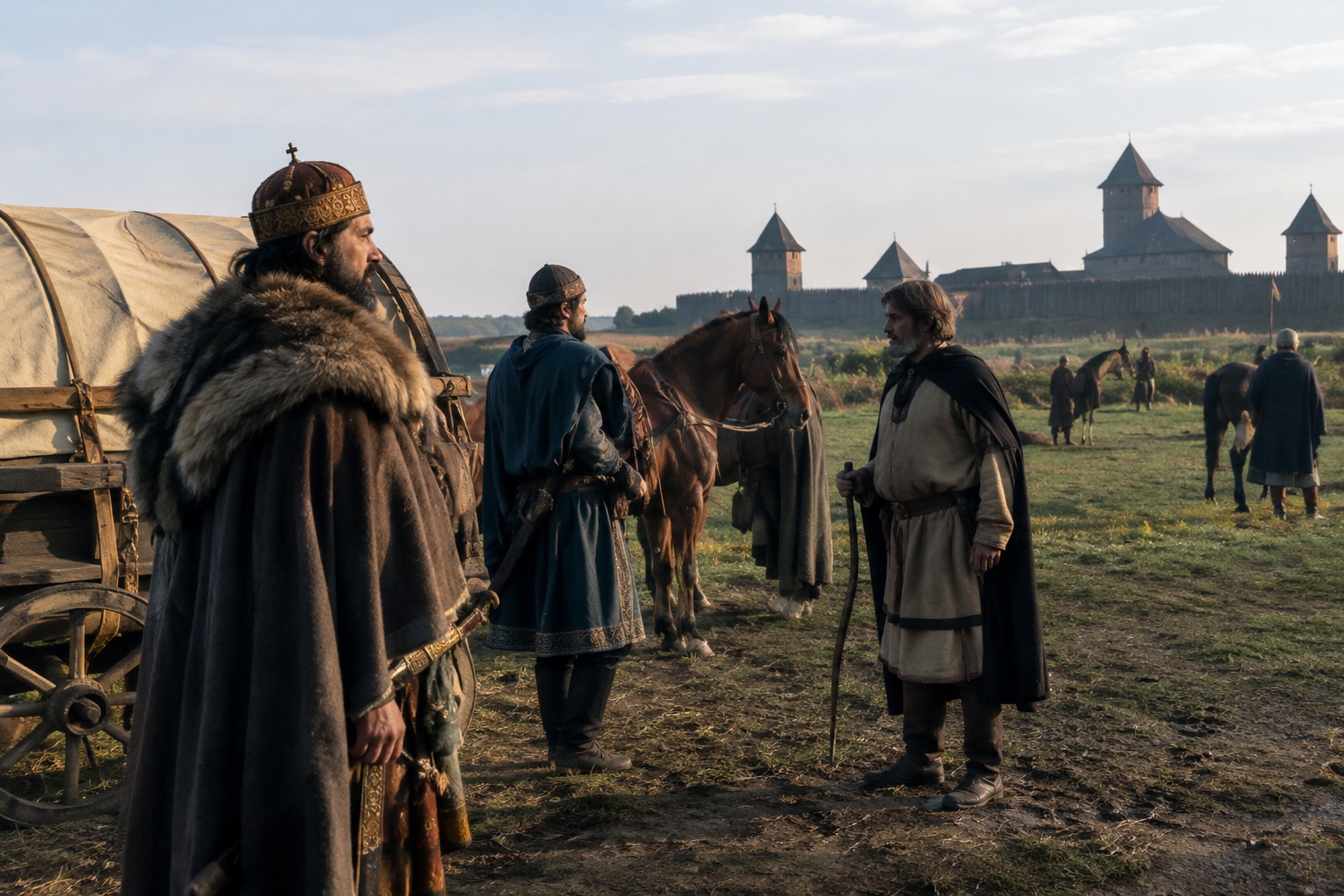
At Székesfehérvár in medieval Hungary, one excavated man from around AD 1000 carries an unusually specific paternal label in modern reporting: G2a2b2a1a1b1a1b2. The individual is recorded as sample AHPS181W, from the Carolingian-period cemetery at Táci úti repülőtér. On the face of it, that is a dry catalogue entry. But it becomes much more interesting when placed where it belongs: in the crowded and politically unsettled Carpathian Basin of the 10th and 11th centuries, where older Roman landscapes, Frankish influence, and the new Hungarian kingdom all overlapped.
This is exactly the kind of case where Y-DNA is useful, so long as we keep its limits in view. A Y-chromosome haplogroup tracks one direct paternal line only, not a person's whole ancestry, language, or identity. Even so, the appearance of this very narrow branch in a man buried in medieval Hungary is a reminder that the paternal histories of the region were never simple, and certainly not reducible to one conquering people or one dynasty.
Sample AHPS181W is associated with Medieval Hungary Carolingian Székesfehérvár Táci úti repülőtér and dated to about AD 1000. That date lands in a moment of transition. Hungary was moving from the world created by the 9th- and 10th-century Magyar conquest into a Christian kingdom tied increasingly to Latin Europe. Székesfehérvár itself would become one of the great ceremonial and political centers of the Hungarian realm.
That matters because the burial does not belong to some distant prehistoric horizon where everything must be guessed from stone and bone alone. It belongs to a documented medieval landscape in which populations had already been mixing for centuries: late Avar communities, local post-Roman groups, people shaped by Carolingian frontier politics, and newcomers linked to the Hungarian conquest. A single paternal line such as G2a2b2a1a1b1a1b2 therefore tells us less about a "type" of medieval Hungarian than about the layered male ancestry that could persist inside a changing kingdom.
A recent ancient-DNA study on elite and medieval-period Hungary, published in Science Advances, has helped sharpen this broader picture by showing how conquest-period roots and later medieval society could coexist with substantial diversity. AHPS181W fits best into that wider story: not a lone curiosity, but one thread in a complicated fabric of paternal lines present in the basin around the millennium.
The haplogroup here deserves careful handling. G2a is a well-known and ancient West Eurasian Y-chromosome lineage, famous in archaeogenetics because many early European farmers carried branches of it in the Neolithic. But that broad fact does not mean every later G lineage in Europe is a straightforward survival from the first farmers, and it certainly does not let us assign a ready-made migration story to the much narrower branch G2a2b2a1a1b1a1b2.
What can safely be said is more modest and more interesting. By the medieval period, G lineages in Europe often appear as minorities within very mixed populations. When one turns up in a man from around AD 1000 in central Hungary, the important point is not that he represents some isolated relic population. It is that paternal lines associated with much deeper Eurasian histories were still present and being folded into medieval societies that chroniclers usually describe in political rather than biological terms.
In other words, the Y-chromosome can preserve an old paternal branch long after kingdoms, languages, and burial customs have changed around it. That is a useful corrective to the tempting but misleading habit of equating every medieval grave with a single ethnic label.
The cemetery designation itself is revealing. The reference to a Carolingian context points us toward the centuries before and around the Hungarian state formed, when western and central Transdanubia were drawn into the orbit of the Frankish world. This was not an empty frontier waiting for one people to arrive. It was a contact zone, administratively and culturally entangled with neighboring powers and older local communities.
By AD 1000, when Stephen I was establishing the Christian kingdom of Hungary, those older frontier layers did not simply vanish. Cemeteries, settlements, and elite centers across the region preserve evidence of continuity alongside change. A paternal lineage like G2a2b2a1a1b1a1b2 in AHPS181W may therefore reflect ancestry embedded in the basin before, during, or after the conquest period; with the current evidence, the honest answer is that we should not force a single origin story.
That may sound cautious, but archaeologically it is the sensible approach. Medieval Hungary was built from incorporation as much as from replacement. Men buried under the early kingdom could descend through their fathers from lines already present in the region, from lines arriving with mobile groups from the steppe, or from lineages introduced through the many west-east connections that structured the basin.
With only one ancient individual supplied here, it would be easy to shrug and move on. But single samples can be valuable when they come from a historically charged place and period. AHPS181W anchors this haplogroup in a real cemetery near a major Hungarian center at the threshold of state formation. That is already more informative than a floating label on a phylogenetic tree.
It also shows how medieval cemeteries complicate neat origin myths. If someone today belongs to G2a2b2a1a1b1a1b2, this Hungarian case does not prove descent from a king, a Magyar war band, or a Neolithic farmer. What it does show is that the branch had reached, or remained in, the Carpathian Basin by the turn of the first millennium, where it became part of the lived population history of a kingdom in the making.
That broader lesson has turned up again and again in ancient DNA from Europe: populations at political frontiers are rarely genetically simple. Studies of neighboring and comparable regions have likewise emphasized diversity, mobility, and local persistence rather than tidy replacement. The medieval basin fits that pattern well.
There is one larger historical backdrop worth noting. Because broader G2a lineages are so prominent in early European farming populations, readers are often tempted to draw a straight line from the Neolithic to any later G branch. The reality is messier. Thousands of years separate the first farming expansions from a man buried in Hungary around AD 1000, and in between lie Bronze Age shifts, Iron Age societies, Roman imperial networks, post-Roman transformations, and early medieval migrations.
Still, the persistence of a G-derived paternal branch into this medieval context is a neat illustration of how old lineages can survive enormous social change. Archaeogenetics has repeatedly shown that while whole populations may transform, some paternal or maternal lines continue quietly through time, carried by families who leave little trace in written history. That is one reason such a precise Y-DNA result can be so arresting: it compresses deep time into one burial record.
For G2a2b2a1a1b1a1b2, the clearest ancient signpost here is not a dynasty or a legendary founder, but a documented medieval man from Székesfehérvár around AD 1000. Sample AHPS181W places this paternal line within the real, mixed, frontier-born society of early medieval Hungary. For anyone researching this haplogroup today, that is the valuable insight: your direct paternal line belongs to a history that could move through great political changes while remaining quietly continuous at the family level.
Comments