Haplogroup G2a2b2a1a1b1a1a2a1b

– 5 min read


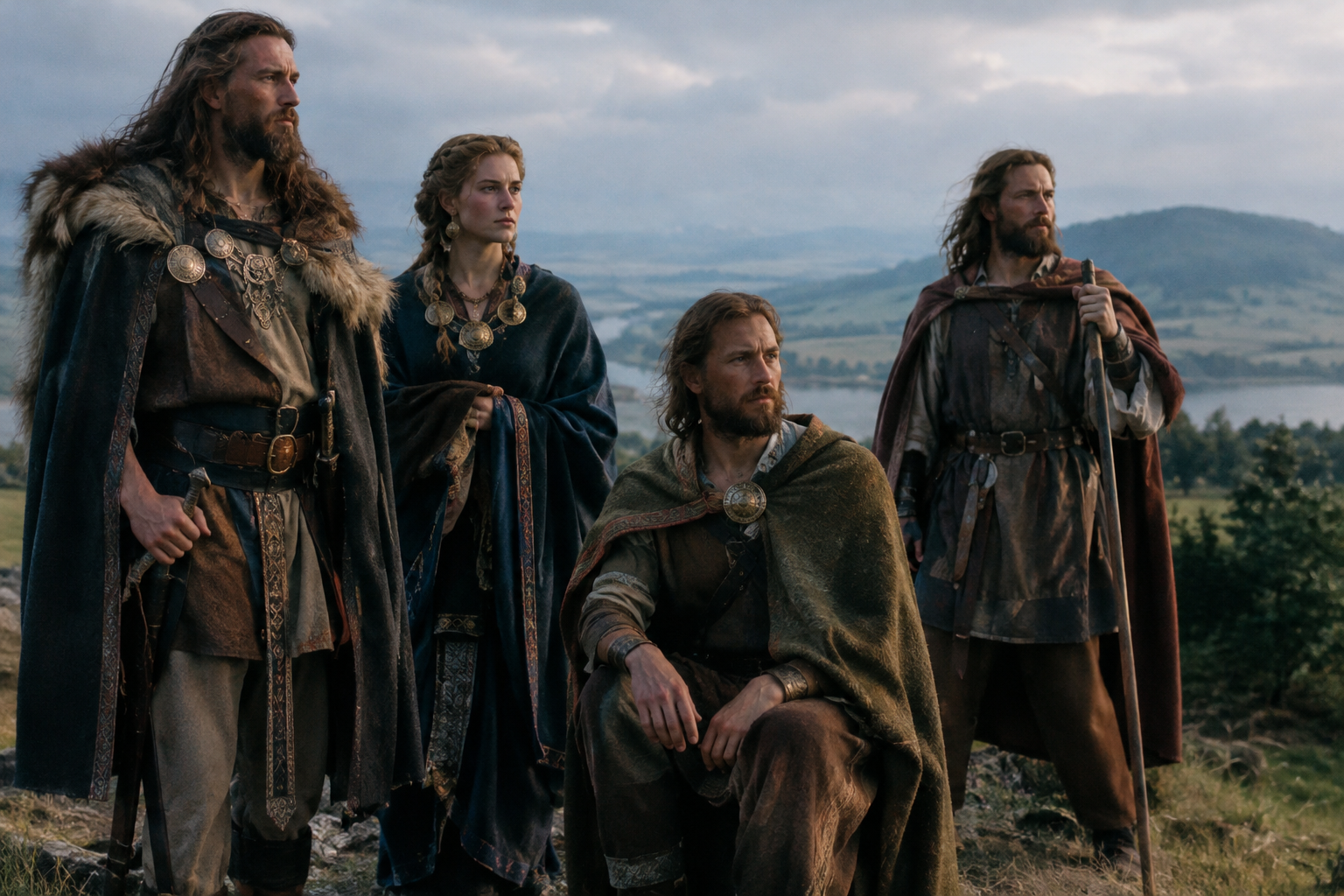
At Magdalenenberg near Villingen-Schwenningen, one of Iron Age Europe's most imposing burial mounds has yielded an especially striking genetic clue. An elite burial dated to around 530 BC, sample MBG017, is associated here with the Y-DNA lineage G2a2b2a1a1b1a1a2a1b - a very specific paternal branch found not in some vague prehistoric fog, but in the company of high-status burials from the early Celtic world.
That matters because Magdalenenberg is not just any cemetery. It sits in the Hallstatt cultural zone of southwest Germany, a region central to the formation of early Celtic elites north of the Alps. Y-DNA tracks one direct paternal line only, not a person's whole ancestry or identity, yet when the same branch appears in several elite burials of roughly the same broader world, it becomes a useful thread for following male-line continuity, status, and local history.
Magdalenenberg has long been famous to archaeologists because of the scale of its mound and its place in the political landscape of the early Iron Age. This was a period when fortified centers, long-distance exchange, and richly furnished graves helped mark out emerging aristocracies in temperate Europe. Sample MBG017 places this paternal line in that environment of rank and display.
What can be said carefully is that G2a2b2a1a1b1a1a2a1b appears here in an individual from an elite burial context in southwest Germany around the sixth century BC. What cannot be said, at least from this evidence alone, is that the haplogroup belonged uniquely to "the Celts" or to one dynasty. Ancient DNA is often most interesting when it narrows the question rather than pretending to settle it.
A genetic study focusing on the spread of populations linked to Celtic-speaking regions has helped sharpen this broader background, showing how archaeogenetics can illuminate central European Iron Age communities without reducing them to a single lineage or tribe. See this ancient DNA research on Celtic-language dispersals and Central European population history.
The pattern becomes more intriguing at Ludwigsburg Roemerhuegel, where two closely dated elite burials from around 500 BC - LWB003 and LWB003b - are also associated with this same haplogroup. We should be cautious here: two nearby burials with closely matching paternal assignments do not automatically prove a father-son sequence or even close kinship unless a study demonstrates it. But they do show that this branch was present more than once in an aristocratic milieu of Iron Age southwest Germany.
That is the sort of repetition that gets an archaeologist's attention. A single elite grave might be an accident of preservation or discovery. Several elite-associated finds in related regions and centuries begin to suggest that this paternal line had some foothold among local male lineages participating in Hallstatt and early La Tene-era power structures.
Roemerhuegel also reminds us that elite burial was part of a wider social grammar in Iron Age Europe. Monumental graves, selective burial treatment, and regional prestige networks did not belong to one family alone; they were features of a competitive world of local rulers and warrior-aristocrats. A lineage like G2a2b2a1a1b1a1a2a1b may have persisted inside that world without ever representing more than one strand in a much larger population.
The fourth sample in this group extends the story westward. CGG023712, dated here to around 455 BC, comes from Parancot in France and is identified as Gallic, in a region associated with the Sequani. That is an important shift in geography. We are no longer looking only at burials in southwest Germany, but at evidence from the broader Celtic-speaking zone on the far side of the Rhine.
Here again, caution is essential. A burial in a region associated historically with the Sequani does not mean the Y-lineage itself was "Sequani" in some exclusive ethnic sense. But it does show that this paternal branch appears within the archaeological and historical orbit of Iron Age Gaul as well as the elite centers of southwest Germany.
In practical terms, that gives this haplogroup a recognisable Iron Age footprint in the upper Danube-Rhine-eastern Gaul corridor. That corridor was one of the key arteries of early Celtic Europe: politically fragmented, commercially active, and culturally connected. A paternal line found at Magdalenenberg, Roemerhuegel, and Parancot is therefore not random scatter. It sits within a coherent historical landscape.
Celtic mobility in the Alpine world
One of the traps in haplogroup writing is to treat a very narrow branch as if it carries the whole biography of its much older parent lineage. That would be misleading here. The wider haplogroup G has deep prehistoric roots in western Eurasia and is often discussed in relation to early farmers and later regional survivals, but that broad history should not simply be pasted onto G2a2b2a1a1b1a1a2a1b without branch-specific evidence.
What this article's evidence actually supports is narrower and more interesting: a rare, highly specific paternal line turns up in multiple Iron Age individuals connected with elite or high-status contexts in the Celtic world of southwest Germany and eastern France. That makes it a lineage worth watching in discussions of male-line continuity inside early Celtic societies.
It also offers a useful corrective to simplistic ideas about Iron Age Europe. The paternal landscape of Celtic-speaking regions was not built from one single Y-DNA signature. Ancient communities that shared material culture, burial customs, or language could include very different paternal lines. This branch is valuable precisely because it shows that an elite Celtic setting could include a lineage that modern readers might not expect if they rely on overly neat population stereotypes.
Archaeology is always balancing the vividness of a tomb against the ordinariness of a population. Elite graves survive, get excavated, and attract attention, but they are not the whole society. Still, when the same paternal branch appears in more than one elite context, that repetition can hint at something structural: perhaps local inheritance patterns, perhaps durable male lines in regional leadership groups, perhaps simply the luck of sampling within a socially prominent stratum.
A newer study circulating as a preprint on Iron Age and Celtic-period ancient DNA points to the continuing expansion of this kind of evidence base. As more burials from Central Europe and Gaul are sequenced, lineages like this one become less anecdotal and more historically legible. The question is no longer whether such branches existed in elite Celtic settings - clearly they did - but how common, local, and long-lasting they were.
That is where sample clusters such as MBG017, LWB003, LWB003b, and CGG023712 become useful. They do not prove a single ruling house spread across regions. They do, however, mark out a paternal presence within the societies that built princely graves, maintained regional identities, and formed part of the early Celtic historical world.
For someone exploring G2a2b2a1a1b1a1a2a1b today, the most solid takeaway is not a grand claim of descent from a named tribe or prince. It is that this branch has a documented presence in the Iron Age Celtic heartland, including elite burials in southwest Germany and a Gallic context in eastern France. That gives the lineage a historically textured setting: not abstract "ancient Europe," but the connected upper Danube and Rhine world of the sixth and fifth centuries BC.
In other words, this is a paternal line with evidence in places where early Celtic power was being materially displayed and politically negotiated. That is a modest claim, but a strong one - and in archaeogenetics, strong modest claims are usually the ones that last.
Comments