Haplogroup G2a2b2a1a1b1a1a1a2a

– 5 min read


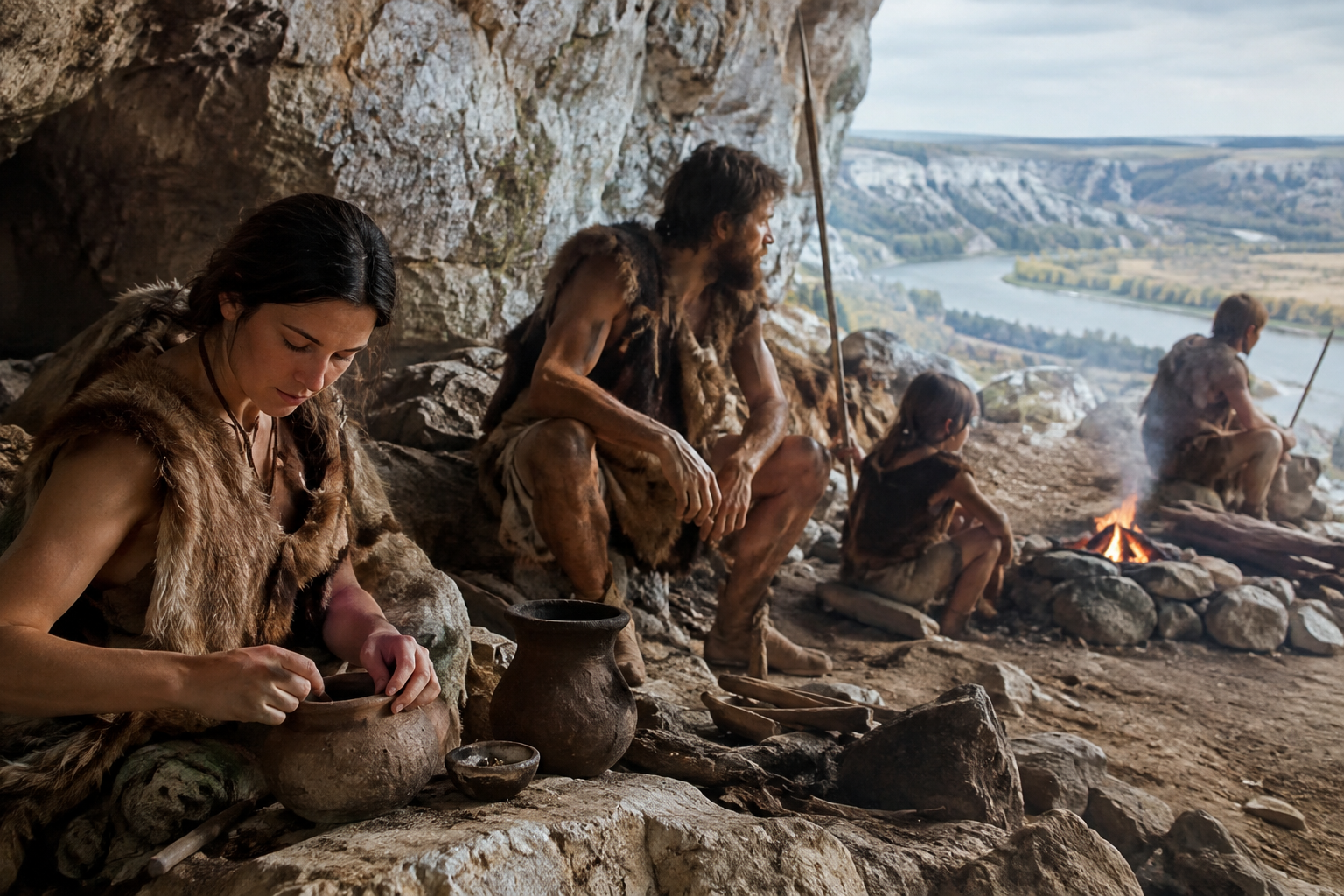
At Verteba Cave in western Ukraine, one ancient male known as I1927 offers a rare and very specific glimpse into a paternal line now labeled G2a2b2a1a1b1a1a1a2a. He is dated to around 3600 BC, in the Chalcolithic, and comes from one of eastern Europe's most famous cave sites: a place closely associated with the farming communities archaeologists usually call Trypillia or Cucuteni-Trypillia.
That matters because haplogroup G, and especially its many branches, turns up again and again in the story of early European farmers. But this article's lineage is not "haplogroup G in general". It is one extremely narrow twig on that larger tree. With I1927, we are not looking at all the men of Neolithic Europe, nor even all G2a lineages. We are looking at one direct paternal line preserved in the bones of a man who lived in a cave landscape used by some of the most remarkable farming societies of prehistoric Ukraine.
Verteba Cave, in present-day Ternopil region, has long attracted attention because it preserves human remains and material from the late Neolithic and Chalcolithic communities of the forest-steppe zone. These were not nomadic herders drifting across empty plains. They belonged to settled agricultural populations whose houses, pottery traditions, and large communities have made the Trypillia horizon one of the defining archaeological phenomena of prehistoric eastern Europe.
I1927 sits within that world. The date of around 3600 BC places him late in the Trypillia sequence, at a time when these farming societies had already flourished for centuries. Cave contexts in this region are especially intriguing because they raise questions about how the dead were treated, how communities used underground places, and how regional ritual practices differed from the better-known settlement sites.
Ancient DNA has become one of the key tools for understanding these populations, and Verteba Cave has featured in wider efforts to map the ancestry of the North Pontic and surrounding regions. For readers interested in the broader background of this landscape, MyTrueAncestry has also explored genomic ancestry in the North Pontic region.
Y-DNA follows one line only: father to son to grandson, down a single paternal chain. So G2a2b2a1a1b1a1a1a2a does not describe all of I1927's ancestry, and it certainly does not define his language, identity, or the full genetic profile of Trypillia society. What it does do is anchor one man within a paternal lineage nested inside the wider G2a cluster that is strongly associated, at broad scale, with many early farming populations across Europe.
That broader point is well established in archaeogenetics. The narrower point is more delicate. A very long terminal name like G2a2b2a1a1b1a1a1a2a represents fine resolution on the Y-chromosome tree, but ancient samples are not always published at exactly the same level of detail in every study. So the safe historical reading is this: I1927 is linked to a highly derived branch within the larger G2a world, and that connection fits the larger pattern in which farming populations carried multiple sub-branches of G2a into different parts of Europe.
This is precisely why ancient DNA matters. It shows that the spread of farming was not the movement of one single male line, but of many related and branching paternal lines. Some became common, some faded, and some survive today only as scattered descendants who would never guess that one of their distant paternal cousins once lived in Chalcolithic Ukraine.
It is tempting to treat any ancient Y-DNA result as a simple migration arrow: this lineage came from here, then moved there. Archaeology is usually less tidy. Verteba Cave is important not just because it gives a geographic location for I1927, but because it places him inside a real cultural setting with its own mortuary practices and local history.
Trypillia communities are famous for large settlements and elaborate ceramics, but burial evidence is often harder to interpret than the settlements themselves. That makes cave finds especially valuable. They remind us that prehistoric communities did not always leave their dead in the neat cemetery patterns that later archaeologists prefer. Sometimes the evidence survives in unusual places, and those places tell us something about social practice as much as population history.
A genetic study associated with ancient individuals from this broader research tradition is linked through this research archive. Even without claiming more than the available evidence allows, the value of such work is clear: it lets archaeologists connect site context, chronology, and paternal descent in a way that older typological studies simply could not.
To understand why I1927 is interesting, it helps to step back. Across much of Neolithic and Chalcolithic Europe, G2a lineages appear regularly among early farmers. They are found from the Balkans into central and western Europe, often in populations descended largely from the first agricultural expansions out of Anatolia and southeast Europe. In that broad sense, I1927 fits an old and familiar prehistoric pattern.
But the eastern European setting gives that pattern a different edge. The Trypillia world was never a simple copy of the first Balkan farming communities, nor was it yet the steppe-dominated landscape that would transform much of Europe later in prehistory. Around 3600 BC, western Ukraine sat in a contact zone: farmers, local traditions, and neighboring populations all interacted across a changing frontier.
So this branch of G2a is a useful reminder that Chalcolithic Ukraine was not genetically blank before later Bronze Age turnovers. Men carrying farmer-associated paternal lines were present there, embedded in substantial communities with deep local histories. That does not mean every Trypillia male belonged to G2a, nor that later populations in the region simply continued unchanged. It means the paternal landscape before the major Bronze Age reshuffling was more varied, and more historically important, than older grand narratives sometimes allowed.
For a wider look at how farming populations transformed Europe, MyTrueAncestry readers may also enjoy this overview of the Neolithic expansion.
One of the most striking lessons of ancient DNA is that paternal lineages can change dramatically even when places remain continuously inhabited. Later European prehistory saw major shifts linked to steppe expansions, Bell Beaker movements, and other regional transformations. In many areas, lineages common among early farmers became rarer in the male line over time.
That makes a lineage like G2a2b2a1a1b1a1a1a2a doubly interesting for modern testers. If your direct paternal line falls on such a branch, it may preserve a thread reaching back into Europe's first and second generations of farming societies rather than to the better-publicized Bronze Age and Iron Age male expansions. Not a guarantee, of course, but a historically meaningful possibility.
There is also a useful caution here. A present-day man carrying this haplogroup is not "a Trypillian" in any simple sense. Millennia of mixture stand between modern families and Chalcolithic cave burials. Yet the paternal signal can still be unexpectedly conservative, keeping one narrow line alive through all the upheavals that changed language, culture, and political worlds many times over.
Mesolithic-Neolithic Transition
The most distinctive thing about haplogroup G2a2b2a1a1b1a1a1a2a, on the evidence here, is not royal glamour or a long parade of famous surnames. It is that one ancient man, I1927 of Verteba Cave, places this paternal line inside the lived reality of Chalcolithic farming Ukraine around 3600 BC. For anyone researching this branch today, that is a serious and evocative clue: your direct male line may belong to a deep stratum of European agricultural history, preserved through thousands of years of change.
Comments