Haplogroup G2a2b1b1a1b

– 5 min read


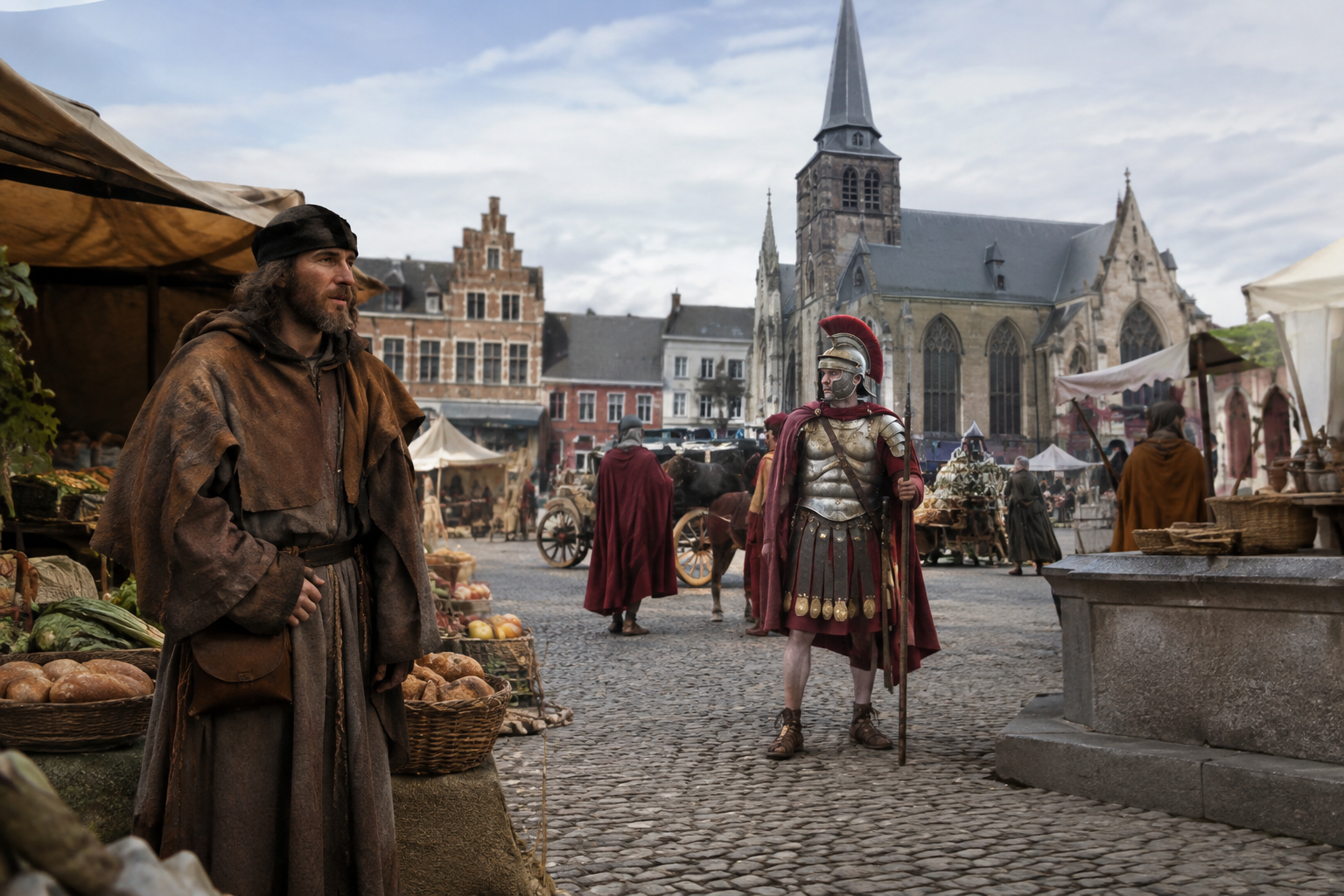
One of the clearest medieval sightings of the Y-DNA haplogroup G2a2b1b1a1b comes from Sint-Truiden in present-day Belgium, where sample ST2913 was dated to about AD 1090. That is already an evocative setting: a growing town in the High Middle Ages, shaped by church institutions, markets, and the steady thickening of urban life. The interest here is not that one man "represents" medieval Belgium, but that his paternal line places this branch of G in a documented town population at a moment when northwestern Europe was becoming more densely connected than ever.
What makes ST2913 especially useful is the contrast it invites. Another ancient individual associated with this same branch, R47, comes from Imperial Rome at Centocelle and is dated to about AD 282. So the evidence for G2a2b1b1a1b in this article is not from one isolated village or a single family crypt. Instead, it appears in two very different historical worlds: late Imperial Rome and medieval urban Belgium. That is a modest dataset, certainly, but not a trivial one.
Sint-Truiden was not a frontier outpost or a legendary royal capital. That is part of why it matters. Places like this are where much of medieval European history actually happened: in market exchange, parish life, craft production, and the ordinary churn of migration into and out of towns. Sample ST2913, dated to around AD 1090, places G2a2b1b1a1b within that social landscape.
An ancient DNA study of the medieval population of Sint-Truiden has helped illuminate how urban communities formed in the Low Countries, and how biological ancestry sat alongside the historical processes of Christianization, commerce, and local mobility. In that setting, a Y-chromosome lineage is best understood as one strand of paternal continuity within a much broader urban population, not as a badge of ethnicity or status. Y-DNA tracks one direct male line only, while every real person had many more ancestors than that single line can show.
The broader significance is simple and rather powerful. By the late 11th century, this branch was present in a town shaped by medieval institutions rather than by Roman imperial administration. That tells us G2a2b1b1a1b was not confined to one ancient migration horizon or one vanished people. It persisted into the medieval north as part of lived communities.
The older of the two samples, R47, comes from Centocelle in Rome and is dated to about AD 282, in the later 3rd century. This was a turbulent period in imperial history, but also one in which Rome remained a magnet for people from across the Mediterranean and beyond. To find a representative of G2a2b1b1a1b in that environment is a reminder that the city was not genetically simple, nor was its male population drawn from a single regional source.
Rome's cemeteries and suburban burial grounds repeatedly show how movement, service, trade, enslavement, and family settlement all fed into the population of the capital. A well-known ancient DNA study of Rome and central Italy, published in Science, showed just how dramatically the city's ancestry profile changed across time. Even without forcing a specific migration story onto sample R47, the context is enough to say that this paternal branch was present in one of the most connected urban centers of the ancient world.
That matters because haplogroup G has a deep and complicated history in West Eurasia, especially in early farming populations and later regional populations around the Mediterranean and Europe. But this article's branch is not "all of G," and it should not be treated that way. What R47 gives us is something narrower and more grounded: a documented late Roman carrier of the article's branch in the metropolitan orbit of Rome.
With only two ancient individuals listed here, the responsible approach is to resist the temptation to turn them into a grand migration map. Still, two points are solid. First, G2a2b1b1a1b was present in very different historical settings separated by roughly eight centuries. Second, those settings are both urban or peri-urban environments tied into wider political and economic networks.
That pattern suggests durability rather than isolation. This was a paternal line capable of appearing in the mixed demographic worlds of late Rome and medieval northern Europe. It does not prove direct descent from R47 to ST2913, nor does it identify a single homeland for the exact branch. But it does show that this lineage belonged to the real human traffic of European history, not to a neatly bounded ethnic label.
This is also where archaeology helps keep genetics honest. A Roman burial near the capital and a medieval burial in Belgium belong to very different social systems, legal orders, languages, and identities. The Y-chromosome links only one paternal thread between them. Everything else about those men's ancestry and lives would have been far more complex.
The most interesting historical thread running through these samples is connectivity. Centocelle belonged to the enormous gravitational field of Rome, where soldiers, migrants, freed people, merchants, and families from many backgrounds could end up in the same cemeteries. Sint-Truiden belonged to a different kind of network: one built through ecclesiastical authority, regional exchange, and the commercial revival of medieval Europe.
Seen in that light, G2a2b1b1a1b appears not as the signature of one moment, but as a paternal line that survived institutional change on a continental scale. Empires fell, towns rose, Latin fragmented, frontiers shifted, and yet this male line remained part of the population history of Europe. A recent genetic study of medieval Belgium, available through Genome Biology, adds useful context for thinking about how urban populations in this region formed and stabilized over time.
For people researching this haplogroup today, that is perhaps the most valuable lesson. Your paternal line may connect you, not to one dramatic founder, but to long-lived processes: settlement, survival, movement, marriage, and re-settlement across changing historical worlds.
Haplogroup G is old and widespread enough to tempt sweeping claims, especially because some of its broader branches are well known from early European farmers. But the branch in this article is G2a2b1b1a1b, a much narrower label. Unless a source firmly documents the deeper history of that exact subclade, it is better not to project the whole prehistory of haplogroup G onto it.
What the current evidence does support is more precise in a different way. This branch is attested in a late Roman individual from Centocelle and in a medieval individual from Sint-Truiden. That combination places it within the documented population history of both the Mediterranean imperial world and the urbanizing society of medieval northwestern Europe.
Roman Hispania's Genetic Legacy
The ancient record for G2a2b1b1a1b is still sparse here, but it is far from empty. R47 in Imperial Rome and ST2913 in medieval Belgium show this paternal line in two places where history was made through movement, mixing, and urban life. For someone carrying this haplogroup today, the safest conclusion is also the most interesting one: your direct paternal line was already part of Europe's connected worlds long before modern surnames and nation-states took shape.



Comments