Haplogroup G2a2a1a2a2a1
– 5 min read


At Viminacium in Serbia, the cemetery known as the Rit necropolis has produced one of those wonderfully unsettling reminders that the Roman world was never as tidy as textbook maps suggest. Among the individuals dated to around AD 200 is sample I15489, assigned here to the Y-DNA haplogroup G2a2a1a2a2a1. That matters because Viminacium was not some sleepy provincial outpost: it was a major city and military centre on the Danube frontier, a place where soldiers, traders, families, and officials crossed paths in the everyday business of empire.
The interesting thing about this haplogroup is that its ancient trail in the material here does not begin with Rome at all. It reaches back much further, to Neolithic southeastern Transdanubia in Hungary, where sample I29877, dated to about 5000 BC in Baranya, is also associated with G2a2a1a2a2a1. So the evidence does not give us a grand dynasty or a single heroic migration. It gives something better: a glimpse of a paternal line appearing first among early farming communities in the Carpathian Basin and then, thousands of years later, in a Roman frontier population shaped by mobility and mixture.
Sample I29877 comes from Neolithic Hungary, specifically southeastern Transdanubia in Baranya, and is dated to around 5000 BC. That places him in the world of Europe's first farming societies, when settled villages, cultivated crops, and domesticated animals were transforming the landscape of the Carpathian Basin. In broad archaeological terms, this was one of the key early zones in which farming lifeways became established north of the Balkans.
That setting is important because haplogroup G, in broad terms, is frequently associated in ancient DNA studies with early European farmers. One must be careful here: that does not mean every branch of G has the same history, nor that a precise subclade like G2a2a1a2a2a1 can simply be equated with "the Neolithic" as a whole. But the Baranya sample does place this paternal line squarely inside one of the most important archaeological transformations in European prehistory: the spread and local development of farming communities in the Carpathian Basin.
A genetic study of ancient populations from this wider region has helped clarify just how central the Carpathian Basin was to early European population history, as new communities formed through both movement and local interaction rather than any single, simple event. For readers interested in that deeper setting, research on the 5th-millennium Carpathian Basin and its surrounding populations provides useful context.
5th-Millennium Carpathian Basin DNA
In other words, if you carry this branch today, one defensible part of its story may lie with the men of those early agricultural worlds in central and southeastern Europe. Not your whole ancestry, of course; Y-DNA traces only one direct paternal line. But that one line can still preserve an unexpectedly old archaeological footprint.
G2a2a1a2a2a1 is a very specific terminal-style label inside the broader Y-haplogroup G tree. The broader family has a long and varied history across western Eurasia, and ancient DNA has repeatedly found different G branches in early farming contexts. The crucial point is not to flatten that complexity. This article's branch is narrower than haplogroup G as a whole, and the evidence here shows only that ancient men associated with this branch appear in a Neolithic Hungarian context and later in a Roman-era Balkan one.
That gap of several millennia is not a flaw in the evidence so much as a reminder of how patchy the ancient record still is. Paternal lines can persist quietly through many cultural changes without leaving a neat chain of excavated father-to-son graves. What archaeology gives us instead are snapshots: one from the first farming horizon of the Carpathian Basin, another from the highly connected frontier society of the Roman Danube.
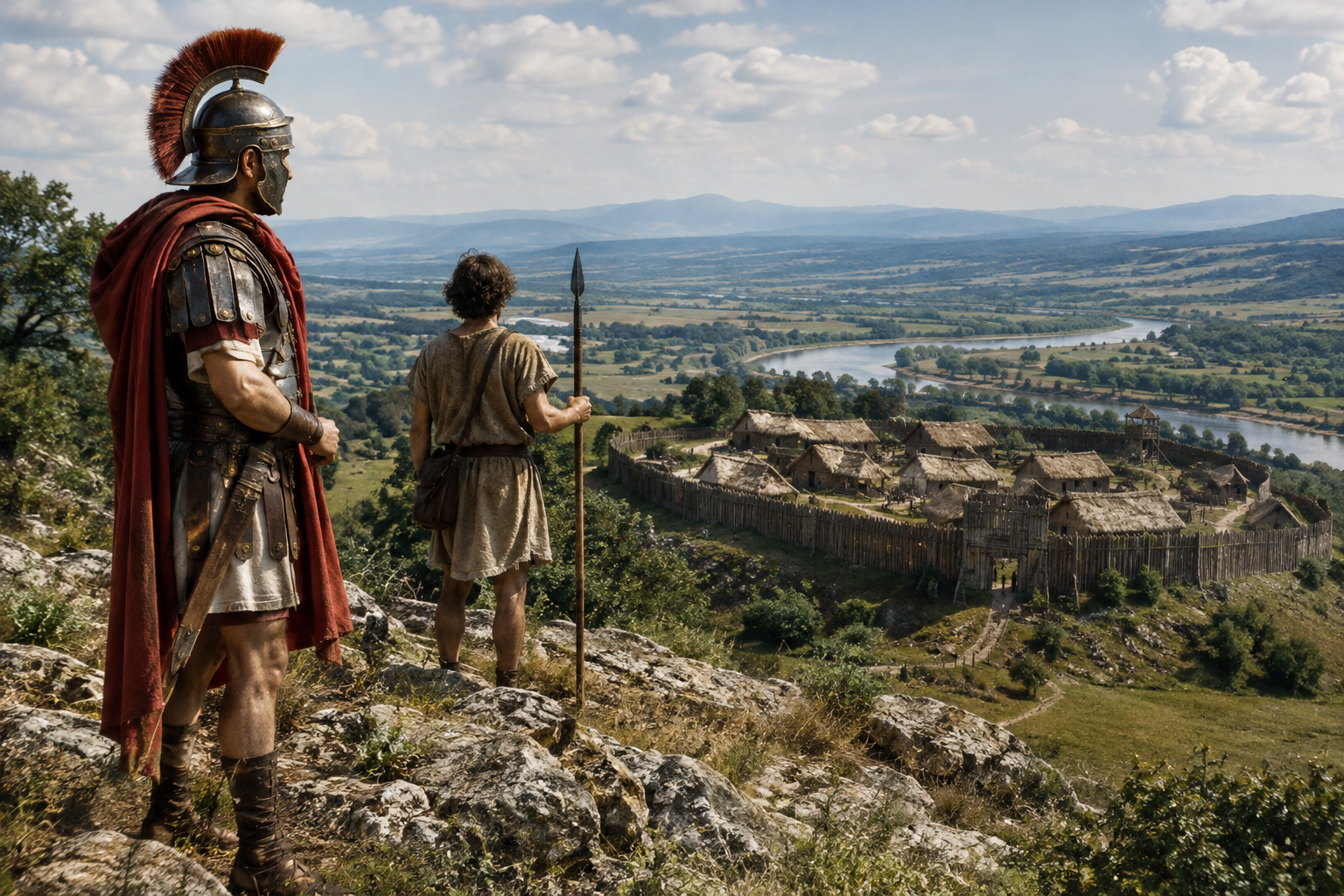
By the time we reach I15489 at Viminacium, dated to around AD 200, the world has changed beyond recognition. Viminacium was one of the great urban and military centres of the Roman Balkans, near the confluence of major roads and the Danube frontier system. Cemeteries there capture the biological reality of empire better than imperial slogans ever could: Rome brought together people of different local backgrounds, and sometimes from very far away, into the same civic and mortuary landscapes.
The presence of G2a2a1a2a2a1 in this setting is a useful corrective to any idea that Roman-era Balkan populations can be reduced to a single ancestry stream. A man bearing a lineage with deep roots in Europe's early farming world appears in a late Roman imperial context where identities would have been political, local, military, and familial all at once. That is exactly the sort of continuity ancient DNA is good at uncovering: not a frozen people, but an old paternal branch surviving into a very different historical order.
An ancient DNA study of Viminacium and the central Balkans has drawn wider attention to the complexity of these Roman frontier populations. The larger lesson is not that one haplogroup explains the site, but that the Danube provinces held a striking mixture of long-established regional ancestry and new arrivals moving through imperial networks.
Set side by side, I29877 and I15489 do not tell a tale of straight-line ethnic continuity. That would be far too crude. What they do suggest is that this paternal branch had a place in the long human history of the middle Danube and its neighbouring regions, surviving the immense changes that separate a Neolithic farming settlement from a Roman frontier necropolis.
And those changes were immense. Between 5000 BC and AD 200 came the Copper Age, Bronze Age, Iron Age, the rise of complex regional societies, expanding trade, the incorporation of the Balkans into Roman rule, and the constant movement of men through armies and households. A Y-lineage that appears at both ends of that span is not proof of an unbroken local dynasty. It is evidence that some paternal threads in European history are astonishingly durable.
This is also why the Carpathian Basin and Balkans matter so much in archaeogenetics. They are not merely corridors between elsewhere and elsewhere. They are regions where populations repeatedly formed, mixed, persisted, and re-formed over thousands of years. A lineage like G2a2a1a2a2a1 is interesting precisely because it appears in those deeply stratified landscapes.
There is a temptation, whenever a haplogroup appears in a Roman context, to reach instantly for soldiers, colonists, or migrants from some named homeland. Sometimes that is justified; often it is not. In the case of I15489, the safest and most historically interesting point is that Viminacium sat in a zone where local Balkan ancestry, Danubian mobility, and wider imperial connections all overlapped. A paternal line could be both regionally old and fully part of Roman society.
The earlier Hungarian sample sharpens that picture. If I29877 represents the branch in one of the classic early-farming zones of central Europe, and I15489 represents it again in the Roman Balkans, then the branch fits neatly into a broader story already familiar from many ancient DNA studies: the deep imprint of early farmer ancestry in southeastern and central Europe, followed by millennia of cultural change layered on top of it.
Deep Balkan Population History
The most distinctive thing about G2a2a1a2a2a1 in this evidence is not royal glamour or a single famous ancestor. It is longevity. This branch appears in a Neolithic farming context in Baranya around 5000 BC and again in the Roman world at Viminacium around AD 200. For someone researching this paternal line today, that is a sober but exciting clue: one part of your direct male ancestry may connect to the very old population history of the Carpathian Basin and Balkans, where early farmers and later imperial communities both left their mark.
Comments