Haplogroup E1b1b1b2b3a

– 5 min read


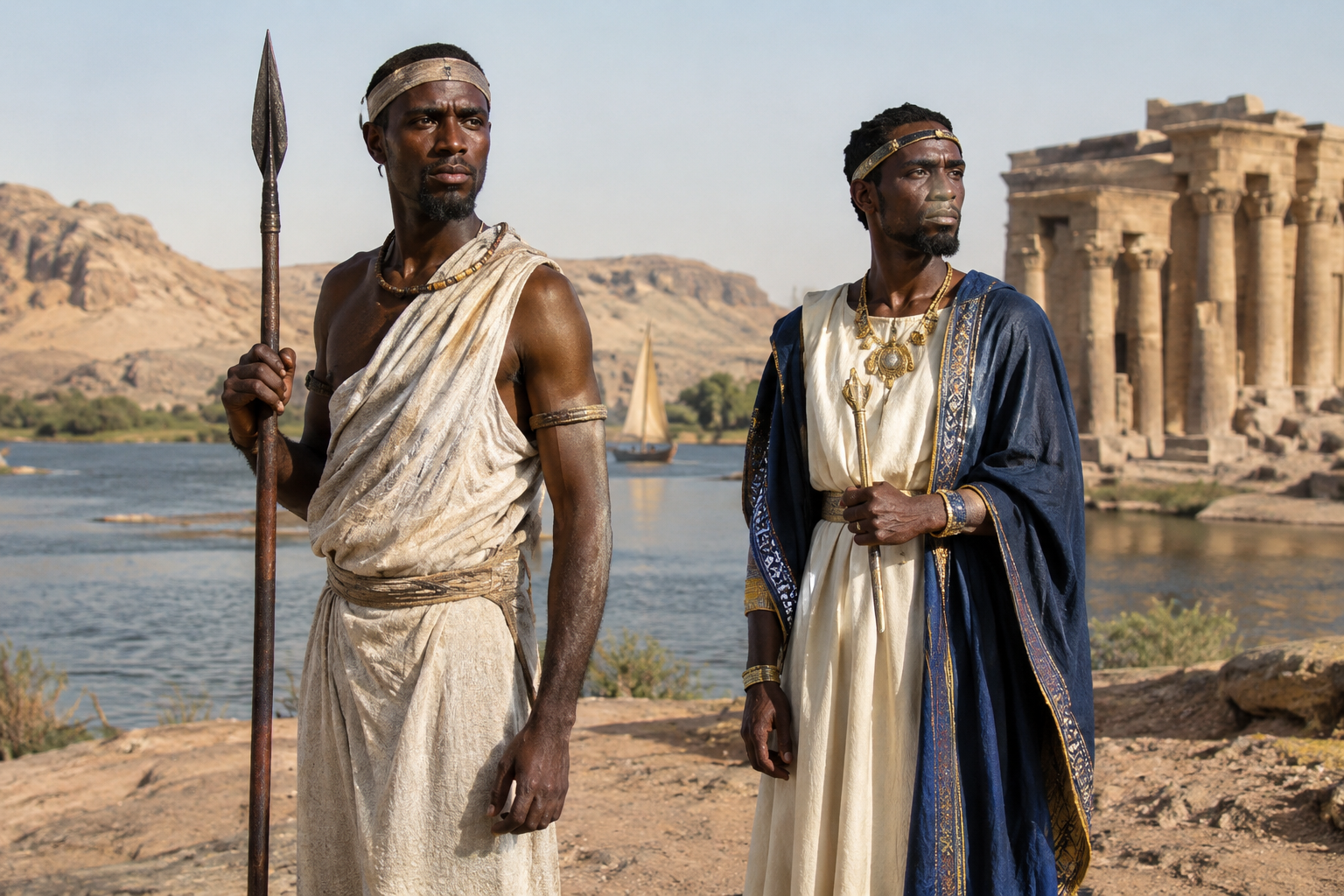
At Kulubnarti in medieval Nubia, on an island in the Nile between the Second and Third Cataracts, ancient DNA has begun to put names of lineages back into a landscape long known from cemeteries, churches, and hard evidence of life on a political frontier. Two male individuals from this community, one from the Early Makurian period around AD 750 and identified as I6138, and another from the Late Makurian period around AD 1210, identified as I6331, have been associated with the Y-DNA haplogroup E1b1b1b2b3a.
That is already interesting, because it gives this paternal line a clear archaeological footing in Christian Nubia across several centuries. Y-DNA traces one direct male line only, not a person's whole ancestry, but when the same branch appears at the same site in different periods, it invites a properly historical question: what sort of continuity, mobility, and family persistence lay behind it?
Kulubnarti is not just a dot on a map. It belonged to the kingdom of Makuria, one of the great Christian polities of medieval northeast Africa, and its cemeteries have become central to discussions of health, inequality, and local population history in Nubia. The site sits in a stretch of the Nile that was both connected and constrained: river traffic tied communities together, while cataracts and desert margins gave the region its own distinctive geography.
In that setting, the presence of E1b1b1b2b3a in both I6138 and I6331 matters because it is not a one-off appearance. These two men were separated by roughly four and a half centuries, yet the paternal branch linked to them remained in the same broader local community. That does not prove an unbroken father-to-son genealogy between the two, but it does suggest that this lineage was part of the durable male population of medieval Kulubnarti rather than a fleeting arrival.
An ancient DNA study examining the people of this region helped make Kulubnarti newly visible as a genetic as well as archaeological community, even where many sample-by-sample details remain cautious or incomplete in public summaries. The relevant research can be found here: https://www.biorxiv.org/content/10.1101/2021.02.17.431423v1.
Kulubnarti and Life on the Edge
The first thing to say, and it is worth saying clearly, is that E1b1b1b2b3a is a very specific label inside the larger E1b1b1 family. The broader E1b1b1 macro-branch has a deep and important history across Africa, the Nile Valley, the Horn of Africa, North Africa, and parts of the Mediterranean and Near East. But one cannot simply pour the whole history of that parent lineage into this narrower subclade and call the job done.
What we can say, on the evidence here, is narrower and more useful. This branch appears in two men from medieval Nubia, one in the eighth century and one in the early thirteenth. That makes E1b1b1b2b3a part of the documented paternal landscape of Makurian-period Kulubnarti.
And that, in turn, is a reminder that medieval Nubia was not an isolated historical backwater. It was a literate Christian kingdom with long political memory, regional diplomacy, and sustained contacts up and down the Nile. A Y-line found there belongs in that real historical setting: not abstractly "African" or "Mediterranean" in some vague sense, but specifically Nubian, medieval, and tied to a community living under Makurian rule.
I6138 comes from Early Makurian Nubia, around AD 750. That places him in a period when Makuria was already an established Christian kingdom and part of the complicated post-Roman, post-Meroitic world of the middle Nile. By contrast, I6331 belongs to Late Makurian Nubia around AD 1210, by which time the kingdom was facing new pressures and a changing regional balance of power.
There is something rather bracingly concrete about that contrast. These are not anonymous "medieval Africans" floating in a timeless past. One lived in the earlier centuries of Makurian stability; the other in a later phase, when the political world of Nubia was shifting. Yet the same paternal branch is reported in both.
That makes the pair more informative together than separately. I6138 shows the branch in an earlier Makurian context; I6331 shows it still present centuries later. Even with only two individuals, the pattern hints at local continuity in male lines at Kulubnarti, and that is exactly the kind of thing ancient DNA is good at illuminating when used carefully alongside archaeology.
Kulubnarti has attracted attention not because it was the capital of an empire or the burial place of kings, but because ordinary communities often tell the sharper historical truth. A site like this lets us ask who stayed, who married in, who moved, and how far social structures persisted over time. The appearance of E1b1b1b2b3a in both early and late phases fits neatly into those larger questions.
It would be quite wrong to turn two men into an entire kingdom. But it would be equally wrong to shrug and say they mean nothing. Ancient DNA from long-used cemeteries can reveal whether paternal lines blink in and out, or whether some remain embedded for centuries. Here, the evidence points toward endurance.
That endurance matters in Nubia because the region sat at a crossroads of African, Nile Valley, and eastern Mediterranean connections. Medieval communities there were shaped by trade, religion, political alliance, and local inheritance. A surviving paternal branch across centuries may reflect exactly that combination of rootedness and contact: people staying put in one sense, while living in a world that was anything but static.
There is another reason this haplogroup is worth pausing over. Medieval Nubia is too often squeezed out of popular history between pharaonic Egypt and the Islamic polities that later dominated the region, as if nothing of consequence happened in between. But Kulubnarti belongs to a fully historical society with churches, written culture, and local communities whose dead can now be studied both osteologically and genetically.
The E1b1b1b2b3a connection helps anchor that point in a personal way. These men were part of the lived history of Christian Nubia, not peripheral to it. Their lineage was one thread in a larger population, and their value lies precisely in that ordinariness: they help show what continuity looked like on the ground.
For readers interested in broader North African context, there is useful background in MyTrueAncestry's post on the evolutionary tapestry of North Africa, though Kulubnarti's medieval Nubian setting remains its own historical case rather than a simple extension of any neighboring region.
For someone who carries E1b1b1b2b3a today, the most responsible takeaway is not a fantasy pedigree but a documented foothold. This branch is attested at Kulubnarti in medieval Makurian Nubia in at least two men, I6138 and I6331, separated by centuries. That places the lineage securely inside the historical population of the middle Nile and suggests a paternal line with real staying power in that region.
It is a small window, but a valuable one. Some haplogroups appear in ancient DNA as isolated flashes; this one, at least here, appears as continuity in a Nubian community that endured across major historical change.


Comments