Haplogroup E1b1b1b2b2

– 5 min read


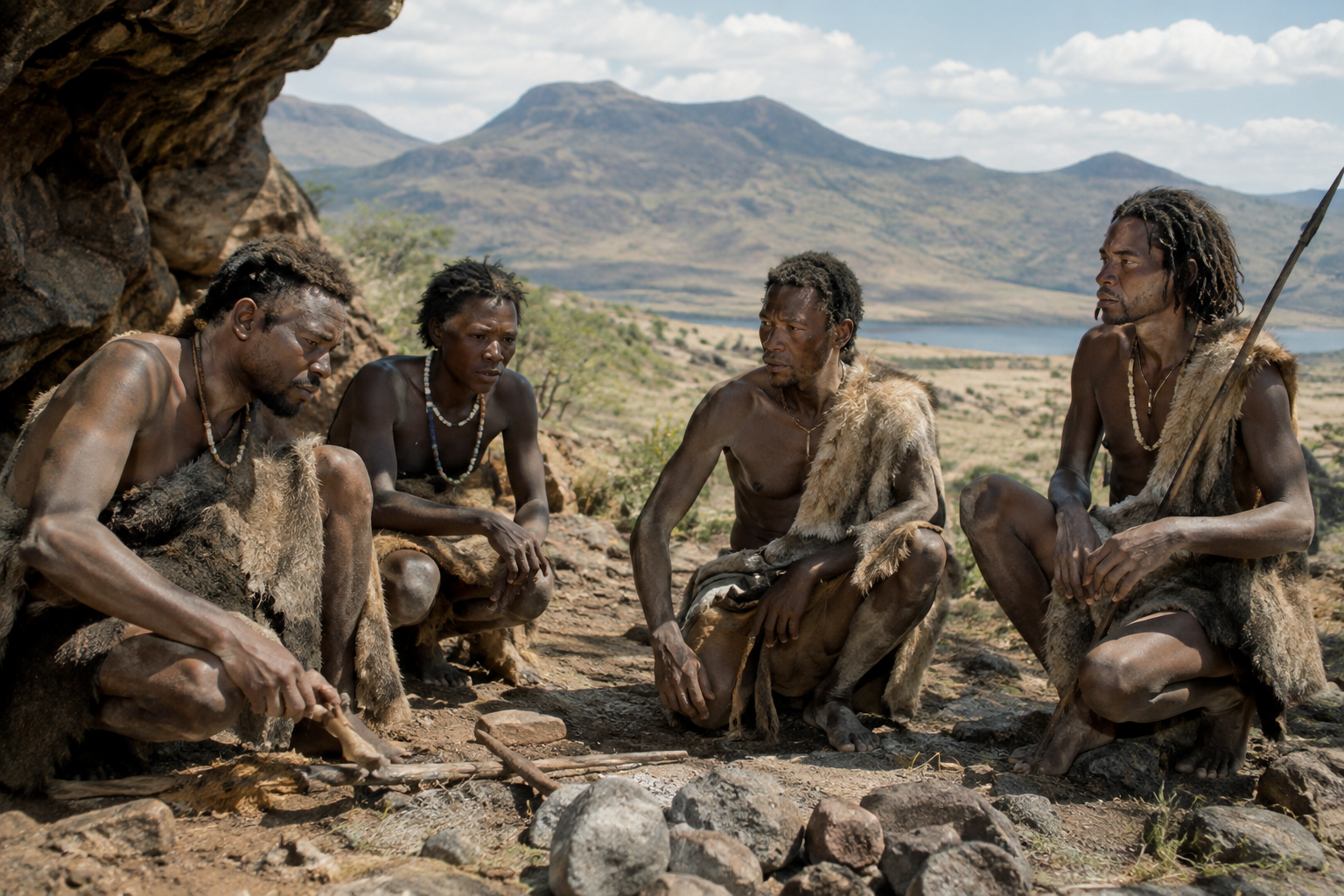
At Rigo Cave in Kenya, one ancient male known as I8923 has become a small but important signpost for tracing the paternal history of eastern Africa. Dated to around 400 BC and described here as PN Cushitic, he sits at an intriguing crossroads: pastoralism, regional mobility, and the long entanglement of foragers and herders in the Horn and eastern Rift worlds. In MyTrueAncestry terms, he is associated with the Y-DNA haplogroup E1b1b1b2b2.
That matters because Y-DNA follows one direct paternal line only, not a person's whole ancestry. Even so, when the same branch appears across several ancient men from eastern and southern Africa, it gives us something archaeology rarely provides on its own: a thread of male-line continuity linking very different landscapes, from cave contexts near Lake Eyasi to later individuals in Botswana.
The Rigo Cave individual is the oldest of the four samples listed here, and therefore the natural place to begin. The label PN Cushitic places him in a pastoral Neolithic setting rather than a hunter-gatherer one. That distinction is crucial. In eastern Africa, the spread of herding did not simply replace older ways of life; it created new mixtures of ancestry, language, subsistence, and social practice.
So when a man from this world is linked with E1b1b1b2b2, we are not looking at a neat ethnic badge. We are looking at one paternal branch present among communities involved in the pastoral transformations of eastern Africa. A broader ancient DNA literature on the region has shown just how important those transformations were for population history, including the movement and mixture of northeastern African-related pastoral ancestry into parts of Kenya and Tanzania; one influential study framing that wider background is this ancient DNA research on eastern Africa.
What Archaeogenetics Actually Does
The next striking case is I13972, from Gishimangeda Cave in the Karatu District of Tanzania's Eyasi Basin, dated here to about 306 AD and described as a Hunter-Gatherer. On the face of it, this looks very different from Rigo Cave. The cultural label is different, the date is later, and the setting belongs to a region famous for long-lasting forager traditions.
And yet the same haplogroup association appears again. That repetition is precisely what makes the evidence interesting. It suggests that E1b1b1b2b2 cannot be reduced to one economy or one social identity. In this case, the paternal line turns up in a man identified within a hunter-gatherer context centuries after the earliest listed pastoral example.
The Eyasi Basin has become increasingly important in African archaeogenetics because it shows how deeply layered eastern African history really is. Research on ancient populations from this broader zone has highlighted that forager ancestry did not vanish when food production spread. Instead, communities persisted, interacted, and sometimes absorbed outside influences while maintaining distinctive lifeways. A major study touching that wider Tanzanian and regional picture is this Nature paper on ancient African genomes.
A second Tanzanian sample, I13977, is listed as Neolithic Tanzania Cushitic and dated here to around 70 AD. That wording immediately raises a useful historical caution. Terms such as "Neolithic" and "Cushitic" are helpful shorthand, but they are not the same thing as a complete identity. Archaeological period, language family, ancestry profile, and paternal haplogroup do not always line up neatly.
Still, I13977 strengthens the regional pattern. Now we have more than one eastern African case associated with E1b1b1b2b2 in settings linked to Cushitic-speaking or Cushitic-related pastoral populations, alongside the Gishimangeda Cave hunter-gatherer case. That is exactly the sort of pattern that archaeologists like: not a grand claim, but a repeated signal appearing in more than one context.
For anyone researching this haplogroup today, the Tanzanian evidence is especially valuable because it shows coexistence rather than a single-track migration story. The branch appears in communities described differently by archaeologists, which hints at a paternal lineage moving through social boundaries rather than belonging to one simple "people."
The geographical range broadens further with XAR002 from Xaro, Botswana, dated here to about 850 AD. This is a very different setting from the pastoral Neolithic caves and shelters of eastern Africa. By the early medieval centuries, southern Africa was a world of complex regional interactions involving foragers, pastoralists, and farming communities, with mobility across riverine and semi-arid landscapes.
XAR002 matters because it shows that the paternal line associated here with E1b1b1b2b2 is not confined to the eastern African Rift. Its presence in Botswana does not by itself prove a direct migration from any one earlier Kenyan or Tanzanian individual; ancient DNA simply does not work like that. But it does show that this branch, or a closely related paternal signal within the broader E1b1b1 framework, had a wider African distribution than a narrowly local story would suggest.
That wider spread fits a broader lesson from African archaeology: boundaries between regions were real, but they were porous. Livestock, technologies, marriage networks, and people moved in stages and in multiple directions. A paternal lineage appearing in both eastern and southern African ancient remains is therefore noteworthy precisely because it points to connected histories without pretending that all those histories were the same.
Africa, Settlement, and Environment
The most responsible way to read this evidence is at two levels at once. First, the narrow level: E1b1b1b2b2 is the article's focal branch, and these listed ancient males are associated with it in eastern and southern Africa between roughly 400 BC and AD 850. Second, the broader level: because ancient Y-DNA resolution can vary, some historical interpretation may rest on a wider parent branch rather than on every tiny downstream split being equally certain in every case.
That is not a weakness so much as the normal state of archaeogenetics. Ancient DNA often gives us a branch, a place, a date, and a context, then asks us to think carefully. Here the careful conclusion is that this paternal line belonged to African men living in markedly different settings: pastoral contexts linked with Cushitic-associated populations, a hunter-gatherer context in Tanzania, and a later southern African individual in Botswana.
Put differently, this is not the story of one vanished tribe marching from A to B. It is the story of a male line present within a web of African histories that included herding, foraging, mobility, and long regional interaction.
If your paternal line falls within E1b1b1b2b2, these ancient finds suggest a lineage with demonstrable roots in Africa's eastern and southern past, visible in both pastoral and forager-associated settings. The most distinctive insight is not a single origin tale, but a pattern of continuity across different communities and centuries. That is often how real history looks: less like a straight line, more like an old landscape where tracks cross, separate, and meet again.




Comments