Haplogroup E1b1b1b2a1a1a1a1f1a

– 5 min read


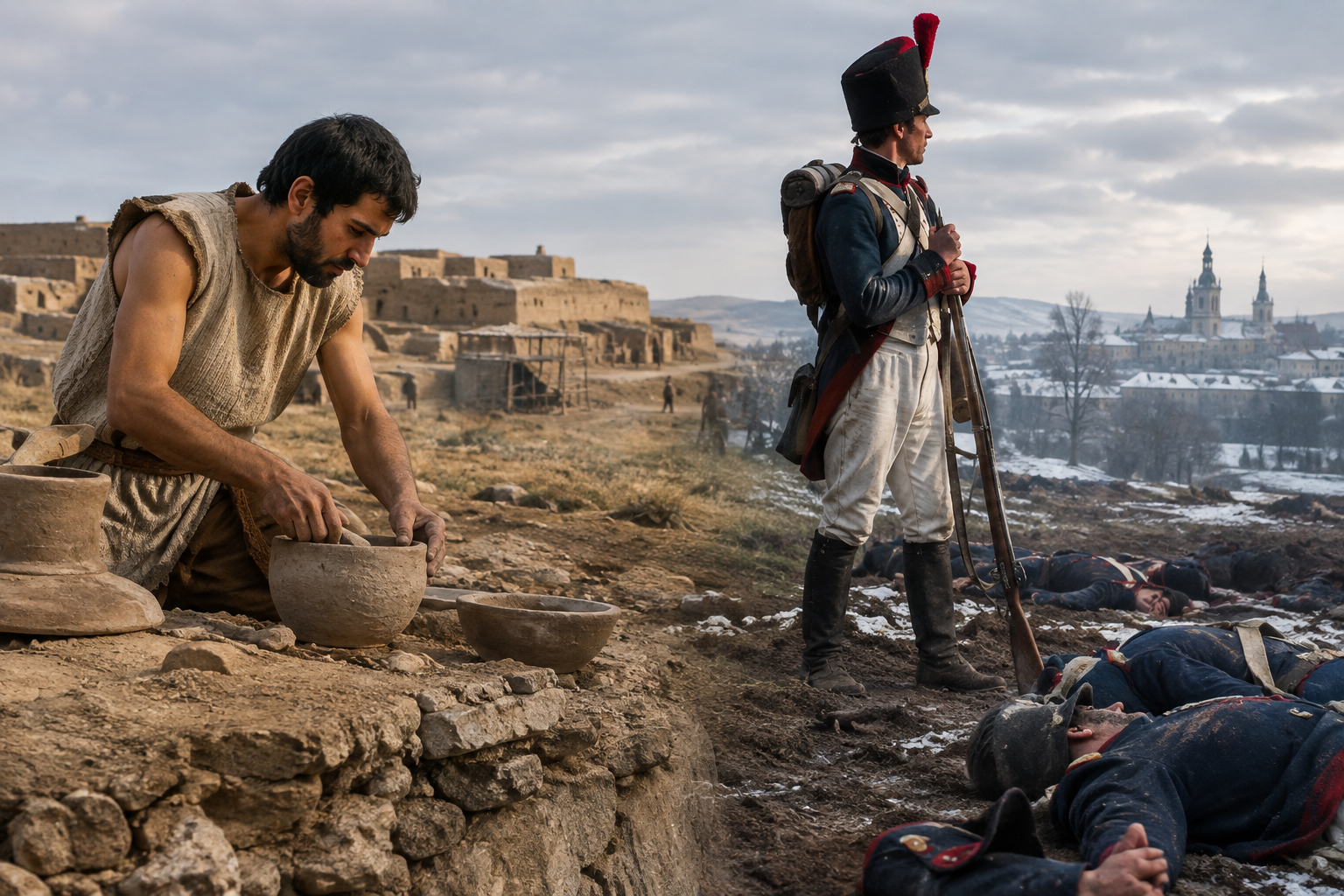
At Arslantepe in eastern Anatolia, one excavated individual dated to around 3262 BC, sample ART015, offers a useful anchor for thinking about the Y-DNA haplogroup E1b1b1b2a1a1a1a1f1a. Arslantepe is no minor village in prehistory. It is one of those places archaeologists return to again and again because it sits right on the fault line between farming village, regional center, and the first experiments in large-scale political power.
That matters because a Y-chromosome line is not a whole people, still less a whole civilization. It traces one direct paternal line only. But when a branch associated here with E1b1b1b2a1a1a1a1f1a turns up in a place like Arslantepe, and then much later in a very different context in the remains of a soldier from Napoleon's retreat, it gives us something better than a slogan about origins. It gives us a long, interrupted archaeological record of male-line continuity and movement across very different historical worlds.
Arslantepe, near modern Malatya, is famous for its long occupation sequence and for the way it illuminates the emergence of hierarchy in late prehistoric Anatolia. By the late 4th millennium BC, the site was already part of a broader world of administrative innovation, expanding exchange, and increasingly formal power. An ancient DNA study of populations from the region, published in Cell, helped place sites like this into a wider genetic history stretching across Anatolia and its neighbors.
Within that setting, ART015 matters not because he can stand for all of Arslantepe, but because he puts this paternal line into a deep Anatolian context. If the assignment is being associated at the fine-grained level of E1b1b1b2a1a1a1a1f1a, that should still be handled carefully: the broader parent haplogroup E1b1b has a much wider history than any one terminal branch. What the Arslantepe individual gives us securely is evidence that a paternal line linked to this article's branch was present in an important Neolithic-to-Chalcolithic and early Bronze Age transition zone.
That is especially interesting in Anatolia, because this region was not a sealed container. It was a crossroads between the Aegean, the Caucasus, northern Mesopotamia, and the Levant. Male lines there could persist locally, spread with farming communities, or be folded into new political systems as settlements grew in scale and ambition.
The difficulty with a lineage as specific as E1b1b1b2a1a1a1a1f1a is that the more detailed the label becomes, the more we need sample-level caution. Archaeologists and geneticists can often say far more confidently that a person belonged to a wider paternal family than that he belonged to one extremely narrow twig of it. So the historically useful point is not to imagine a neat tribe or a single migration arrow attached to this exact string of letters.
Instead, the better question is where the branch appears in securely dated human remains. In this case, one of those appearances is in late prehistoric Anatolia, in a settlement world tied to early administration, regional exchange, and social differentiation. That does not make the branch "Anatolian" in any exclusive sense. But it does place it in one of the major theaters where the human landscape of western Eurasia was being remade after the spread of farming.
This is where archaeology saves us from lazy storytelling. A haplogroup is not a culture. Arslantepe's inhabitants were defined by buildings, economies, tools, burial practices, and political change, not by a Y-chromosome label alone. Yet the Y line does add one more thread to the picture: a direct paternal ancestry line embedded in a site central to the making of early complex societies.
The second supplied individual could hardly come from a more different world. Sample YYY090A comes from the mass grave of a soldier of Napoleon's Grande Armee, dated to 1812 AD, from the Vilnius context connected with the catastrophic retreat from Russia. Here the haplogroup associated with E1b1b1b2a1a1a1a1f1a appears not in a prehistoric mound settlement, but in one of the best-known military disasters in European history.
This is the sort of contrast that makes ancient DNA so compelling when handled properly. The same direct paternal line, or a line reported in association with the same narrow branch, can show up in utterly different social settings: one man living in the world of prehistoric Anatolian centers, another dying amid the collapse of an imperial campaign more than five millennia later.
A recent preprint on the Vilnius mass grave and related material is linked here through this research publication. Without overclaiming specific details beyond the sample information at hand, the wider historical point is clear enough. Napoleonic armies were composite forces, drawing in men from many regions and backgrounds, so the presence of a paternal line like this one in such a burial context is a reminder that early modern and modern European armies were often genetic meeting grounds as much as military institutions.
The Vilnius graves have attracted attention because they preserve the human wreckage of retreat: men far from home, thrown together by war, logistics, weather, and epidemic disease. For Y-DNA research, such contexts are useful not because they define a stable local population, but because they show how widely male lines could circulate by the early 19th century. A paternal lineage that may once be visible in prehistoric Anatolia had, by this point, long since entered the complex web of European and Mediterranean history.
It is also worth remembering that military dead are often poor representatives of the civilian population around them. A soldier buried near Vilnius need not have been local to Lithuania, Belarus, Poland, France, or anywhere else nearby. He belonged first to an army on campaign. That makes the sample historically vivid, but also a warning against simplistic maps of "where a haplogroup belongs."
In other words, YYY090A is valuable not as a national symbol, but as evidence of mobility. By the Napoleonic age, male lines had been mixed, transplanted, and redistributed through conquest, trade, marriage, urban growth, and military service for thousands of years.
Although the sample set here is small, the wider parent haplogroup E1b1b is well known in discussions of the Mediterranean, the Balkans, and parts of Southwest Asia and North Africa. That does not mean every sub-branch has the same distribution or history. Still, the combination of an early Anatolian case and a much later European military burial fits a broader historical truth: paternal lines linked to the E1b1b family have long been part of the human story in the lands between Anatolia, southeastern Europe, and the Mediterranean basin.
That makes this lineage particularly interesting for members whose deeper paternal matches seem to cluster around those regions. The evidence does not license grand claims about a single ancestral nation or heroic founder. What it does suggest is durability across changing social worlds: farming expansions, early urban experiments, imperial entanglements, and modern warfare.
For this haplogroup, the most striking thing is not a single kingdom, dynasty, or ethnic label, but the span between the known contexts. One associated ancient sample, ART015, places the line in the world of late prehistoric Anatolia at Arslantepe, where complex society was taking shape. Another, YYY090A, places it in the shattered multinational army of 1812. Between those two points lies an enormous amount of unwritten family history.
For someone researching a paternal line today, that is the real value of E1b1b1b2a1a1a1a1f1a. It points toward a branch with a plausible deep history in the wider eastern Mediterranean and adjacent regions, while also showing how thoroughly later history could carry such lineages across Europe. The archaeology does not give you a ready-made identity. It gives you something better: real men, in real places, at very different moments in the human past.
Comments