Haplogroup E1b1b1b2a1a1a1a1e1

– 4 min read


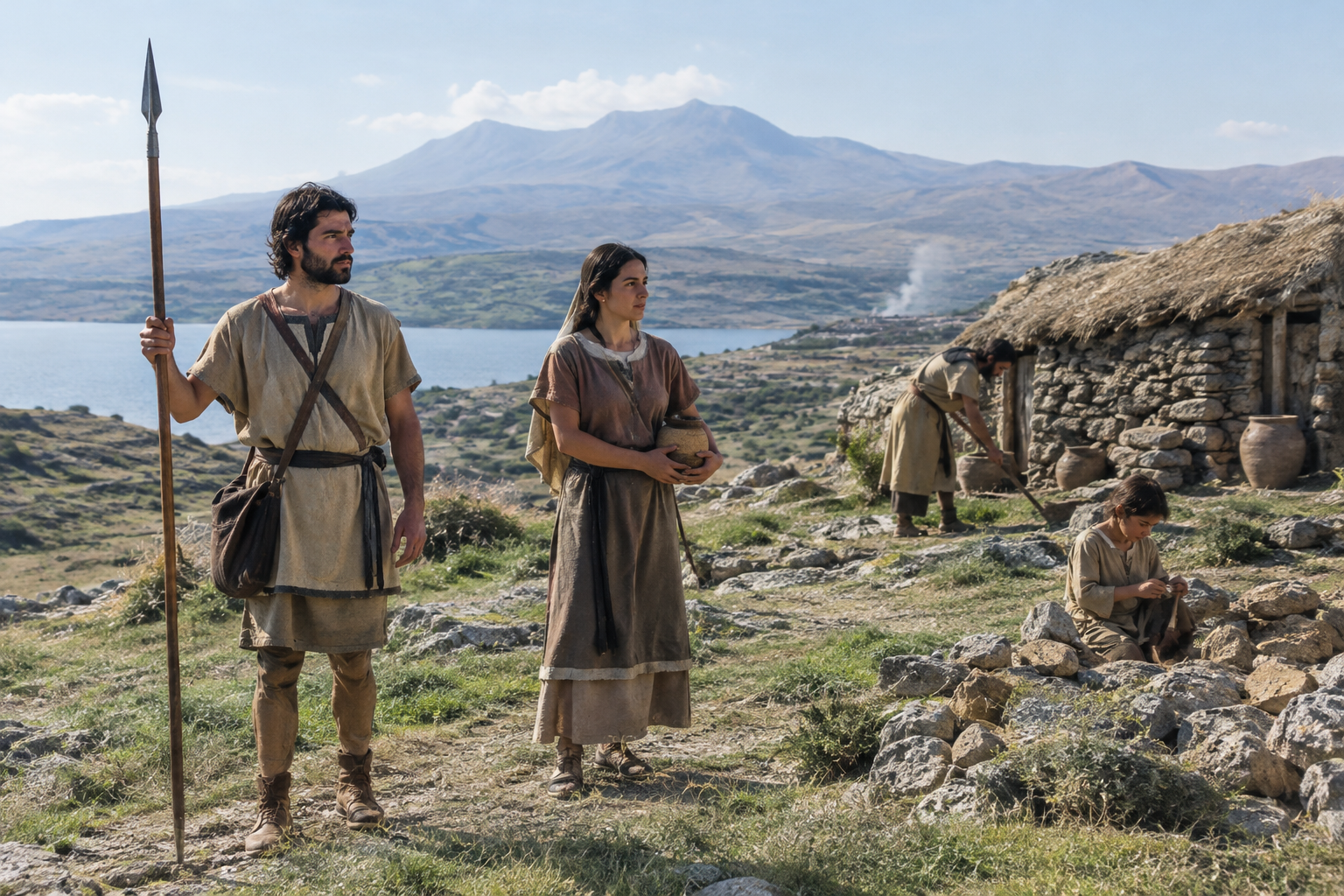
At Nerkin-Getashen in the Gegharkunik region of Armenia, one Late Bronze Age man - sample I15733, dated to about 1370 BC - gives us a rare fixed point for the very specific Y-DNA branch E1b1b1b2a1a1a1a1e1. That is already interesting, because Nerkin-Getashen sits in the South Caucasus at a time when highland societies were part of a busy world of mountain routes, fortified settlements, and shifting political landscapes just before the rise of Urartu.
With a lineage this narrow, one ancient result matters a great deal. It does not tell us everything about the population of Late Bronze Age Armenia, and Y-DNA traces only one direct paternal line rather than a person's whole ancestry. But it does place this paternal branch in a real human setting: a man living in the Armenian highlands in the centuries before the fully historical Urartian kingdom took shape.
The sample is identified as Pre-Urartian Late Bronze Age Armenia Nerkin-Getashen Gegharkunuk. That label matters. "Pre-Urartian" places the individual in the cultural and political landscape that existed before the kingdom of Urartu became the dominant power around Lake Van and across much of the highland zone. In other words, this is evidence from the world out of which later Iron Age states emerged, not from the mature Urartian period itself.
Gegharkunik, around Lake Sevan, was not some isolated upland backwater. It lay in a corridor between the South Caucasus, eastern Anatolia, and the Iranian plateau. A paternal lineage found here may have deep local roots, or it may reflect older movements into the highlands from neighboring regions. What makes I15733 valuable is that he anchors the branch in a place and period where archaeology and ancient DNA are increasingly showing long-term continuity mixed with repeated episodes of contact.
A major ancient DNA study of the wider region, published in Science, helped establish just how informative the South Caucasus can be when genetic evidence is tied closely to excavated human remains. Even where one specific Y-line cannot stand for an entire people, these studies make it possible to place paternal branches like this one into a serious archaeological framework rather than leaving them as abstract strings of letters and numbers.
E1b1b1b2a1a1a1a1e1 is an extremely fine-grained label within the broader E1b1b paternal family. That broader family has a long and complicated history across parts of Africa, the Near East, the Mediterranean, and southeastern Europe. But one of the common mistakes in public genetics is to take the big map of a parent haplogroup and paste it straight onto a tiny downstream branch. We should resist that.
For this article, the strongest statement is the simplest one: this specific branch, or a classification associated with it, appears in a man from Late Bronze Age Armenia. That does not mean the branch originated there, nor that everyone carrying nearby E1b1b lineages shared the same history. It does mean that by the later second millennium BC, this paternal line had reached - or was present within - the social world of the Armenian highlands.
That is useful for family historians. A deep Y-DNA branch often feels frustratingly technical until an ancient sample places it on the ground. Once that happens, the lineage stops being merely a phylogenetic code and becomes part of a documented archaeological landscape.
The Late Bronze Age South Caucasus was full of movement, but not movement in the crude old sense of one neat people replacing another. Archaeology points instead to fortified communities, regional interaction, and changing power structures spread across valleys, uplands, and lake basins. Ancient DNA has been especially valuable here because it shows that continuity and mixture can coexist over very long periods.
That makes Nerkin-Getashen a revealing setting for this haplogroup. A paternal line in such a region may have been maintained locally for generations, while the autosomal ancestry of the wider community changed through marriages, alliances, and mobility. This is exactly why Y-DNA is so compelling and so limited at once: it can preserve one male line across centuries even as the broader genetic profile around it shifts.
Anyone interested in how the neighboring Iranian world fits into these eastern highland connections may also find it useful to compare work on ancient populations farther southeast. The broad lesson is not that Armenia and Iran were the same, but that the highland zones between them were historically interconnected in ways genetics can sometimes detect.
There is a temptation, whenever Armenia appears in deep history, to rush toward famous later labels: Urartian, Armenian, Persian, Roman, Byzantine. But I15733 belongs to an earlier chapter. He lived before the better documented Iron Age states imposed the kinds of written identities historians like to work with. That makes the sample especially valuable, because it helps illuminate populations who are archaeologically visible but textually dim.
In practical terms, this means the lineage should not be forced into a later ethnic box. A man buried in Late Bronze Age Gegharkunik was not automatically "Urartian" in the later state sense, still less a stand-in for any modern nation. The right historical move is subtler: to place him among the communities whose descendants, neighbors, and rivals would later participate in the formation of the highland polities known from the first millennium BC.
This kind of restraint is not dull; it is where the real excitement lies. Ancient DNA is most illuminating when it helps us recover the human background to later history - the populations already living, marrying, farming, trading, and burying their dead before the grand names of the textbooks arrive.
A single ancient Y-DNA result can never tell the whole story of a region. Yet for a narrowly defined haplogroup like E1b1b1b2a1a1a1a1e1, one well-placed individual can be enormously informative. I15733 shows that this paternal line belongs, at least in part, to the prehistoric and protohistoric story of the South Caucasus, not only to later genealogies or modern distributions.
That matters beyond Armenia. The Caucasus has often acted as both refuge and crossroads - a place where lineages can persist, branch, and reappear in unexpected historical settings. Readers interested in wider Black Sea and steppe connections may want to explore how ancient mobility around nearby regions complicates any simple picture of fixed ancestral homelands.
If your paternal line falls under E1b1b1b2a1a1a1a1e1, the most solid ancient clue currently highlighted here is a man from Nerkin-Getashen in Late Bronze Age Armenia. That does not make every modern carrier "Armenian" in any simple sense. But it does suggest that this branch was present in the South Caucasus before the rise of Urartu, inside a highland world shaped by continuity, contact, and long regional memory.

Comments