Haplogroup E1b1b1b1

– 5 min read


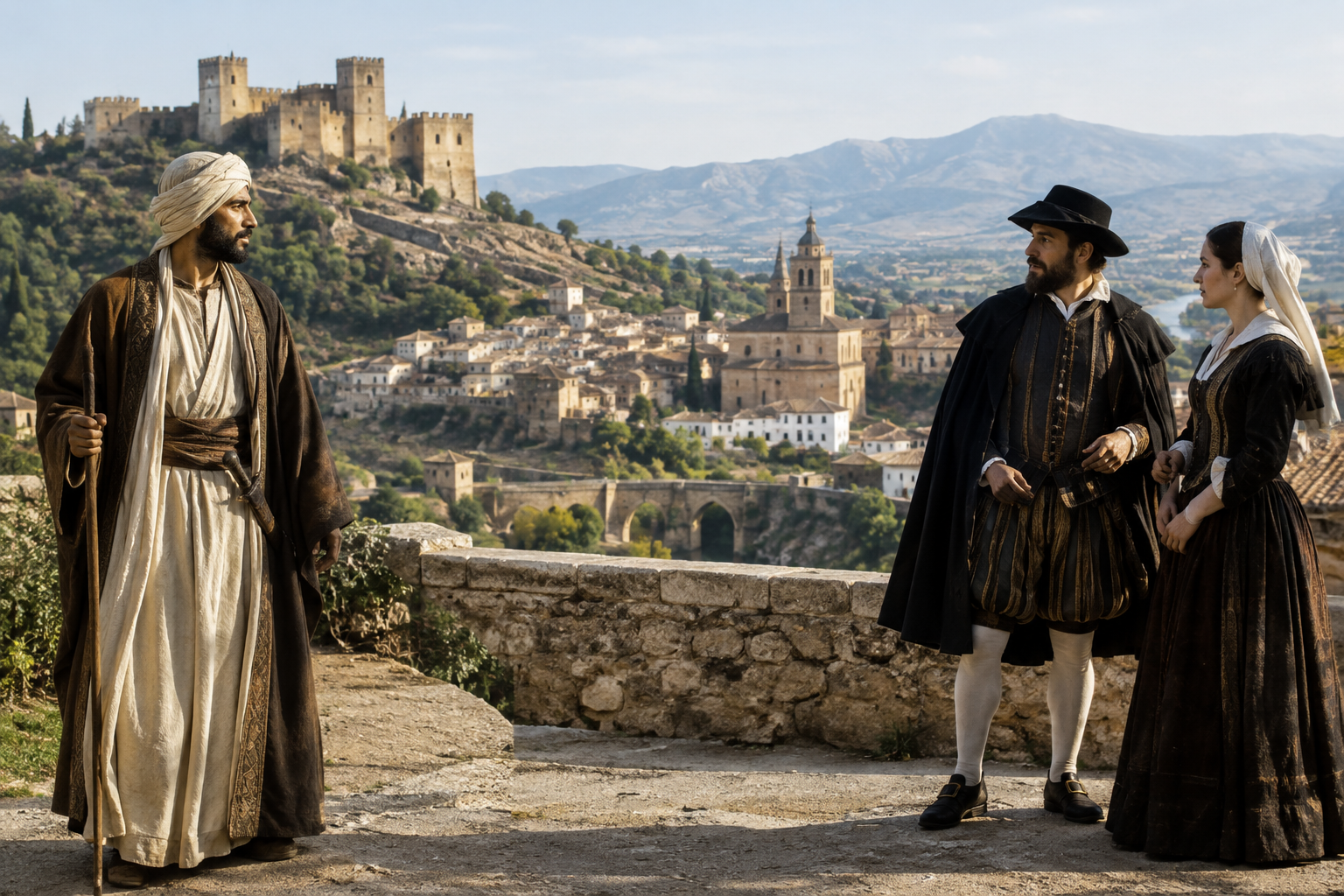
In about AD 1150, one man buried at Segorbe in the Valencian Community carried a paternal line assigned here to E1b1b1b1. He appears in the record simply as sample MS060, but the setting matters far beyond one identifier. Segorbe stood in a part of eastern Iberia shaped by Islamic rule, frontier exchange, and the constant movement of people across the western Mediterranean. A Y-chromosome result from that world is a reminder that medieval Spain was not a sealed kingdom of fixed types, but a busy human crossroads.
That is a useful place to start for this haplogroup. Y-DNA follows one direct paternal line only, not a person's whole ancestry, language, religion, or identity. Even so, when a branch such as E1b1b1b1 appears in medieval Iberian contexts, it opens a very specific historical question: how did paternal lines with deeper roots outside much of Atlantic Europe become part of the lived population history of Islamic and post-Islamic Spain?
E1b1b1b1 is a branch within the broader E1b1b1 Y-chromosome family, a major paternal lineage with an important history in North Africa, the Mediterranean, and parts of the Near East and southern Europe. For Iberian history, that wider background matters, but it must be handled carefully. A man assigned to E1b1b1b1 in medieval Spain is not automatically a recent migrant from any single region, nor does the haplogroup by itself tell us whether his family spoke Arabic, Romance, Berber, or something else.
What it does suggest is a paternal history connected to the long human networks of the Mediterranean basin. Those networks existed well before the Middle Ages, and they intensified in Iberia under Roman rule, late antique mobility, and then the political and demographic changes that followed the Islamic conquest of the peninsula.
MS060 is especially interesting because Segorbe sat in a region where political control and population composition were both dynamic. Around the 12th century, eastern Iberia was tied into the world of al-Andalus, yet also exposed to pressure from expanding Christian polities to the north. Towns and rural communities in this zone were shaped by older Iberian continuity, Islamic-era settlement, trade, slavery, conversion, intermarriage, and local persistence.
So a paternal lineage such as E1b1b1b1 in this context is historically plausible in several overlapping ways. It could reflect lineages already present in Iberia from earlier Mediterranean contacts, lineages strengthened during the Islamic centuries through movement from North Africa, or lineages maintained locally across generations in communities that later changed language, religion, or legal status. The point is not to force one route, but to see MS060 as evidence that medieval Valencia belonged to a genuinely connected world.
A major ancient DNA study of the Iberian Peninsula and nearby regions, published research on population change in Iberia, has helped frame exactly this broader picture: long-term continuity mixed with repeated episodes of incoming ancestry from different directions. That does not, by itself, prove the biography of MS060. It does, however, make clear that paternal diversity in medieval Iberia was part of a documented historical pattern rather than an anomaly.
The second sample is from a very different political moment. I3807, dated to about AD 1550, comes from post-Reconquista Granada. By then, the Nasrid kingdom had fallen, Castilian rule had been established, and the old Islamic society of southern Iberia was undergoing enormous stress, adaptation, and reclassification. Yet a genetic result from this period often shows precisely what historians already suspect from documents: conquest did not wipe the population clean.
Granada in the 16th century still contained descendants of people who had lived through the Islamic centuries, including communities later labelled Moriscos after conversion to Christianity. A Y-line such as E1b1b1b1 in this setting fits that historical depth. It may represent paternal continuity through the transition from Muslim-ruled to Christian-ruled society, showing that political rupture and biological replacement are not the same thing.
That matters because Reconquista narratives are often told as if one population simply replaced another. Ancient DNA keeps spoiling that tidy story. In many regions, the evidence points instead to survival, mixture, and reclassification. A man buried in Granada around 1550 may belong to a Christian polity while still carrying a paternal line with a much older place in the western Islamic Mediterranean.
On their own, MS060 and I3807 are only two men. Together, they form a small but telling sequence across about four centuries of Iberian history. One belongs to Islamic-period eastern Spain; the other to Christian-ruled Granada after the fall of Muslim power. The recurrence of E1b1b1b1 across those settings suggests endurance as much as arrival.
That is an important distinction. When people see a haplogroup associated with North Africa or the Mediterranean, they sometimes imagine a single dramatic migration. Real history is usually less theatrical and more interesting. Iberia saw repeated contacts across the Strait of Gibraltar, movement within al-Andalus, military settlement, urban migration, enslavement, mercantile travel, and the quiet continuity of families who simply stayed put while regimes changed above them.
In that sense, these two men belong to one of the great themes of Spanish history: the mismatch between political labels and human continuity. Dynasties rise, confessions change, borders shift, but paternal lines can persist through all of it.
The western Mediterranean was never divided neatly into European and African biological zones. It was a zone of exchange. Ancient DNA from medieval Iberia increasingly reveals local people with varied ancestry profiles, alongside evidence for newcomers from elsewhere in the Mediterranean and beyond. That broader context makes E1b1b1b1 in Spain historically unsurprising, even if each individual case needs caution.
A landmark ancient DNA study on the Iberian Peninsula, research examining long-term population history in Iberia, helped establish just how layered the peninsula's genetic past really is. For readers following medieval Spanish material, that larger backdrop is helpful: Islamic-period and post-Reconquista burials did not emerge from nowhere, but from populations already shaped by millennia of mobility and mixture.
If your paternal line falls under E1b1b1b1, these Spanish samples offer a grounded historical clue rather than a fantasy pedigree. They show that this lineage was present in Iberia in both the Islamic period and the centuries after Christian conquest, in regions where North African, Mediterranean, and local Iberian histories overlapped closely. That does not identify one ancestor or one ethnicity. It does place your line within a documented human story of endurance across some of the most important cultural transitions in Spanish history.
For that reason, E1b1b1b1 is especially evocative in Iberian archaeology. It is not just a marker of movement into Spain, but of continuity within Spain: a paternal line surviving from one social order into the next, while the names of kingdoms, faiths, and rulers changed around it.






Comments