Haplogroup E1b1b1a1b2c1a

– 4 min read


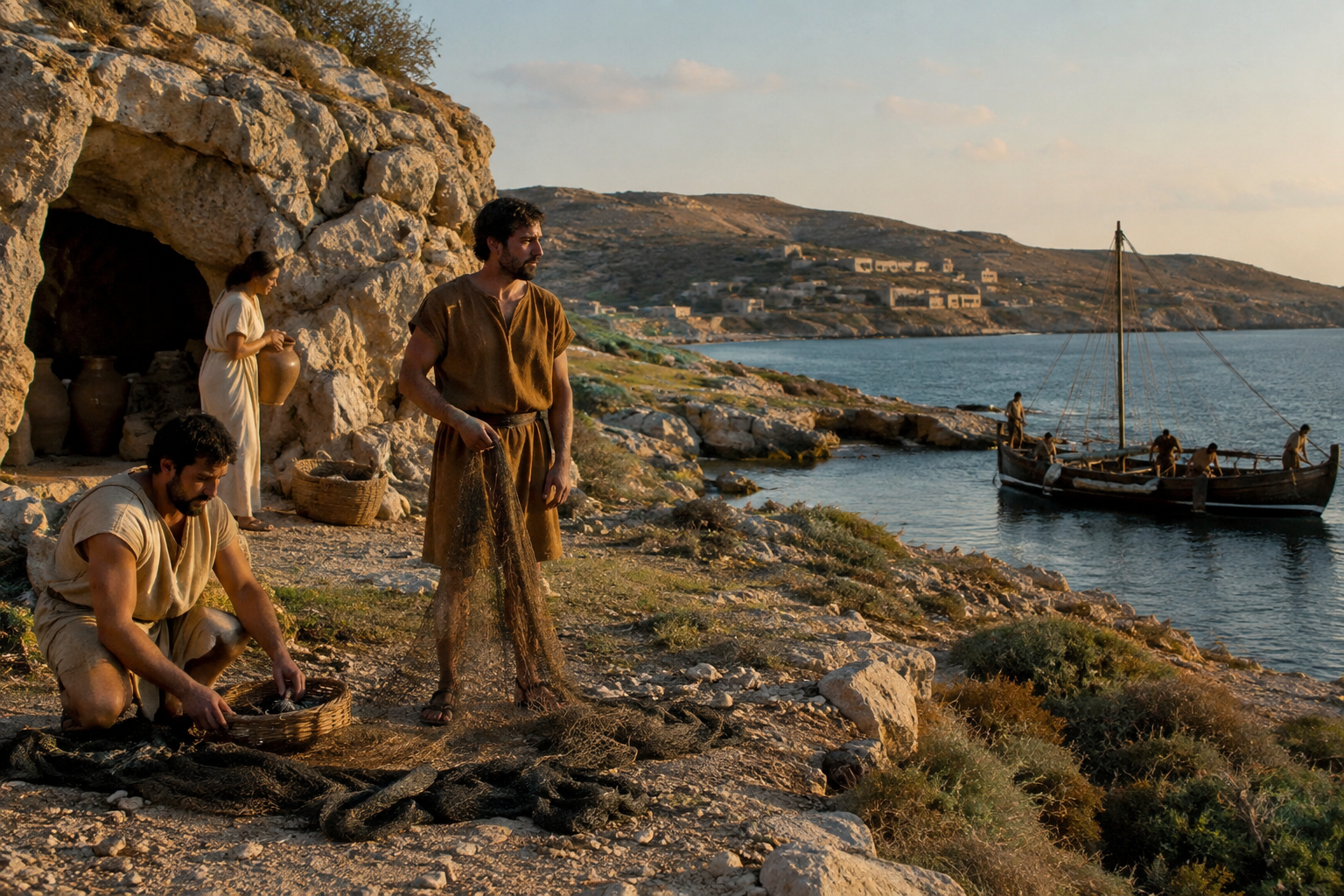
At Villaricos on the southeastern coast of Spain, archaeologists recovered the remains of a man dated to around 604 BC and identified in ancient DNA work as sample I18201. He belonged to the Punic world of Iberia, a world made by Phoenician expansion, coastal trade, and sustained contact between local communities and newcomers from across the western Mediterranean. For anyone interested in the Y-DNA haplogroup E1b1b1a1b2c1a, that is where the story becomes concrete: not in a vague map of migrations, but in one excavated individual from a Punic site in Almeria, at Cuevas del Almanzora-Villaricos.
This matters because Y-DNA follows one direct paternal line only, not a person's whole ancestry. Even so, a paternal lineage tied to a clearly Punic-period burial in Iberia tells us something historically precise. It places this branch, or a lineage reported within its immediate genetic neighborhood, in a colonial and commercial society shaped by movement between North Africa, Iberia, and the broader Phoenician-Punic sphere.
Villaricos is one of those places where archaeology strips away easy national labels. In the first millennium BC, this coast was not simply "Spanish" in any modern sense. It was part of a maritime zone connected to Phoenician and later Punic settlements, with harbors, exchange networks, and communities whose lives were tied to the sea as much as to the inland valleys.
Sample I18201 comes from that setting. The key point is not that one burial can stand for all Punic men in Iberia; it cannot. The real significance is narrower and more useful: E1b1b1a1b2c1a appears here in a securely ancient Mediterranean context associated with Punic Spain, showing that this paternal line had reached, or was present within, a western Phoenician colonial landscape by the 7th to 6th century BC.
An ancient DNA study of Punic and related western Mediterranean populations has helped bring these communities into focus, showing just how mixed and regionally entangled they could be rather than neatly bounded colonies transplanted intact from elsewhere. For the research context behind this broader picture, see this genetic study.
Punic DNA in the western Mediterranean
The label E1b1b1a1b2c1a is very specific, far more specific than the broad parent haplogroup E1b1b. That wider family has a long and complicated history across Africa, the Mediterranean, and parts of western Eurasia. But it would be careless to pour all of that deep background straight into this much narrower branch as though the entire story were already known in detail.
What can be said responsibly is that lineages within E1b1b are well documented in Mediterranean and North African contexts, which makes their appearance in Punic Iberia historically unsurprising. What the Villaricos evidence gives us is not the full origin story of E1b1b1a1b2c1a, but a fixed point: a paternal line reported within this branch in an Iron Age Punic burial on the Iberian coast.
That distinction matters. A narrow subclade is not shorthand for an ethnicity, a language, or a single homeland. A man buried in Punic Spain may have had local Iberian relatives, North African connections, eastern Mediterranean ancestry, or some combination of these. The Y chromosome records only one thread through that much larger social fabric.
It is tempting to imagine Punic communities abroad as neat colonial outposts peopled by a small set of migrants. Archaeology usually points in a messier and more interesting direction. Ports along the Iberian coast were places of intermarriage, recruitment, mobility, and long-term coexistence with local populations. Over generations, paternal lines could persist, spread, or disappear within communities that were culturally Punic but biologically varied.
That is exactly why a sample like I18201 deserves attention. It does not merely add another dot to a haplogroup map. It belongs to a historical formation that connected Carthage, Phoenician traditions, indigenous Iberian societies, and wider Mediterranean commerce. In that setting, the presence of E1b1b1a1b2c1a fits a world where family histories crossed the sea repeatedly.
Readers interested in how later populations of Iberia also carried the marks of long-term mixture may want to compare this with Roman-period evidence, where the peninsula again appears as a meeting place rather than a closed population.
Roman Hispania and later Iberian mixture
The site matters geographically as much as genetically. Almeria faces one of the great corridors of ancient movement: the western Mediterranean sea-lanes linking southern Iberia, the Balearics, North Africa, and beyond. Goods moved along these routes, certainly, but so did sailors, settlers, spouses, mercenaries, craftspeople, and children.
That larger setting helps explain why a paternal lineage associated with E1b1b1a1b2c1a in Punic Spain is historically meaningful. It need not signal a single dramatic migration event. It may instead reflect the ordinary workings of Phoenician and Punic expansion: communities reproduced over generations through trade, colonization, alliance, and local incorporation.
One of the strengths of ancient DNA is that it lets us test these old historical commonplaces. Instead of speaking abstractly about "Mediterranean connectivity," we can point to individual burials and ask what kinds of lineages were actually present in them. I18201 is one such answer, modest but valuable.
With only one named ancient sample here, caution is essential. I18201 is not a royal founder, not a whole tribe, and not proof that every carrier of E1b1b1a1b2c1a descends from Punic settlers. But one well-placed ancient individual can still change the conversation, because he gives this lineage a documented foothold in a particular time and cultural setting.
That is especially useful in Iberia, where ancient DNA has increasingly shown that population history cannot be reduced to a single layer, whether "native," "Phoenician," "Roman," or "Visigothic." Different periods brought different mixtures, and coastal zones were often the first places where those new combinations appeared.
A related case can be seen in work on medieval and early historic Iberian diversity, where burials again reveal that the peninsula's populations were more varied than older textbook categories allowed.
Diverse origins in early medieval Iberia
For a modern tester, the most distinctive lesson of E1b1b1a1b2c1a is not a grand claim about identity, but a historically grounded possibility. This paternal line is now tied, through sample I18201, to the Punic world of Iron Age southeastern Iberia - a world shaped by sea-borne exchange and by deep connections between Iberia and the southern Mediterranean. If your direct paternal line falls here, that does not make you "Punic" in any simple sense, but it does place your Y-chromosome within a lineage that was present in one of antiquity's most cosmopolitan frontier societies.

Comments