Haplogroup E1b1b1a1b1a5a2

– 5 min read


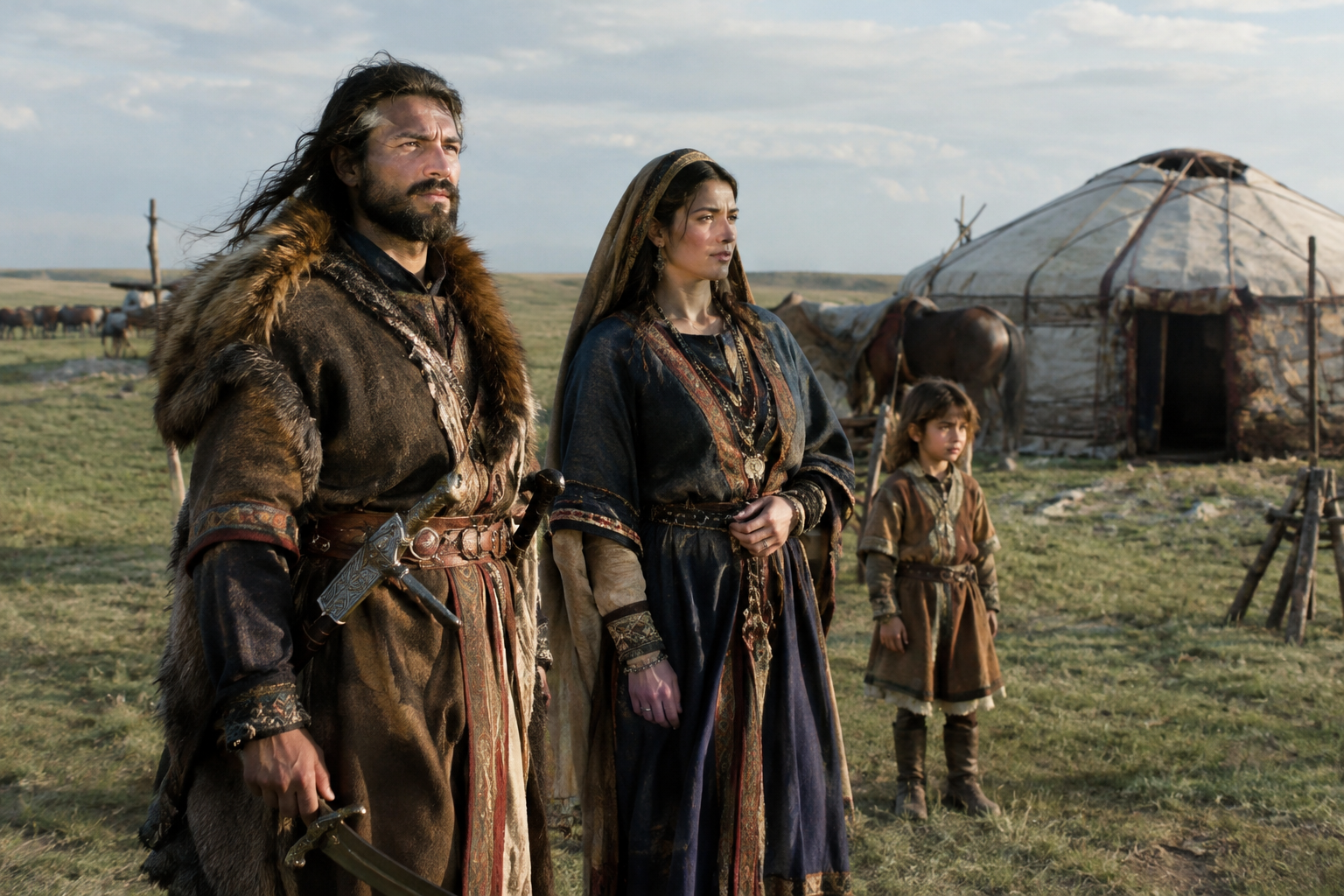
At Kiskunorozsma-Kettoshatar in Hungary, one excavated man from around AD 750 carries an unexpectedly long Y-chromosome label: E1b1b1a1b1a5a2. In the records he appears simply as KK1-252, an Avar-period individual from the Carpathian Basin. That may sound like a tiny clue, and in one sense it is. But tiny clues are often where ancient history becomes most interesting, because a single paternal line can show up in places where older textbook stories once imagined far tidier populations.
KK1-252 matters not because one grave can explain the whole Avar world, but because it points to the sheer diversity of that world. The Avar Khaganate, which dominated much of the Carpathian Basin between the late sixth and early ninth centuries, was never a simple ethnic block. A paternal lineage within the broader E1b1b family appearing in this setting fits a larger archaeological picture in which the early medieval steppe frontier in Europe was populated by people of varied origins, mixed histories, and shifting political loyalties.
The site name Kiskunorozsma-Kettoshatar places KK1-252 on the Great Hungarian Plain, a region that became one of the great meeting grounds of early medieval Europe. By about AD 750, this was Avar territory, though "Avar" in archaeology and history usually describes a political and cultural horizon rather than a single biological population. Cemeteries from this period often reveal a society shaped by movement, incorporation, and local continuity as much as by conquest.
That is exactly why a haplogroup such as E1b1b1a1b1a5a2 is so intriguing here. Y-DNA traces one direct paternal line only, not a person's whole ancestry, but it can still illuminate how many different male lines were present within a single historical formation. In the Carpathian Basin, those lines include branches more often associated today with southeastern Europe, the Mediterranean, and parts of the Near East as well as lineages widespread on the Eurasian steppe and in central or northern Europe.
An ancient DNA study of the region, published in Current Biology, helped underline this point for Avar and neighboring period populations: the political map and the genetic map do not simply sit on top of one another like tracing paper. Elite identities, burial customs, and paternal lineages do not always tell the same story, and that is part of the fascination.
The first thing to keep straight is scale. E1b1b1a1b1a5a2 is not the same thing as the whole of haplogroup E1b1b. The parent branch E1b1b has a deep and wide history across Africa, the Mediterranean, and western Eurasia, with many sub-branches spreading in very different times and contexts. A narrow terminal lineage like this one belongs to that larger family, but it does not inherit every migration tale ever told about E1b1b.
That distinction matters especially in popular ancestry discussions. It would be much too easy to see an E1b1b-derived line in Avar-period Hungary and start assigning a single neat origin story to the man in the grave. But early medieval people did not carry labels saying "local," "steppe," "Balkan," or "Mediterranean." They carried ancestors. Some had fathers' fathers who had lived nearby for centuries; others had family histories shaped by military service, resettlement, marriage, trade, enslavement, or alliance across astonishing distances.
So the safest and most useful reading is this: KK1-252 shows that one branch within the wider E1b1b family was present in an Avar-period community in Hungary around the mid-eighth century. That does not make the entire Avar population E1b1b, and it does not turn this one man into proof of a single migration route. It does, however, reinforce the broader picture of a mixed Carpathian Basin in the centuries after Rome.
Archaeologists have long known that the Carpathian Basin is one of Europe's great corridors. Roman administrators, Germanic-speaking groups, Huns, Gepids, Lombards, Avars, Slavs, and later Magyars all passed through, settled, ruled, or were absorbed there. Ancient DNA has sharpened that picture, not by replacing archaeology, but by showing just how much biological diversity could sit inside one cemetery or one political system.
For the Avar period, this has become one of the biggest historical corrections of recent years. Older narratives often imagined steppe empires in Europe as if they arrived as compact peoples who remained biologically distinct. The genomic evidence instead suggests layered populations: some individuals with strong eastern steppe connections, others with profiles closer to local European groups, and many communities that make sense only if we imagine generations of interaction.
KK1-252 belongs inside that more complicated landscape. A paternal line classified as E1b1b1a1b1a5a2 in an Avar cemetery is a reminder that the khaganate drew in men and families whose ancestry did not fit a single steppe template. That should not surprise us. Empires almost never work by purity. They work by recruitment, subordination, adaptation, and the continual remaking of communities.
Within the wider geography of Europe, branches of E1b1b are especially relevant to the Balkans and the Mediterranean, though different subclades have very different stories. That makes the Carpathian Basin a perfectly plausible place to encounter such a lineage in the early Middle Ages. Hungary sat just north of the Balkans, just west of the Pontic steppe routes, and well within the long shadow of Rome and Byzantium.
In other words, one does not need a melodramatic explanation. A paternal line like this could have reached the region through much older Balkan or southeastern European ancestry, through late Roman population movements, through mobility under Avar rule, or through still earlier processes whose details remain invisible at present resolution. Avar cemeteries are full of exactly this sort of warning against historical overconfidence: the labels in our books are often broader than the lives that produced the bones.
That wider southeastern context is worth keeping in mind when reading any one sample. The Avar polity was connected, directly or indirectly, to Byzantium, to the Balkans, to frontier warfare, and to local farming communities across the plain. A Y-chromosome branch with wider Mediterranean or Balkan associations does not look out of place in such a setting; rather, it helps confirm how entangled this region had become by the eighth century.
There is also a methodological lesson here. A single individual such as KK1-252 can be historically vivid without being statistically overwhelming. We should resist the temptation to inflate one burial into a complete account of the Avar state, the Hungarian Plain, or the full history of E1b1b1a1b1a5a2.
But one sample is not meaningless. Quite the reverse. Ancient DNA advances by accumulating exactly these well-contextualized points: a grave, a date, a site, a lineage, a comparison. Each new point either confirms an existing pattern or unsettles it. KK1-252 belongs to the second category, or at least to the category that insists on nuance. He represents a paternal branch that complicates any idea of the Avar-period population as narrowly homogeneous.
This is where archaeology and genetics work best together. The cemetery gives us the historical setting; the Y-chromosome gives us one line of descent; the larger regional comparisons help us see that early medieval Hungary was not a sealed ethnic box but a society of mixture. The result is not less history. It is better history.
If your paternal line falls under E1b1b1a1b1a5a2, this Avar-period man from Kiskunorozsma-Kettoshatar offers a solid, if modest, historical anchor: by around AD 750, a branch associated with your line was present in the multicultural world of the Carpathian Basin. That does not identify a tribe, a language, or a noble house. What it does suggest is something rather more interesting and more historically honest: your direct paternal ancestry belongs to the sort of lineage that could already be moving through, or established within, one of early medieval Europe's great contact zones.
And perhaps that is the proper lesson of KK1-252. Not a fantasy of pure descent, but a glimpse of how real populations were made: by overlap, absorption, survival, and the stubborn persistence of individual family lines through changing empires.

Comments