Haplogroup E1b1b1a1b1a10a1a3

– 5 min read


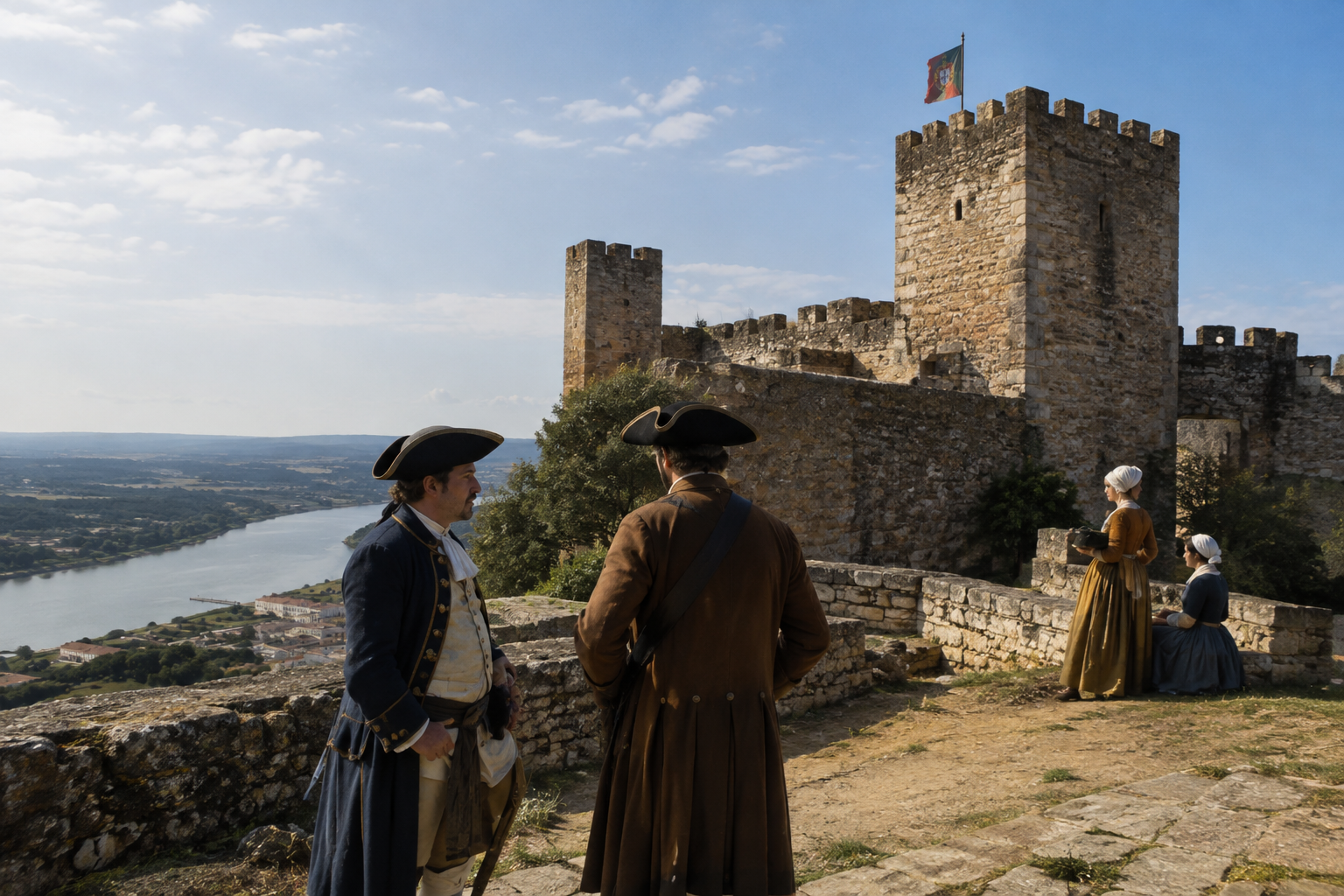
At Castelo de Montemor-o-Velho in Portugal, one ancient Y-chromosome result brings an unusually late and local glimpse into a deep paternal line. The individual known as LP111_8, dated to around AD 1750, belongs in the Early Modern period rather than the prehistoric or Roman worlds more often associated with ancient DNA headlines. That matters, because haplogroup E1b1b1a1b1a10a1a3 is not appearing here as an abstract branch on a chart, but in the remains of a man from a documented Portuguese setting with long historical layers behind it.
The immediate lesson is a useful one for anyone exploring paternal ancestry: Y-DNA traces one direct male line only, not a person's whole ancestry, language, or social identity. Even so, a lineage as specific as E1b1b1a1b1a10a1a3 can be historically revealing when it turns up in a place like Montemor-o-Velho, where medieval fortification, river access, Christian and Islamic frontiers, Atlantic connections, and later imperial-era mobility all form part of the background.
Montemor-o-Velho stands in central Portugal near the lower Mondego, a landscape that has been important for settlement and power for many centuries. The castle dominates a strategic height above wetlands and river routes, and the wider region was shaped by Roman administration, Visigothic rule, al-Andalus, the Christian reconquest, and the consolidation of the Portuguese kingdom. By the time of LP111_8 in the eighteenth century, this was no frontier outpost, but a place already carrying the accumulated inheritance of many earlier populations.
That is exactly what makes LP111_8 interesting. A highly specific Y-line such as E1b1b1a1b1a10a1a3 in Early Modern Portugal suggests persistence rather than novelty. It does not tell us when that paternal branch first entered Iberia, nor does it identify the man's language, class, or family history. But it does show that this branch was part of the lived male population of Portugal by about AD 1750, surviving through the upheavals that reshaped Iberia from antiquity into the modern age.
A broader genetic study of Portugal and adjoining regions has increasingly shown that Iberian history cannot be reduced to one simple ancestral layer. Roman-era mobility, post-Roman change, Islamic-period connections, local continuity, and later admixture all left traces in the peninsula's populations. That larger picture helps frame why a lineage under the wider E1b1b1 umbrella in Portugal is historically plausible without forcing a single dramatic origin story.
The haplogroup in this article is a very narrow twig on the much larger E1b1b1 tree, one of the best-known paternal clades in the Mediterranean world, North Africa, and parts of Europe and the Near East. The difficulty, and also the fascination, lies in scale. We can say quite safely that the parent lineage has long been part of the population history of lands bordering the Mediterranean. We cannot safely assume that every tiny downstream branch followed exactly the same route or arrived in every place at the same time.
That distinction matters here. E1b1b1a1b1a10a1a3 is far more specific than the broad label E1b1b1, and the evidence in hand does not justify inventing a neat migration tale for this exact subclade. A sensible reading is narrower: LP111_8 shows this direct paternal line was present in Portugal in the eighteenth century, while the deeper ancestry of the wider branch points toward the long-standing entanglement of Iberia with Mediterranean and North African population history.
Portugal is a particularly good place to see why genetic categories and historical labels must not be confused. The same region can contain descendants of prehistoric farmers, Iron Age communities, Roman settlers and soldiers, people linked to Islamic-period societies, later converts, migrants, and families rooted locally for centuries. A Y-line survives through fathers and sons, but the surrounding ancestry can change enormously from one generation to the next.
The old temptation in writing Iberian history is to divide everything into neat boxes: indigenous, Roman, Visigothic, Muslim, Christian. Ancient DNA keeps spoiling that tidy scheme. Across the peninsula, genetic studies increasingly show continuity mixed with repeated episodes of movement and mixture. That does not make historical identities unreal; it simply means that political and religious labels do not map perfectly onto paternal lineages.
For Portugal, this is especially important. Atlantic-facing though it is, the country has never been sealed off from the Mediterranean. Trade, conquest, enslavement, military recruitment, marriage, conversion, resettlement, and everyday local mobility all helped shape the male population over many centuries. A branch like E1b1b1a1b1a10a1a3 fits comfortably within that sort of history, where lineages can endure quietly in ordinary communities long after the events that first brought them there have vanished from written memory.
For readers who want the larger Iberian background, MyTrueAncestry has also explored the peninsula's changing populations under Roman rule and beyond. Those broader studies are useful here not because they identify LP111_8 personally, but because they show the kind of historical setting in which such a paternal lineage could persist.
There is something refreshing about an Early Modern sample. Prehistoric and Roman burials often ask us to reconstruct worlds with very few names and documents. By contrast, an eighteenth-century Portuguese individual lived in a society of parishes, taxation, monarchy, empire, and dense local record-keeping, even if this particular burial is not tied here to a named person. In other words, LP111_8 belongs to a historical world that is much closer to genealogical time.
That does not mean we can leap from a haplogroup to a surname or a known family. We cannot. But it does mean that this result sits at an intriguing threshold between deep ancestry and the paper trail. For many MyTrueAncestry users, that is precisely the point where genetic evidence becomes most evocative: not in proving a grand legend, but in showing that a distinctive paternal branch was present in a real community at a date that overlaps with the beginnings of many modern family histories.
An ancient DNA study connected with Portuguese regional history has helped push this kind of work into later centuries, where archaeology and genetics begin to overlap more directly with archival society. The relevant research can be found here: https://genomebiology.biomedcentral.com/articles/10.1186/s13059-025-03707-2. Even without overclaiming what one sample can prove, this sort of work sharpens the picture of who actually lived in places like Montemor-o-Velho.
Montemor-o-Velho is a particularly apt setting for a lineage like this because its history is so layered. The town and its castle sat within a zone repeatedly reworked by changing states and economies, yet never emptied of people. Communities there absorbed new rulers and new connections while retaining local continuities. Genetic diversity in such a place should not surprise us; indeed, uniformity would be the stranger result.
This is where the wider context of Iberian ancient DNA becomes helpful again. Studies of medieval and early modern Spain and Portugal have revealed populations that were often more mixed, mobile, and locally varied than older national stories liked to admit. The article on seventh-century Madrid, for example, shows how even a single burial ground can hold people of notably diverse origins.
Seen in that light, LP111_8 is not an anomaly to be explained away. He is better understood as one more reminder that the Iberian Peninsula was never genetically simple. His Y-chromosome line may have deeper roots somewhere else around the Mediterranean or North Africa, or it may have been in western Iberia for a very long time already. With the evidence currently in view, the honest answer is that both are possible, and the sample is valuable precisely because it pins the lineage to a real place and period.
If your paternal line falls under E1b1b1a1b1a10a1a3, the strongest takeaway from the ancient evidence here is modest but meaningful. This branch was present in Portugal by the Early Modern period, represented by LP111_8 from Castelo de Montemor-o-Velho, and it belongs to a wider paternal family long connected with Mediterranean history. That does not hand you a ready-made ethnic label or a noble pedigree. It does, however, place your direct male line inside the very real human mixture that shaped Iberia over centuries of conquest, coexistence, trade, and local continuity.

Comments