Haplogroup E1b1b1a1b1a10a1a1b
– 5 min read


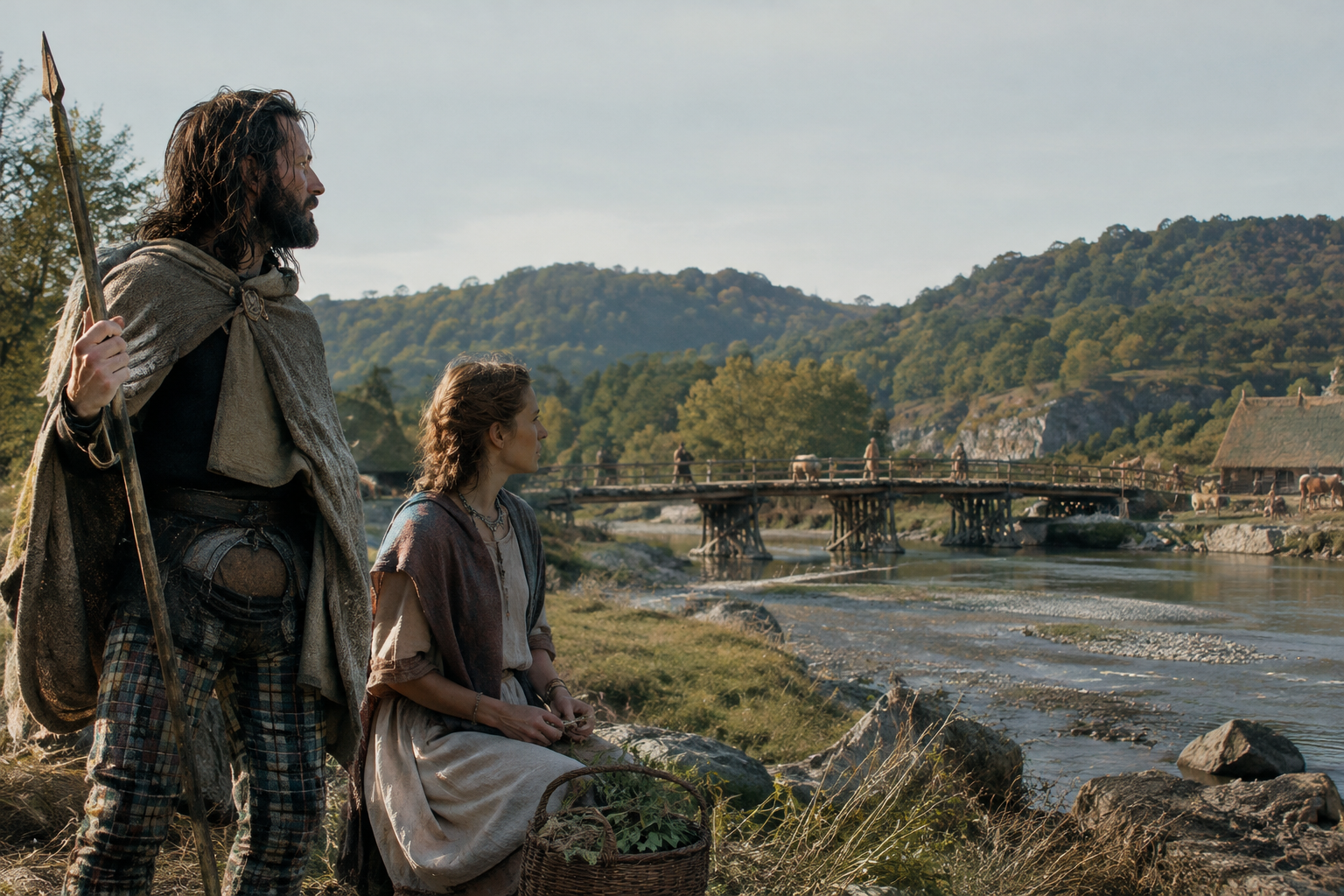
At Pont de Cornaux-Les-Sauges in Switzerland, one man dated to around 200 BC carries an unexpectedly long modern label: E1b1b1a1b1a10a1a1b. In the ancient record he appears more simply as sample 3437, a Gallo-Celtic individual from the Late Iron Age. Yet that small genetic detail matters, because it places a distinctly paternal line inside a Celtic community north of the Alps, in a period when Switzerland sat in the middle of movement, exchange, and local continuity rather than at the edge of events.
This is exactly the kind of finding that ancient DNA is good at clarifying. Y-DNA traces one direct paternal line only - father to son across generations - so it does not define a person's whole ancestry, language, or identity. But when a lineage such as E1b1b1a1b1a10a1a1b turns up in an Iron Age burial from Celtic Switzerland, it becomes a sharp little piece of evidence for how varied paternal histories could be within communities that archaeology would otherwise describe under one broad cultural label.
Pont de Cornaux-Les-Sauges lies in the Swiss Plateau, a region deeply connected to the wider Late Iron Age world of temperate Europe. By about the 3rd to 1st centuries BC, communities here were part of the cultural sphere usually associated with La Tene traditions: oppida, regional exchange networks, distinctive material culture, and close links across what are now France, Switzerland, southern Germany, and beyond.
Sample 3437 belongs to that setting. The date given - around 200 BC - places him before the Roman conquest of Gaul but well within the flourishing of Iron Age Celtic societies. That alone makes the haplogroup noteworthy: this is not a medieval arrival, nor a Roman-period newcomer documented by text, but a paternal line already present in a Gallo-Celtic setting in pre-Roman Switzerland.
A recent ancient DNA study examining mobility and burial evidence in Celtic Switzerland helps frame why such individuals matter, even when only a few personal details are available from a summary listing. The broader significance is that Late Iron Age communities in this region were neither genetically uniform nor historically isolated; they were local populations shaped by long-standing connections across Europe. See the MyTrueAncestry discussion here:
The article haplogroup here is very specific: E1b1b1a1b1a10a1a1b. That is a narrow twig on the much larger E haplogroup tree. It would be a mistake to dump the entire history of haplogroup E onto this one sub-branch, as though every ancient movement linked to its distant parent automatically explains this Swiss Iron Age individual. Ancient DNA simply does not work like that.
What can be said more safely is that lineages within the wider E1b1b family have a long and complicated history in the Mediterranean, the Balkans, and parts of Europe. Their appearance in Iron Age central-western Europe is therefore historically plausible and archaeologically interesting. In practical terms, sample 3437 shows that by the Late Iron Age, a paternal line assigned here to E1b1b1a1b1a10a1a1b was part of the human landscape of Celtic Switzerland.
That matters because older popular histories often imagined Iron Age peoples as tidy biological blocks: Celts here, Italics there, Germans elsewhere. Ancient DNA keeps spoiling that neat picture. Cultural communities could be coherent in language and practice while still containing multiple paternal ancestries, accumulated over generations of marriage, migration, and local integration.
There is no contradiction in finding this lineage in a Gallo-Celtic burial. Archaeology describes the cultural world of Pont de Cornaux-Les-Sauges; Y-DNA describes one line of fathers. A man could belong fully to an Iron Age Celtic-speaking community while carrying a paternal lineage whose deeper roots lay elsewhere in prehistoric or earlier historic Europe.
That distinction is important for anyone reading too much into a haplogroup label. Sample 3437 was not "less Celtic" because of his Y-chromosome. If anything, his presence reminds us what Celtic Europe actually was: not a sealed ethnic container, but a social world that absorbed people and lineages over time.
This fits nicely with a wider pattern seen across ancient Europe, where archaeology and genomics together are showing that language, burial custom, and paternal descent do not always line up in simple one-to-one ways. For a broader look at how ancient DNA is reshaping debates around Celtic origins and spread, this related article is worth reading:
With only one ancient individual listed here, there is a temptation either to overstate the finding or to dismiss it as too slight to matter. Both reactions miss the point. Ancient population history is built from exactly these small, securely placed observations: one man, one site, one date, one paternal line, added to a much larger comparative map.
Because Pont de Cornaux-Les-Sauges belongs to a studied Late Iron Age context, sample 3437 is more informative than a detached genetic curiosity. He anchors this branch in a real place and period. That lets researchers and family historians say something concrete: this paternal line, or a very near branch of it, was present in pre-Roman Celtic Switzerland by around 200 BC.
The underlying archaeological-genetic study of these Swiss Iron Age remains is linked here as supporting research: https://www.nature.com/articles/s41598-024-62524-y. Even without forcing more detail than the current evidence allows, the study context reinforces an important point - mobility and local burial traditions in Iron Age Switzerland can only be properly understood when genetics is added to the archaeological picture.
It is also worth remembering where this burial sits geographically. Switzerland in the Iron Age was not some remote upland backwater. It linked routes between the upper Rhine, eastern Gaul, northern Italy, and the Alpine passes. Goods, styles, and people moved through this landscape for centuries.
In that setting, a lineage like E1b1b1a1b1a10a1a1b is not especially surprising; what is valuable is that it is now documented rather than guessed. Ancient DNA turns vague historical possibilities into dated evidence. One paternal line in one burial cannot map the whole movement, but it can show that a connection had already happened, and had happened early enough for that line to be fully embedded within a Late Iron Age community.
Readers interested in how similar questions play out elsewhere in Europe may enjoy this parallel piece on Iron Age ritual and regional identity in Iberia:
For someone researching a present-day paternal line, the most responsible takeaway is not a grand claim of descent from a named tribe or elite family. It is something subtler, and in many ways more interesting. The ancient evidence places this branch in a real Iron Age Celtic setting in Switzerland, showing that the paternal history behind E1b1b1a1b1a10a1a1b was already part of the complex human mix of central Europe before Rome took control of the region.
That makes this haplogroup a reminder that family lines often crossed cultural frontiers long before written genealogy began. In the case of sample 3437, the line was not hovering at the margins of Europe. It was there, in a Gallo-Celtic community, buried in the archaeological world of Late Iron Age Switzerland.
Comments