Haplogroup E1b1b1a1a1c1b1b
– 5 min read


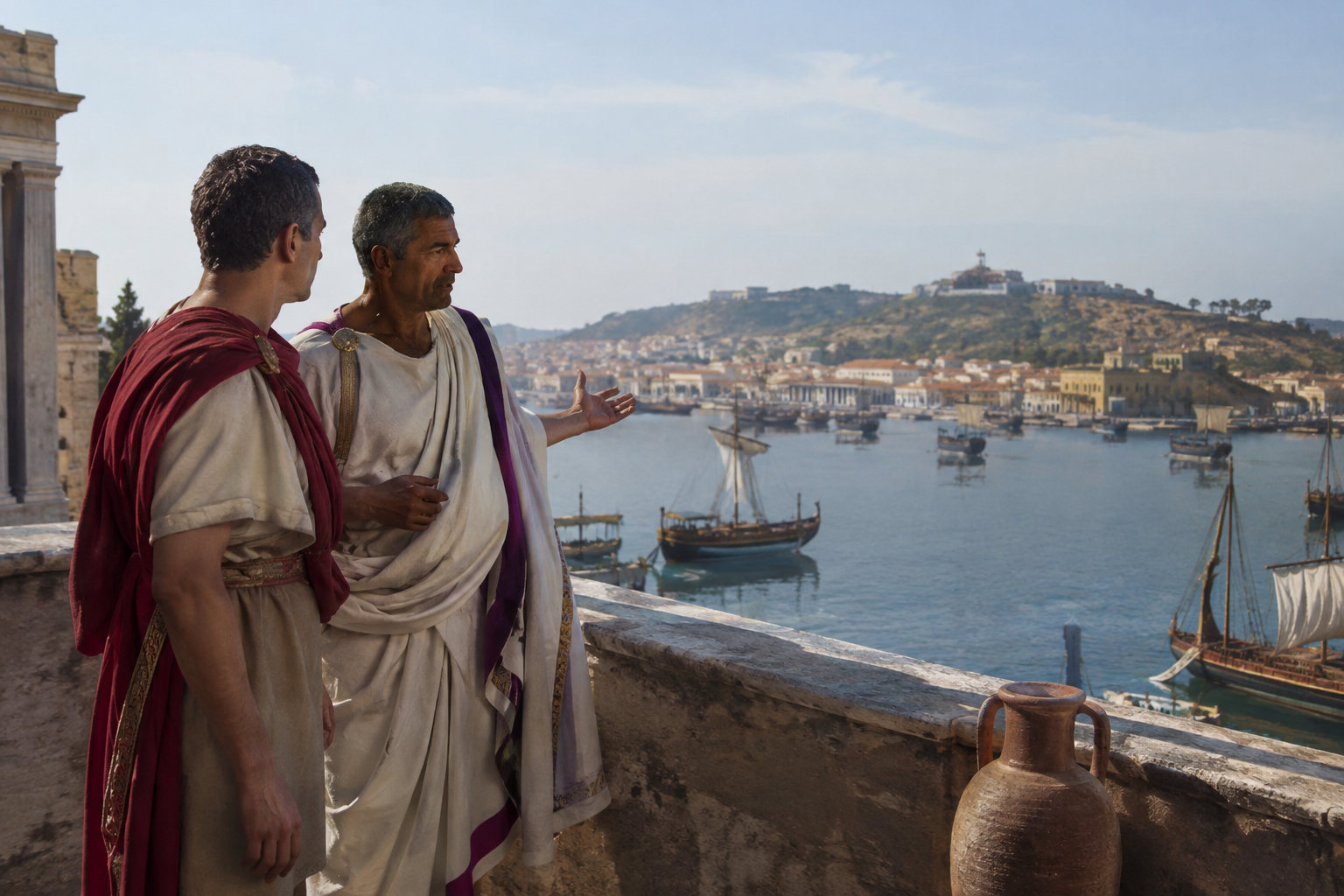
One of the clearest ancient signposts for the Y-DNA haplogroup E1b1b1a1a1c1b1b in this set is a man labelled R113, dated to around AD 100 and identified as a Carthago Outlier in the Roman Empire. Even that brief description is revealing. Carthage, in Roman North Africa, was not some quiet provincial backwater. It was one of the great cities of the Mediterranean, rebuilt after Rome's destruction of Punic Carthage and turned into a thriving imperial centre of trade, administration, religion, and movement.
That matters because a paternal lineage like E1b1b1a1a1c1b1b is not, by itself, a badge of language, ethnicity, or status. Y-DNA tracks one direct male line only. But when a branch of E1b1b appears in an ancient individual from Roman Carthage, it places that paternal line in a very specific historical world: a North African metropolis where local ancestry, imperial mobility, and long Mediterranean connections all met in the same streets, households, and cemeteries.
The sample R113 is especially interesting because of the label Outlier. In archaeogenetics, that usually signals that an individual's broader genetic profile stood apart in some way from the local cluster used by the researchers. It does not automatically mean a recent immigrant, still less does it tell us exactly where he or his father's father came from. But it does tell us that Roman Carthage was genetically varied enough for such distinctions to matter.
Carthage under Roman rule was a city made by repeated historical layering. First came the Punic past, then Roman colonisation, then centuries of commercial and human traffic linking North Africa with Italy, Iberia, the central Mediterranean, and the eastern provinces. A lineage assigned here to E1b1b1a1a1c1b1b sits comfortably within that broad North African and Mediterranean setting, though the precise sub-branch should not be burdened with a grand migration tale that the evidence does not itself supply.
A major ancient DNA study on the broader Punic and central Mediterranean world, published in Science, helped show just how mixed and mobile these populations could be. The point is not that every individual in Carthage shared the same ancestry, but almost the opposite: cities shaped by empire and sea travel gathered people whose family histories could be surprisingly different, even when they lived side by side.
The wider haplogroup E1b1b is one of the most historically important Y-chromosome lineages around the Mediterranean and in parts of Africa, the Balkans, and the Near East. But your article haplogroup is not that whole umbrella. It is the much narrower branch E1b1b1a1a1c1b1b, and that distinction matters. A broad parent haplogroup can be ancient and widespread, while a downstream branch may have a much more specific and still poorly documented history.
With only one ancient sample supplied here, caution is not a nuisance; it is the whole craft. We can say that this branch, or a reported assignment associated with it, appears in Roman-period North Africa at Carthage in the case of R113. We cannot honestly say that the branch was uniquely Punic, uniquely Berber, uniquely Roman, or tied to one named people in the literary sources. Ancient cities are rarely so tidy.
That said, there is a real historical value in even one well-placed sample. It shows that this paternal line was present in an urban Roman North African context by the early imperial period. For someone exploring this haplogroup today, that is a proper archaeological anchor: not myth, not heraldry, but a man in a documented ancient population.
Roman Carthage inherited a strategic position that had been important for centuries before the emperors arrived. The city sat at the hinge between Africa and the wider sea routes of the western and central Mediterranean. Grain, oil, ceramics, officials, merchants, soldiers, enslaved people, and families moved through this world constantly. So did genes.
That is why a single paternal lineage found there should be read in context. A man buried in Roman Carthage might reflect deep local continuity, recent movement within North Africa, or ancestry linked to some other imperial shore. The power of ancient DNA is not that it abolishes such possibilities, but that it lets us place real individuals inside them.
North Africa is increasingly coming into focus as a region with its own long genetic history, rather than merely a receiving end of Mediterranean events. That broader perspective is useful here, because E1b1b lineages often appear in discussions of African and Mediterranean population history, though always with the warning that one branch cannot stand for the whole. For a wider regional backdrop, MyTrueAncestry's piece on North Africa's population history is a helpful companion.
There is a temptation, when dealing with imperial archaeology, to let the political label do too much work. "Roman Carthage" is true enough as a historical description. But Roman rule did not replace the population with a single new people, nor did it erase older North African identities overnight. What the archaeology and genetics keep showing, again and again, is coexistence: continuity mixed with movement, local roots mixed with arrivals.
The sample name Carthago Outlier Roman Empire captures that beautifully, almost accidentally. "Roman Empire" gives the political frame. "Carthago" gives the city. "Outlier" reminds us that individuals did not always fit the average profile. In other words, the empire was not populated by neat textbook types. It was populated by actual people with tangled family histories.
That is one reason Roman-era genetic studies have been so valuable. They complicate older assumptions that ancient communities can be read straight from ethnicity labels in texts. If you are interested in how Roman-period DNA can preserve both mobility and local persistence, the MyTrueAncestry article on Roman Hispania's lasting genetic legacy offers a good comparison from another western province.
It is easy to dismiss a lone sample as too little. But archaeology is often built from just such fragments, provided they are securely placed. R113 gives this haplogroup a documented presence in one of the major cities of the Roman Mediterranean around AD 100. That is already more useful than a hundred romantic guesses about ancient warriors, lost tribes, or dynastic founders.
It also hints at something important for members of the MyTrueAncestry community: paternal lines can turn up in places where history was busy. Ports, colonies, market towns, garrison zones, and old sacred cities are precisely where lineages get difficult to narrate in a simple straight line. That is not disappointing. It is the real texture of the past.
For another example of how ancient DNA can reveal diverse origins within a single historic community, see the article on diverse origins at a 7th-century Madrid burial site. The lesson is similar: one burial ground, one political world, many different family stories.
For E1b1b1a1a1c1b1b, the standout evidence here is not a legendary dynasty or a sweeping migration claim. It is a real ancient man, R113, from Roman Carthage around AD 100. That places this paternal line within the crowded, mixed, unmistakably Mediterranean world of Roman North Africa. If this is your haplogroup, the safest historical insight is also the most interesting one: your direct paternal line belongs to a branch that can already be found in one of antiquity's great crossroads, where local continuity and long-distance movement were part of everyday life.
Comments