Haplogroup E1b1a1a1a2a1

– 5 min read


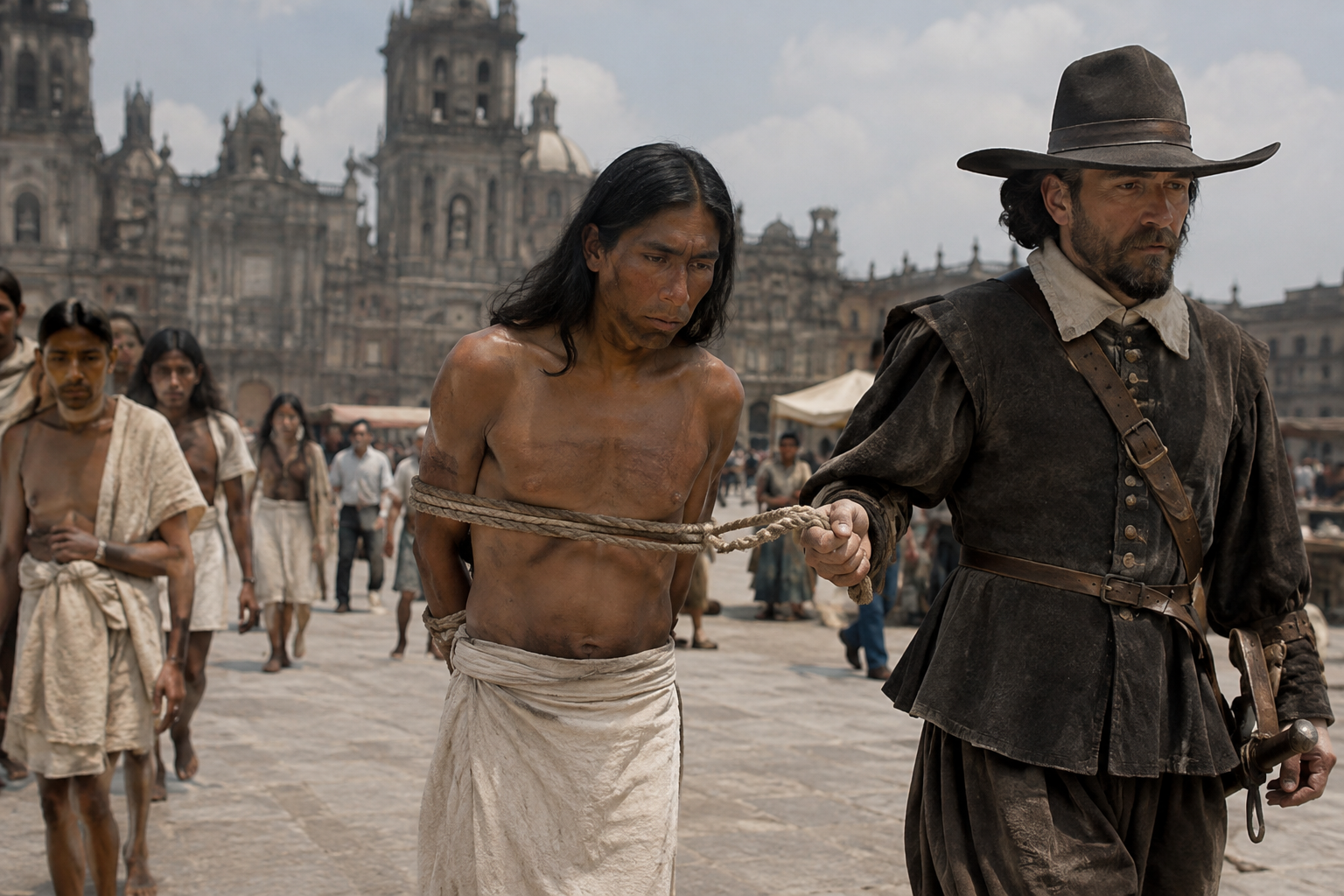
In early colonial Mexico City, one excavated burial from around AD 1535 has become a stark witness to the first decades of the Atlantic slave trade. The individual known as SJN002, identified among people taken to New Spain from Africa, is associated here with the Y-DNA haplogroup E1b1a1a1a2a1. That long string of letters and numbers marks a paternal line, passed from father to son, and in this case it appears not in a royal tomb or an Iron Age barrow, but in one of the hardest historical settings imaginable: the forced movement of enslaved Africans into the Spanish colonial world.
That is what makes this lineage so arresting in the ancient DNA record. E1b1a1a1a2a1 belongs within the wider E1b1a family, a major set of paternal lineages strongly associated with many populations in sub-Saharan Africa, especially West and West-Central Africa. But the important point is not to blur the wider family into this exact branch. What we have here is one documented early colonial individual, from one violent historical system, showing how a paternal lineage from Africa entered the archaeological record of the Americas under coercion rather than choice.
By the 1530s, Mexico City had become one of the central hubs of Spanish rule in the Americas. It was built on the ruins of Tenochtitlan, fed by imperial ambition, and linked to trade routes that reached across the Atlantic and deep into the African coast. Enslaved Africans were brought into this new colonial capital very early, and their lives are often far harder to recover from written records than those of priests, officials, or conquerors.
The significance of SJN002 lies precisely there. Ancient DNA can sometimes restore one thin but meaningful thread of biography where the archive is otherwise brutal in its silence. A study of first-generation Africans from early colonial Mexico, available at https://www.researchgate.net/publication/341056035_Origin_and_Health_Status_of_First-Generation_Africans_from_Early_Colonial_Mexico, drew attention to the origins and health of people caught up in that system. Even without turning one man into a symbol for millions, the sample reminds us that the early colonial city was already a place of forced long-distance migration.
Y-DNA traces one direct paternal line only. It does not capture a person's whole ancestry, language, legal status, community ties, or lived identity. Still, paternal lineages can be historically revealing when they appear in the right archaeological setting, and SJN002 is exactly that kind of case.
The broader E1b1a family is widely linked to demographic expansions within sub-Saharan Africa over the last several thousand years, including regions later heavily targeted by slave-trading networks. Yet it would be careless to assign one exact homeland to E1b1a1a1a2a1 from this sample alone. What can be said more safely is that this branch fits the larger genetic picture of African paternal ancestry present in the early forced diaspora to the Americas.
That matters because colonial paperwork often flattened African people into categories useful to traders and administrators. Genetics does not replace history, but it can challenge that flattening by showing that the enslaved were not a faceless mass. They carried many distinct family lines, biological histories, and regional origins, even when the archive tried to erase them.
There is a temptation, when discussing haplogroups, to leap straight into deep prehistory. Here the more urgent story is much later and much more specific. SJN002 belongs to the archaeology of the early modern Atlantic world: ships, ports, markets, churches, hospitals, and burial grounds shaped by conquest and human trafficking.
That makes this sample part of a growing body of evidence showing how ancient DNA can illuminate mobility in periods once thought to be documented only by texts. In some regions, as in the study discussed in Ancient DNA reveals diverse origins at a 7th-century Madrid burial site, genetics has revealed unexpectedly varied backgrounds within particular cemeteries. Early colonial Mexico offers a related but harsher lesson: diversity was present there too, but often produced by enslavement, displacement, and empire.
Seen archaeologically, this is not only a story about Africa or only a story about Mexico. It is about a connected world in which bodies, pathogens, goods, and institutions moved together. The dead from early colonial cemeteries can therefore tell us about trade, coercion, disease environments, and the making of new urban societies in the Americas.
SJN002 also belongs to a broader shift in archaeogenetics. For years, public discussion of ancient DNA was dominated by Europe, steppe migrations, and prehistoric farmers. Important as those subjects are, they can overshadow the equally powerful histories visible in African and African-diaspora remains. A lineage such as E1b1a1a1a2a1 enters the record here not as an abstract population marker, but as evidence attached to a named sample from a known historical trauma.
That is one reason African population history remains so essential to interpreting the Americas. The diversity of African maternal and paternal lines, and the long demographic history behind them, shaped the human foundations of colonial societies from the sixteenth century onward. For readers wanting a wider genetic backdrop, the post on African Maternal DNA Diversity and Population History offers a useful companion from the maternal side of the story.
There is also a useful corrective here for anyone tempted to think of ancestry as tidy or bounded. Colonial Latin America was never genetically simple. Indigenous American, European, African, and later mixed communities all formed part of the same social landscape, though not on equal terms. A paternal lineage like E1b1a1a1a2a1 survives in the evidence as one small sign of that deeply unequal entanglement.
With only one ancient individual named here, caution is necessary. SJN002 does not stand for every enslaved African in New Spain, and one reported association cannot map the whole distribution of E1b1a1a1a2a1 across time and place. But archaeology often works like this: one grave, properly contextualized, can open a very large historical argument.
In this case, the argument is that paternal ancestry can anchor human stories that written history only partly records. The sample places an African Y-line in early colonial Mexico at a very early date, around AD 1535, and ties that lineage to the brutal emergence of the Atlantic slave system in the Americas. For descendants researching a haplogroup like E1b1a1a1a2a1, that does not provide a neat family tree, but it does place the lineage within one of the central historical movements of the last five centuries.
How Ancient DNA Rebuilds History
The most distinctive thing about E1b1a1a1a2a1 in this article is not deep-time speculation but its appearance in a documented early colonial burial from Mexico City. Through SJN002, this paternal line enters the archaeological record of the Americas in a context shaped by enslavement, Atlantic transport, and the remaking of societies after conquest. For anyone who carries this lineage today, that is a reminder that Y-DNA can sometimes point not only toward distant origins in Africa, but also toward the specific historical rupture that carried African families into the New World.
Comments