Haplogroup E1b1a1a1a1c1b2a2

– 5 min read


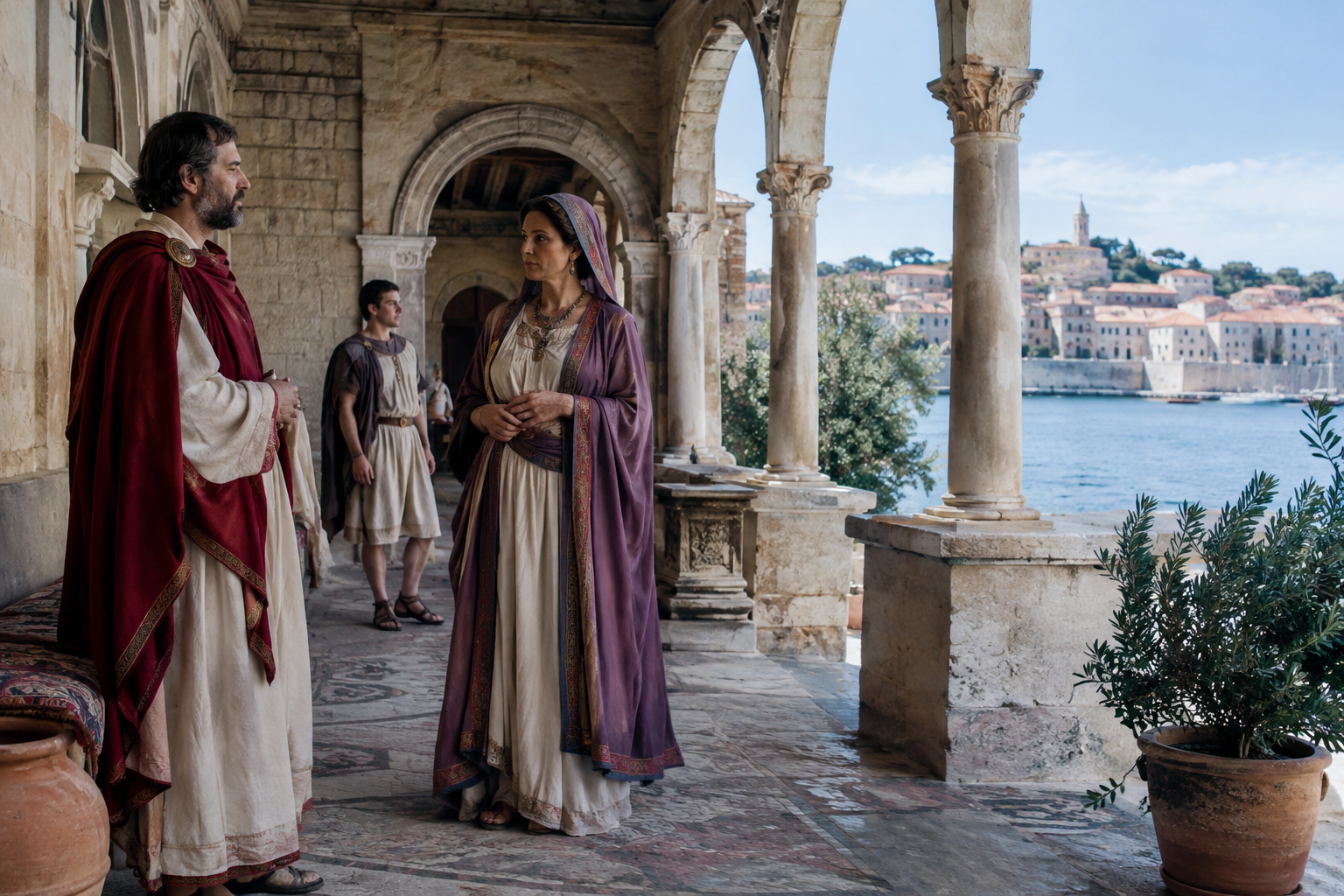
At Hvar-Radoševic Palace on the Croatian island of Hvar, one late Roman burial has become unexpectedly important for the history of a very specific paternal line. The individual labelled I33886, dated to about AD 400, has been associated here with the Y-DNA haplogroup E1b1a1a1a1c1b2a2. That is a striking result not because one grave can explain a whole lineage, but because it places this paternal branch in the world of the late Empire on the eastern Adriatic, a region where Roman power, local continuity, and long-distance movement all met.
The setting matters. By around AD 400, Dalmatia was still Roman, but it was no sleepy provincial backwater. Islands like Hvar sat within maritime routes linking the Adriatic to Italy, the Balkans, and the wider Mediterranean. A single Y-chromosome result from such a place does not tell us the whole ancestry of the man in the grave, but it does show that one direct paternal line later classified as E1b1a1a1a1c1b2a2 had reached this connected imperial landscape.
The ancient individual in question comes from the Hvar-Radoševic Palace site in Croatia and is listed simply as a Late Imperial Roman burial. Even with sparse details, that context is already informative. This was a period of changing military recruitment, intensified mobility, and mixed local communities across the Roman world. Men buried in Dalmatia in the fourth and early fifth centuries could reflect family roots in the region, movement through imperial service, trade, enslavement, or generations of settlement in a port-linked society.
What makes I33886 especially interesting is not that he can be turned into a grand historical symbol, but that he resists simplistic assumptions about who lived in Roman provincial settings. Ancient DNA has repeatedly shown that Roman and post-Roman communities were often more varied than older textbook pictures allowed. In that sense, a lineage such as E1b1a1a1a1c1b2a2 appearing in late Roman Croatia belongs to a larger archaeological lesson: the Empire moved people as well as goods.
A recent archaeological and genetic discussion of the Hvar material can be found in research on the site published here: https://link.springer.com/article/10.1007/s12520-024-02050-0. Even without leaning on details not securely available, the broader point is clear enough: these Adriatic burials help place paternal lineages inside a real excavated Roman landscape rather than an abstract migration map.
This long label marks a very narrow branch within the wider E1b1a paternal tree. That distinction is important. The broader E1b1a family has its own deep history, especially in Africa, but it would be careless to pour all of that vast background straight into this much narrower subclade without sample-specific evidence. For this article, the securely useful fact is more modest: a paternal line classified as E1b1a1a1a1c1b2a2 is represented in a late Roman burial on Hvar.
Y-DNA follows one direct male line only: father to son to son across generations. It does not describe a person's full ancestry, language, legal identity, or social position. The man buried as I33886 may have had a genome-wide ancestry profile shaped by many different ancestors, as all real people do. The value of Y-DNA here is that it gives us one sharply defined thread within that larger human story.
Dalmatia is a particularly good place to think about paternal lineages because the region was never isolated. Long before the end of Roman rule in the West, the eastern Adriatic coast had become deeply entangled with imperial administration, military logistics, sea traffic, and urban life. Ports and islands were not edges of the map; they were connectors.
That makes Hvar-Radoševic Palace more than a local curiosity. A burial from around AD 400 sits in a world where movement between the Balkans, Italy, the Aegean, and farther afield was entirely plausible. The ancient DNA result does not allow us to name the exact route by which this paternal line arrived on Hvar, nor should we pretend otherwise. But it fits the now familiar archaeological picture of the Roman Empire as a place of demographic circulation on a very large scale.
This is one reason Roman-era genetics has changed historical discussion so much. Older narratives often assumed that provincial populations could be neatly labelled and tidily bounded. Ancient genomes keep spoiling that simplicity. They show continuity in some places, sharp turnover in others, and above all a steady habit of human mixing that written sources only partially capture.
The Hvar burial also makes more sense when set against wider work on ancient Croatia. One of the recurring findings in archaeogenetics is that regions can show substantial continuity in some lines of descent while paternal markers shift more noticeably over time. That is not mysterious. Male-line turnover can reflect migration, warfare, military recruitment, marriage patterns, social advantage, or simply the accident of which family lines leave descendants.
For readers tracing E1b1a1a1a1c1b2a2, the significance is not that late Roman Hvar was full of men from the same paternal branch. We have one named ancient individual here, not a dynasty. The importance lies in seeing the branch anchored to a documented burial in a known historical setting: Roman Dalmatia at the edge of Late Antiquity.
That helps correct a common mistake in popular ancestry discussions. People often imagine haplogroups as if they map cleanly onto nations or ethnic labels. Archaeology is far messier, and much more interesting. A haplogroup can appear in one place because of one family, a cluster of related men, military service, maritime movement, enslavement, or centuries of quiet local inheritance. Without multiple closely related burials and fuller contextual data, the honest answer is usually a careful range of possibilities rather than a single heroic origin story.
Croatia's shifting paternal lines
There is a temptation to think of the years around AD 400 only in terms of imperial decline, frontier pressure, and collapsing institutions. Those things mattered, certainly. But from the viewpoint of a cemetery, what we often see is not sudden darkness but continued human complexity. Communities kept burying their dead, maintaining households, moving across regions, and absorbing newcomers.
In that light, the appearance of E1b1a1a1a1c1b2a2 in late Roman Croatia is best read as evidence of inclusion within a connected world, not an anomaly demanding melodrama. The Roman Empire and its successor societies created many opportunities for paternal lines to travel beyond the regions where they may once have been more concentrated. Sometimes the archaeology gives us military hardware, inscriptions, or imported goods to sharpen the story. Here the genetic signal is more restrained, but the historical setting still does a great deal of explanatory work.
Comparable studies elsewhere in late antique Europe have reached similar conclusions about mixed origins and local diversity in supposedly well-defined communities. Hvar therefore belongs to a broader reevaluation of the period, one in which identity was lived socially and politically, while ancestry could be surprisingly varied underneath.
Diverse origins in early medieval Madrid
For a man researching the haplogroup E1b1a1a1a1c1b2a2 today, I33886 offers one solid and useful kind of connection: a real ancient bearer in a securely historical place, the late Roman Adriatic. It does not promise descent from a famous house, and it does not reduce a whole lineage to one ethnicity. What it does provide is something better grounded: evidence that this paternal branch formed part of the human traffic of the Roman world, present in Dalmatia at a time when empire still stitched together widely different people.
That is often how ancient DNA is most valuable. Not as a fairy tale of pure origins, but as a way of putting a lineage back among excavated graves, dated communities, and the untidy movement of history.

Comments