Haplogroup E1b1a1a1a1c1a1a3

– 5 min read


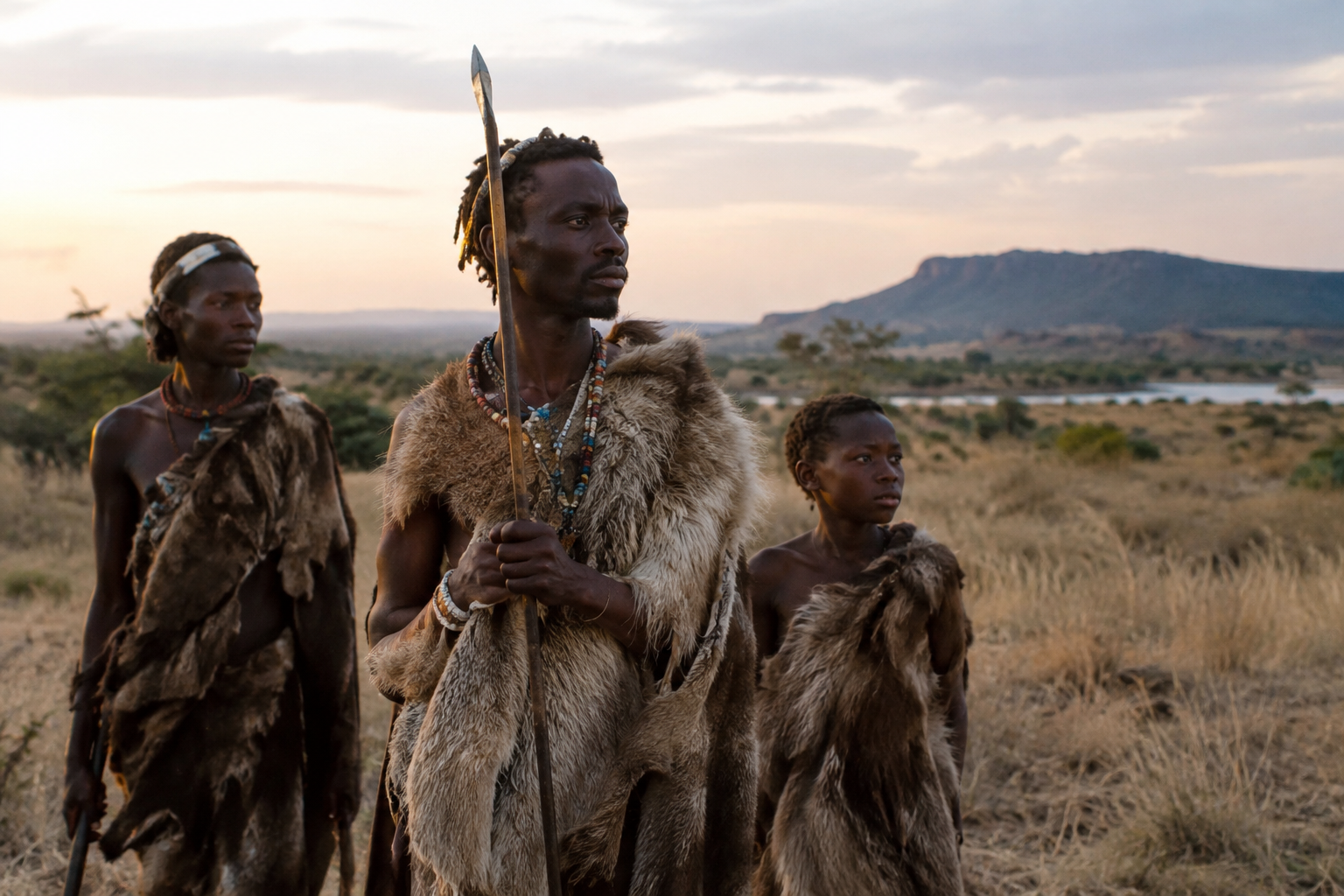
In the archaeological record of southern Africa, even a single ancient Y chromosome can carry a great deal of weight. One such case is XAR001, an individual dated to around AD 850 from Xaro, Botswana. For anyone interested in the haplogroup E1b1a1a1a1c1a1a3, this is the crucial starting point: a documented paternal line from an early farming context in the northern Kalahari region, appearing in a period when southern Africa was being reshaped by mobility, cattle keeping, farming, and interaction between very different communities.
That matters because E1b1a1a1a1c1a1a3 sits within the much larger Y-chromosome family usually associated with the broad E1b1a world, a major paternal lineage in many sub-Saharan African populations. But the narrower branch in this article is not the same thing as the whole parent lineage. What XAR001 gives us is not a grand shortcut to all of African history. It gives us something better: one real man, in one real landscape, at one historically important moment.
Xaro lies in Botswana, in the wider ecological sphere of the Okavango and Kalahari margins, an area that was never some isolated backwater. By the first millennium AD, this region was part of a lively patchwork of foragers, herders, and farming communities, linked by exchange, movement, and shifting settlement patterns. Ancient DNA has begun to show that these worlds were biologically as well as culturally entangled.
XAR001 is especially valuable because southern African ancient DNA is difficult to recover and still relatively scarce compared with Europe or parts of Asia. Each successful sample therefore helps anchor a history that older scholarship too often flattened into simple migration stories. In reality, the archaeology of Botswana and its neighboring regions points to prolonged contact zones rather than a single neat wave of replacement.
An ancient DNA study of southern African population history, published in Science Advances, helped frame this wider picture by showing deep population structure alongside later mixing in the region. That broader research context is important for reading XAR001 carefully: one paternal lineage appears within a community, but communities themselves were already products of long interaction.
Malaria and African Settlement
A Y-DNA lineage tracks one direct paternal line only: father to son to son across generations. It does not summarize a person's whole ancestry, language, or identity. Even so, in the right context it can illuminate historical processes very well. In the case of XAR001, the presence of a lineage associated with the E1b1a family fits an archaeological horizon in which food-producing populations had become established across large parts of southern Africa.
By around AD 850, the subcontinent had already seen centuries of movement by communities using pottery, metallurgy, livestock, and farming practices often linked, in broad historical terms, to the expansion of Bantu languages. That does not mean every site can be labeled straightforwardly, nor that every paternal line tells the same story. But XAR001 does place this branch of the Y chromosome in a region where those long-term shifts were very much underway.
The date is important too. This is not an early Holocene hunter-gatherer skeleton, nor a recent colonial-era burial. It belongs to the early medieval centuries of southern Africa, when local societies were developing new economic and political forms. In other words, E1b1a1a1a1c1a1a3 is not appearing here in abstraction, but in a period of real social change.
There is a temptation, whenever a Y haplogroup associated with food-producing populations appears in southern Africa, to tell a brisk story of newcomers arriving and everyone else vanishing. Archaeology has long shown that this is far too crude. Botswana sat between ecological zones and cultural traditions. People moved through it, settled within it, married across boundaries, traded, and adapted to difficult environments in different ways.
That makes XAR001 more interesting, not less. A paternal lineage like E1b1a1a1a1c1a1a3 in this setting may reflect ancestry tied to expanding farming populations, but the individual himself lived in a local world shaped by regional realities: water access, cattle economies, mobility, and relations with neighboring peoples whose ancestry could be quite different. Ancient DNA from southern Africa repeatedly points toward admixture and complexity rather than isolated blocks of population.
So when people ask what such a haplogroup "means," the best historical answer is often local. In this case, it suggests a paternal connection into the demographic transformations of first-millennium southern Africa, especially those associated with food production and settlement expansion across the region. What it does not do is reduce XAR001 to a label.
The parent lineage behind E1b1a1a1a1c1a1a3 is one of the major Y-chromosome families in Africa today, especially in many western, central, eastern, and southern populations with ancestry connected to Bantu-speaking peoples. That broad pattern has made E1b1a central to discussions of population movement in sub-Saharan Africa. But broad pattern is the phrase to keep in mind.
A narrow branch such as E1b1a1a1a1c1a1a3 cannot simply inherit every migration claim ever made for E1b1a as a whole. The deeper branching history, local expansions, and later founder effects may all differ. With only the evidence supplied here, the responsible claim is modest and solid: this branch is represented by XAR001 at Xaro in Botswana around AD 850, and that places it within an archaeologically important southern African setting.
That may sound cautious, but caution is exactly what makes ancient DNA useful. Once we stop forcing lineages into overblown civilizational myths, they become sharper historical tools. They can show when a paternal line is present, where it appears, and in what sort of community it appears. That is already a great deal.
One ancient individual is never the whole population. Yet one individual can still change the texture of a historical map. XAR001 shows that by the ninth century AD, a paternal lineage within this E1b1a branch was present in Botswana's archaeological landscape. That aligns well with a regional history of demographic mixture, the spread of food-producing lifeways, and the formation of new communities across southern Africa.
It also helps correct an old habit in world history writing: treating sub-Saharan Africa as if it entered the historical record only when outsiders described it. In fact, the evidence is in the ground. Sites like Xaro, and genomes like that of XAR001, belong to a long internal African history of adaptation, movement, and social reinvention.
If your paternal line falls under E1b1a1a1a1c1a1a3, the strongest ancient anchor offered here is XAR001 from Xaro, Botswana, around AD 850. That does not make every modern carrier "from Xaro," of course. What it does suggest is that this lineage formed part of the human landscape of early medieval southern Africa, in a region shaped by farming expansion, local interaction, and deep older population diversity. It is a reminder that paternal ancestry can connect not just to a continent or a label, but to a specific place where archaeology and genetics briefly meet.

Comments