Haplogroup E1b1a1a1a1a

– 5 min read


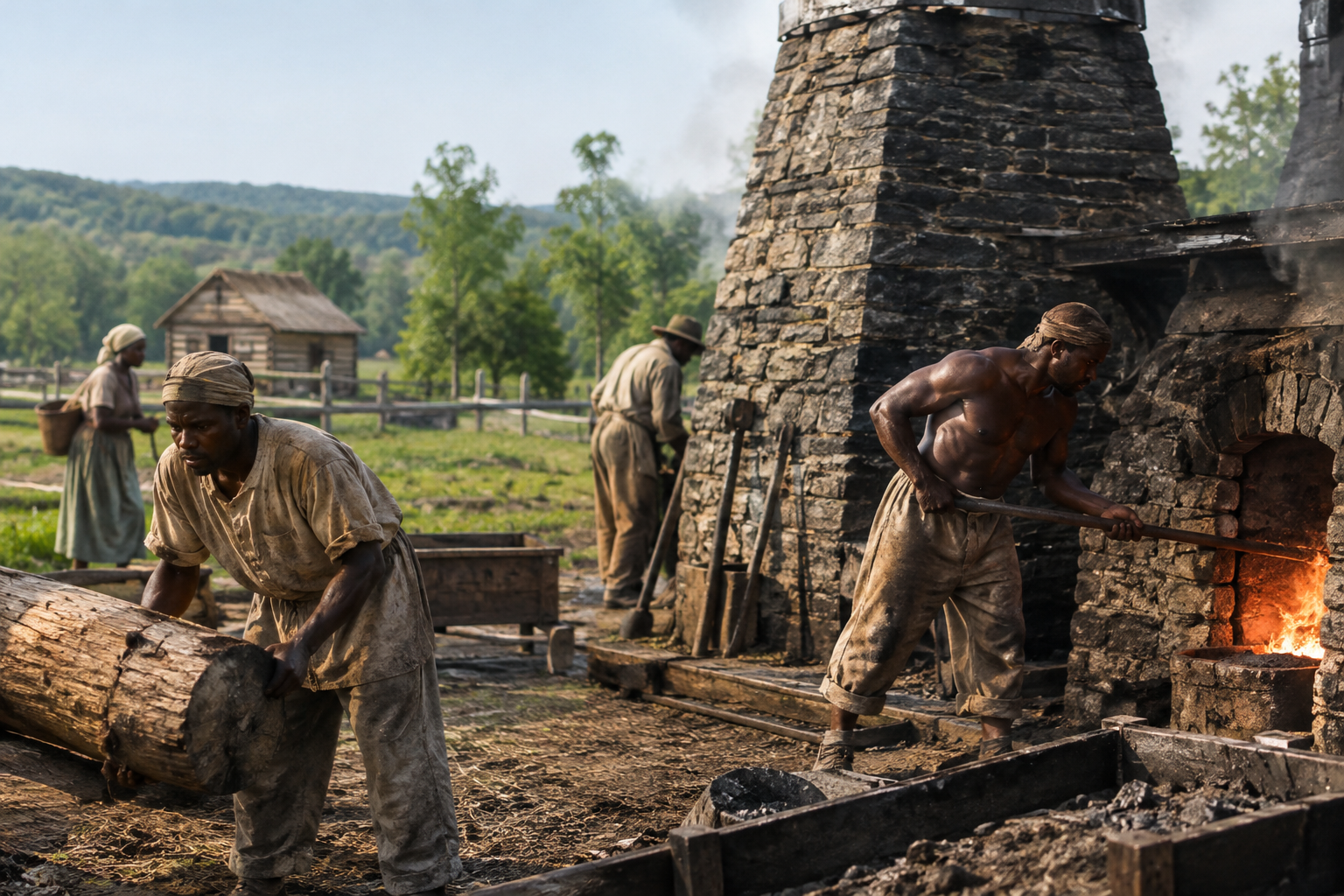
At Catoctin Furnace in Maryland, archaeologists and geneticists recovered the remains of men, women, and children whose lives were bound up with one of early industrial America's ironworks. One of those individuals, I8087, is identified as an enslaved laborer dating to around AD 1810. For a Y-DNA article, that matters because he connects the haplogroup E1b1a1a1a1a to a named historical setting that is both painfully specific and historically important: forced labor, Atlantic displacement, and the making of an industrial landscape.
This is not a royal or battlefield lineage in the evidence here. It appears instead in two very different human stories: an African-context individual from Deloraine Farm in Kenya, I8802, dated to around AD 820 and described as Bantu, and a much later man in antebellum Maryland. That contrast is the real historical interest of this branch. Y-DNA follows one direct paternal line rather than a person's whole ancestry, but even that single line can illuminate how African paternal histories survived movement across regions, languages, and empires.
The sample I8087 comes from the burial ground associated with Catoctin Furnace, an iron-producing site in Maryland that depended on enslaved labor. Here the haplogroup is not an abstract marker on a tree. It belongs to a person who lived in the early nineteenth century in the United States, in a system that uprooted families and severed many documentary trails while never quite erasing biological ancestry.
That is one reason lineages like E1b1a1a1a1a carry unusual weight in African diasporic genealogy. Written records for enslaved people are often fragmentary, distorted, or entirely absent. A paternal haplogroup cannot restore a lost name or village by itself, but it can preserve a line of continuity where archives fail. In this case, the broader context strongly points toward West-Central or broader sub-Saharan African paternal origins carried into North America through the slave trade, even if this single sample cannot by itself identify an exact embarkation point or ethnic identity.
Research on early Maryland populations has shown just how entangled colonial and early American ancestry could be, and how much ancient and historical DNA can reveal when documents fall silent. That wider setting makes Catoctin Furnace especially important for MyTrueAncestry readers interested in tracing lineages through slavery-era America.
E1b1a1a1a1a is a downstream branch within the much larger E1b1a family complex, one of the most widespread paternal lineages in sub-Saharan Africa and particularly prominent in populations linked in broad terms with Bantu-speaking expansions. That larger background is useful, but it should be handled carefully. A narrow subclade is not automatically identical in age, range, or history to its parent branch.
What can be said more safely is that this haplogroup sits within a paternal tradition strongly associated with African population histories over the last few thousand years, especially those involving farming communities, language spread, and regional mobility south of the Sahara. The two ancient individuals listed here fit that broad picture well: one in eastern Africa during the first millennium AD, one in the African diaspora in North America roughly a thousand years later.
That does not mean every man with this haplogroup shares the same recent homeland, language, or historical path. Haplogroups move through kinship, migration, conquest, enslavement, marriage, and community formation. The virtue of archaeology is that it forces us to place those processes in real landscapes rather than in vague maps shaded by modern assumptions.
The older of the two individuals, I8802, comes from Deloraine Farm in Kenya and is dated to around AD 820, with the description "IA Bantu" - in other words, an Iron Age context associated in the record with Bantu-speaking populations. That is a valuable anchor point. Instead of inferring African history backward from the Atlantic world alone, we can see the haplogroup in an African archaeological setting centuries before the height of the transatlantic slave trade.
Eastern Africa in the early medieval period was already a place of movement: inland farming communities, pastoral neighbors, local exchange systems, and increasingly active links to the Indian Ocean coast. A paternal lineage found in this context does not mean a single "Bantu migration" in the simplistic old textbook sense. It does, however, fit the long and complicated spread of communities carrying related languages, technologies, and family lines across large parts of sub-Saharan Africa.
A major ancient DNA study of African population history, published in Science, helped establish just how regionally varied and dynamic these histories were. That matters here because E1b1a1a1a1a should be understood not as a badge of one frozen identity, but as part of a living African demographic story with deep local variation.
The striking thing about these two samples is not that they prove a direct chain from one man to the other; they do not. The point is that they place the same paternal branch in two historical worlds linked by much larger processes. One is an African Iron Age context in Kenya around AD 820. The other is an enslaved worker in industrial Maryland around AD 1810. Between them lies a millennium of African regional history and, later, the catastrophe of Atlantic slavery.
For descendants researching this haplogroup today, that pairing is unusually evocative. It suggests that the branch belongs firmly within African paternal history before its appearance in the Americas. In other words, this is not a lineage first noticed in diaspora populations and then vaguely projected back onto Africa; the archaeological evidence, limited though it is, already shows it on African soil in an early medieval context.
Catoctin Furnace also reminds us that industrial archaeology and African diasporic history belong together. Furnaces, slag heaps, workshops, and company settlements can seem at first glance like the story of technology. But once human remains and DNA enter the frame, they become just as much the story of coerced labor, kinship disruption, and survival.
That broader theme has been explored in research on the Catoctin community and related historical populations, including work available through bioRxiv. Even without overclaiming sample-level detail from every publication, the direction of the evidence is clear: genetic data can restore historical visibility to people long treated as anonymous labor.
Some haplogroup articles are built from dozens of burials spread across many centuries. This one is leaner, but in some ways sharper. I8802 and I8087 do not simply add two dots to a distribution map. Together they show how a paternal lineage associated with African population history appears both in an early medieval eastern African context and in the lived reality of the African diaspora in the United States.
That combination also helps guard against two common mistakes. The first is to reduce African haplogroups to a modern frequency table, as though their history begins in present-day genetics. The second is to flatten all African-descended people in the Americas into a single undifferentiated origin. The evidence here points in the opposite direction: continuity at the level of paternal descent, but diversity and historical complexity in everything built around it.
African Ancestry in Ancient DNA
For E1b1a1a1a1a, the most responsible conclusion is also the most powerful one. This branch belongs within the deep and varied paternal history of sub-Saharan Africa, and the ancient individuals tied to it show both an African archaeological presence and a later survival through the violence of enslavement in America. If this is your haplogroup, the evidence does not hand you a ready-made tribe or famous pedigree. It offers something better grounded: a direct paternal line that was already part of African history long before it crossed the Atlantic, and that endured in spite of everything meant to erase it.
Comments