Haplogroup E1b1a1a1

– 5 min read


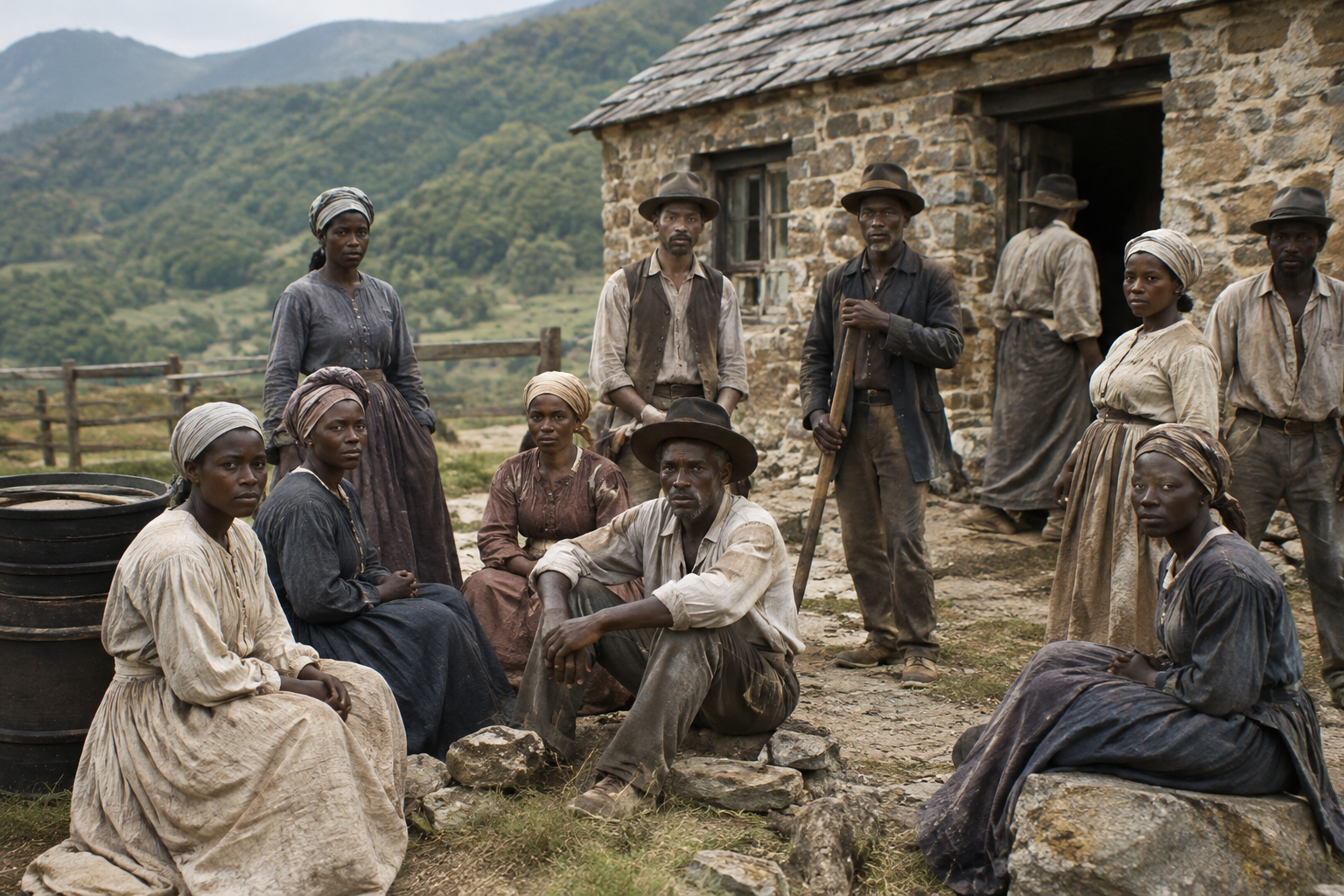
Some Y-DNA haplogroups turn up in royal tombs, warrior cemeteries, or prehistoric barrows. Haplogroup E1b1a1a1 tells a rather different, and in many ways more urgent, story. Its importance lies not in a neat dynastic label but in how it helps recover the paternal histories of African men whose lives were caught up in forced migration, enslavement, and empire. That alone makes it historically compelling.
Y-DNA haplogroups trace one narrow line of ancestry: the direct paternal line, passed from father to son. They do not describe a person's whole ancestry, culture, language, or identity. Even so, they can be extraordinarily useful. In the case of E1b1a1a1, a branch within the wider E1b1a paternal tree, the broader picture points toward sub-Saharan Africa, especially regions shaped by the long demographic history of western and central Africa, including expansions often discussed in connection with Bantu-speaking populations. For a branch as specific as E1b1a1a1, caution matters: we should not simply assign to it every part of the much larger history of E1b1a. But it clearly belongs to one of the major paternal lineages of African population history, and ancient DNA is now allowing that history to be told through named individuals rather than abstractions.
The wider E1b1a family is one of the most historically significant Y-chromosome lineages in Africa. Its modern distribution and its place in the Y-tree have made it central to discussions of population growth, migration, and settlement across large parts of sub-Saharan Africa. In broad terms, scholars connect branches of E1b1a with major population expansions over many centuries, though the routes, timings, and local mixtures varied greatly from region to region.
That is worth stressing, because haplogroups can tempt us into overly tidy maps. Real people married across communities, moved for trade, war, pastoralism, farming, and coercion, and lived in societies far more complicated than a single genetic label can capture. With E1b1a1a1, what we can say responsibly is that it sits within a deeply African paternal framework, and that its appearance in later historical contexts helps document how African paternal lineages endured, dispersed, and survived under extreme historical pressure.
Explore How Ancient DNA Reconstructs History
The most striking evidence supplied here comes not from prehistory but from the 19th century, and from one of the grimmest archives in the world: the graves of people rescued from slave ships. At Ruperts Valley on St. Helena, a British Atlantic island used in the suppression of the transatlantic slave trade, ancient DNA has helped restore some measure of identity to men, women, and children who were removed from Africa by violence and died far from home.
Among the individuals associated with E1b1a1a1 are STH_213, STH_245, STH_248, STH_253, STH_289, STH_344, STH_351, STH_415, STH_441, STH_460, STH_499, STH_514, and STH_520, all identified as Liberated Slave Trade Victim St. Helena Ruperts Valley Year:1848 AD. Even listed this way, they are arresting. Not legendary founders, not kings, not nobles: people whose paternal ancestry belonged to long-established African lineages and whose final resting place records the machinery of the slave trade at its violent end point.
What makes these St. Helena individuals so important is that they show E1b1a1a1 not as a theoretical population marker but as lived history. Their Y-DNA does not tell us their exact ethnicity, language, or home village, and it certainly does not make them members of one single uniform group. But taken together, they fit the broader expectation that lineages within E1b1a1a1 would be found among African men uprooted by the Atlantic trade. Genetics, here, works beside archaeology and history to expose the scale of displacement while also returning individuality to the dead.
A second case, I8085, identified as Enslaved Laborer Catoctin Iron-Working Furnace Antebellum Maryland Year:1810 AD, brings the story into North America. This is another powerful reminder that Y-DNA lineages crossed oceans not only through migration in the ordinary sense, but through captivity and forced labor. The paternal line carried by I8085 links the industrial landscapes of antebellum Maryland to much older African histories. It does not prove a precise place of origin, but it does place African paternal ancestry firmly within the material history of early American industry.
Read About Colonial-Era DNA in Maryland
If there is a historical theme running through E1b1a1a1 in the supplied evidence, it is continuity under rupture. The paternal line itself persisted, but the worlds around its carriers were broken apart. Ancient DNA is particularly good at showing this, because it preserves biological continuity even where names, languages, kin networks, and legal identities were shattered by enslavement.
That is why this haplogroup matters beyond genetics. It offers a way to discuss the Atlantic world from the viewpoint of ancestry as well as empire. St. Helena and Maryland were very different places, but both became contact zones where African paternal lineages were forcibly inserted into new social landscapes. The men represented by STH_213 or I8085 were not simply "migrants" in the bland demographic sense. Their presence records systems of capture, transport, labor, and mortality. Y-DNA cannot tell the whole story, but without it some parts of that story would remain invisible.
Readers interested in the broader African context may also want to compare this paternal evidence with work on maternal ancestry, which often reveals the same complexity from a different genetic line.
Explore African Maternal DNA History
Normally, a haplogroup feature might move neatly from ancient samples to noble houses and their ancestral strongholds. Here, though, the supplied field for associated noble families and castles is effectively empty. Far from being a problem, that absence tells its own story. Not every lineage enters the historical record through heraldry, land tenure, or stone fortresses. Some survive in ledgers of shipping, plantation accounts, burial grounds, and industrial work sites.
In other words, E1b1a1a1 reminds us that the archive of the past is uneven. Castles preserve the memory of the powerful. Graves at Ruperts Valley preserve the memory of people whom power tried to erase. Genetics does not equalize those histories, but it can force them into the same field of vision. A named noble house may leave charters and battlements; a liberated African child on St. Helena may leave only bone, burial context, and DNA. Both belong to history, though only one was traditionally granted a monument.
That is one of the most important correctives ancient DNA offers. Written genealogy tends to follow inheritance, property, and status. Archaeogenetics can widen the frame. It can recover paternal lines from places where no chronicler bothered to write a pedigree.
See How DNA Reshapes Historical Genealogy
So what does this haplogroup reveal? First, that direct paternal ancestry can preserve deep regional history across enormous upheaval. Second, that ancient DNA is not only about remote prehistory; it is equally powerful in the study of slavery, colonialism, and the modern era. And third, that sharing a haplogroup does not prove close relationship. A man today with E1b1a1a1 is not thereby a direct descendant of STH_441 or I8085, nor does the haplogroup alone identify a specific people or family. What it does provide is context: a place within the long history of African paternal lineages and, in this case, within the historical realities of the Atlantic slave trade and African diaspora.
That combination of scale and intimacy is what makes E1b1a1a1 so memorable. It belongs to a vast African past, yet in the evidence here it comes to us through individuals with sample IDs, dates, and burial places. The science is careful, but the result is still profound: these men can be located within human history not just as victims of a system, but as carriers of lineages with much older roots.
If you want to explore how DNA can connect your own results to ancient individuals, historical populations, and the wider human past, MyTrueAncestry offers a remarkable way to begin. Ancient DNA matches do not prove direct descent from a particular person or noble house, but they can open unexpected windows onto the deep story behind your ancestry.
Comments