Haplogroup D1a2a1
– 5 min read


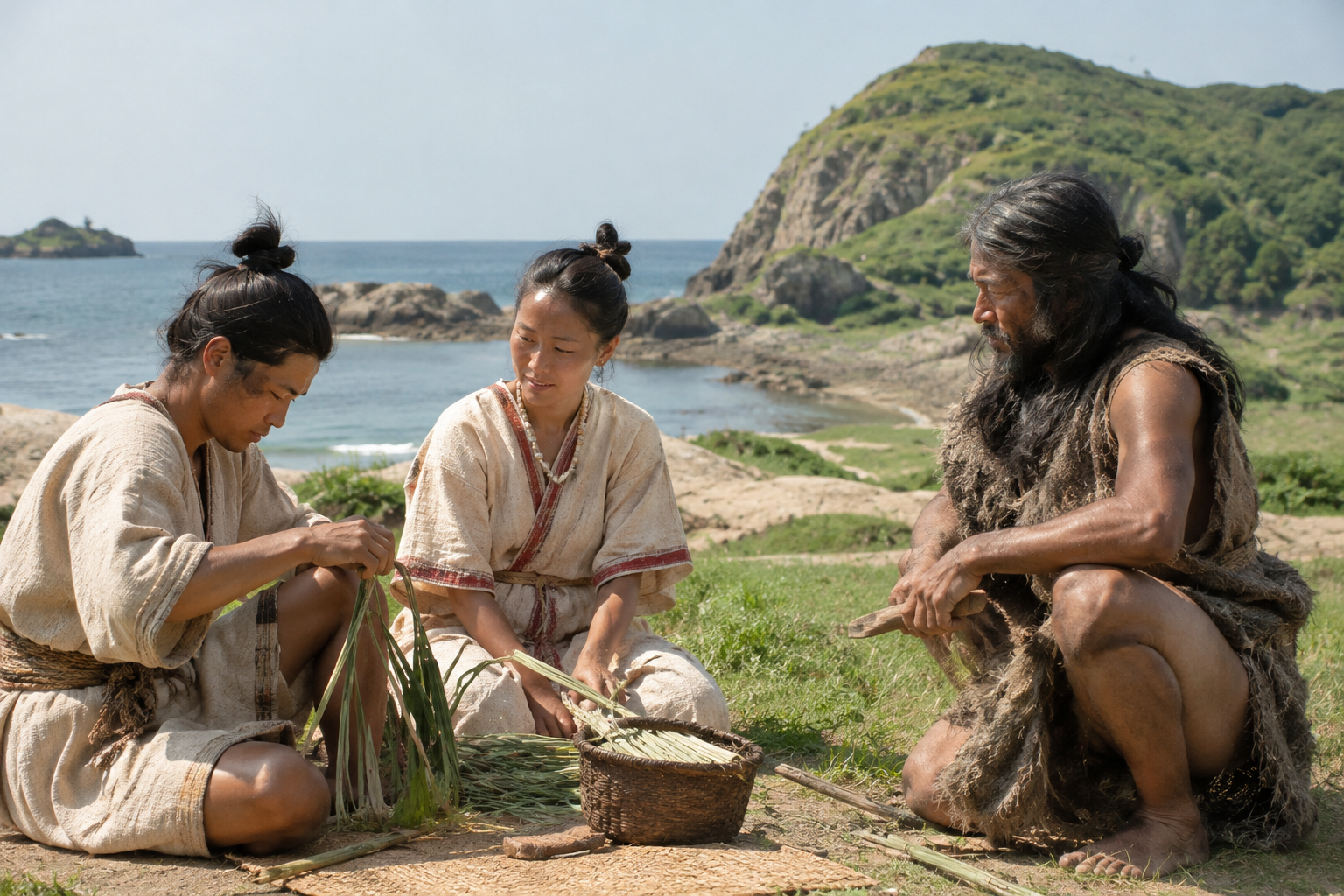
At NAG012 and NAG037 in ancient Okinawa, both dated to around 680 BC, the striking point is not lavish archaeology or dynastic fame. It is continuity. Two male individuals from the Ryukyu island world, separated from the Japanese main islands by sea and by a rather distinctive history, have been associated with the Y-DNA haplogroup D1a2a1. That immediately places this paternal line in one of the most historically revealing settings in East Asian archaeogenetics: the long survival of Jomon-related ancestry in the islands to Japan's south.
A third sample broadens the frame. GDI008, from ancient Janghang in Korea and dated to around 4600 BC, suggests that this paternal branch, or a very closely related lineage within the wider D family, was present far earlier on the East Asian mainland. Taken together, these samples do not tell a simple tale of one people marching neatly from one place to another. They do something more interesting. They show that D1a2a1 belongs to a very old paternal landscape in East Asia, one whose later survivors can turn up in places that look, at first glance, peripheral but are in fact central to understanding deep regional history.
Y-DNA traces one direct paternal line: father to son to son across many generations. That is useful, but it is only one thread in a person's ancestry. With D1a2a1, the important point is that we are dealing with a sub-branch of haplogroup D, a lineage with deep antiquity in East Asia and a patchy, highly informative modern distribution.
One should be careful here. The wider haplogroup D is older and broader than D1a2a1 itself, and not every statement about haplogroup D can simply be dropped onto this narrower branch. But the ancient pattern is still revealing. When D1a2a1 appears in prehistoric and protohistoric East Asian contexts, it tends to point us toward populations with substantial local depth rather than obviously recent intrusive male lines.
That is exactly why the Okinawan evidence matters. It places this paternal branch in a region often discussed in terms of maritime contact, cultural layering, and island survival, but where ancient DNA increasingly shows that older lineages were not washed away by later history.
For readers interested in that island context, this related piece is especially useful:
The two Okinawan individuals, NAG012 and NAG037, are the clearest archaeological anchor for this article because they place D1a2a1 in a specific island setting before the historical era. Around 680 BC, Okinawa was not part of any centralized Japanese state. It belonged to the older cultural worlds of the Ryukyus, whose communities developed under island conditions and maintained links both local and maritime.
What makes these samples so important is not that they are dramatic individuals with famous names, but that they fit a broader pattern seen in ancient Ryukyu genomics: substantial continuity with Jomon-related ancestry. In other words, the Ryukyu Islands preserved genetic components that were later diluted to varying degrees elsewhere in the Japanese archipelago. A study of these island populations is discussed in related MyTrueAncestry coverage, which explores how ancient Ryukyu genomes illuminate that continuity.
That does not mean NAG012 and NAG037 were somehow frozen relics of a vanished world. Island societies are never static. But their paternal lineage helps show that some very old East Asian male lines remained established in Okinawa well into the 1st millennium BC. In historical terms, that is a powerful reminder that later state formation and later migration patterns did not erase every earlier layer.
Archaeologists have long known that islands can preserve unusual combinations of continuity and change. The Ryukyus are a perfect example. They were connected by sea routes, yet still sheltered local traditions and populations over long periods. That makes them especially valuable when tracing ancient paternal lines like D1a2a1.
In mainland narratives, population change can look overwhelming: new crops, new ceramics, new political centres, new languages. But islands often complicate that story. A lineage found in ancient Okinawa may reflect male ancestry that once had a broader distribution and later became rarer elsewhere. The survival of D1a2a1 in these Okinawan samples is therefore historically suggestive even without any grand claim about a single migration event.
There is another reason this matters for MyTrueAncestry users. People often assume that a rare or regionally concentrated haplogroup must reflect some recent founder or isolated family. Sometimes the opposite is true. What looks unusual today may be the remnant of something much older.
A wider look at East Asian paternal history helps frame that point:
East Asian Y-Chromosome Migrations
The sample GDI008, from ancient Janghang in Korea and dated to around 4600 BC, pushes the story much further back. This is the oldest sample in the set, and therefore the one that most strongly hints at the deep time depth of the lineage in Northeast Asia. A 5th-millennium-BC Korean context places the branch, or a closely related paternal assignment within the same cluster, in a world long before the political entities that later dominate East Asian history.
That date matters because it belongs to a prehistoric Korea of hunter-gatherers and early food-producing communities, not to historically documented kingdoms. So one must resist the temptation to read later ethnic or national labels backward into the evidence. GDI008 is important precisely because it belongs to that earlier layer.
Historically, Korea sits in a crucial position between continental Northeast Asia, the Yellow Sea world, and the Japanese archipelago. A paternal lineage appearing there in the 5th millennium BC does not prove a direct line from Janghang to Okinawa, still less from GDI008 to either Okinawan individual. What it does suggest is that lineages connected with D1a2a1 had a deep mainland presence before later cultural transformations reshaped the region.
This is where archaeogenetics is at its best. It does not hand us a tidy migration map with arrows and labels. It reveals old survivals, unexpected distributions, and the stubborn refusal of real human history to behave like a textbook diagram.
Readers following ancient DNA work in Korea and nearby regions may also want this parallel case study:
It is tempting to force these samples into one clean narrative: mainland origin, island refuge, modern descendants. But the evidence is thinner, and more interesting, than that. We have one early Korean sample and two later Okinawan ones. That is enough to show regional depth and persistence. It is not enough to claim a single uninterrupted, documented route.
Even so, the pattern fits a broader picture emerging from East Asian ancient DNA. Coastal zones, islands, and peninsulas often preserve traces of ancient population structure that later historical expansions only partly obscured. In that sense, D1a2a1 is not merely a technical label on a Y-chromosome tree. It is part of the evidence that the peopling of East Asia involved multiple enduring lineages, not one simple replacement after another.
That broader question - how paternal lines moved along coasts and inland corridors - is explored further in this related article:
6,000 Years in the Yellow River
For someone who belongs to D1a2a1 today, the most defensible takeaway is not a promise of descent from a named ruler or a single heroic migration. It is something older, and in its way more impressive: this paternal line appears tied to very deep East Asian history, with ancient evidence in prehistoric Korea and later continuity in the Ryukyu island world. The strongest lesson of NAG012, NAG037, and GDI008 is that some paternal lineages endured through enormous cultural change, surviving in places where archaeology and genetics together can still catch sight of them.





Comments