Haplogroup D1a1a1a1b
– 5 min read


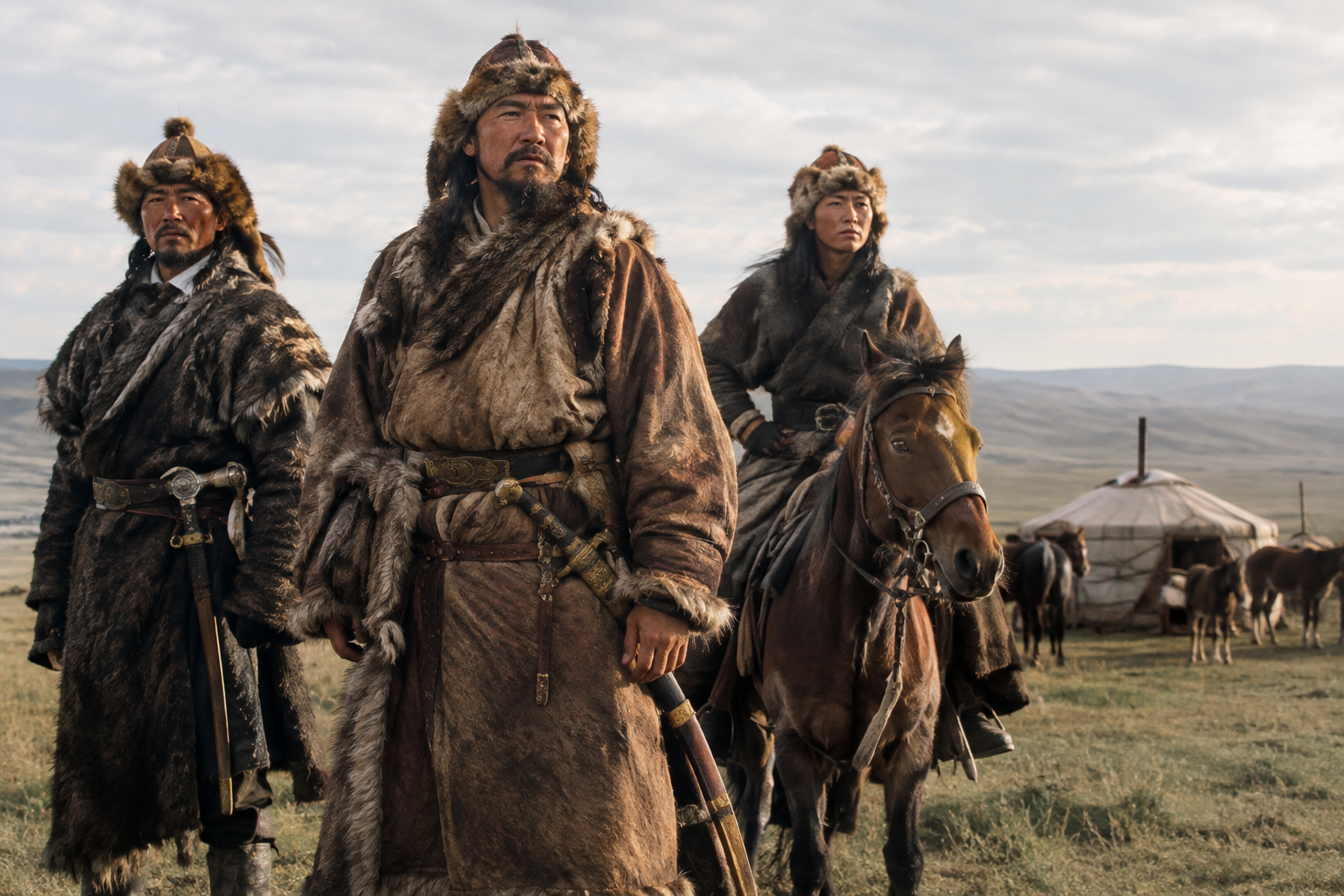
One of the few ancient signposts for Y-DNA haplogroup D1a1a1a1b comes from medieval Mongolia: individual GD2-4, dated around 1350 AD from Gurvan Dov Tavan Khailaast. That is already enough to make the case interesting. This is not a branch that turns up in the familiar parade of Bronze Age western steppe lineages. Instead, it belongs to a much older and more easterly paternal world, one that has long been associated with parts of Inner and East Asia and is only rarely illuminated by ancient DNA.
That rarity matters. A Y-chromosome lineage tracks one direct paternal line only, not the whole ancestry of a person or population, but when a branch as distinctive as D1a1a1a1b appears in an excavated medieval context, it gives us something concrete to hold onto. In the case of GD2-4, it places this paternal line in the Mongolian world of the 14th century, centuries after the rise of the Mongol Empire and at a time when the steppe remained a zone of movement, mixing, and political afterlife.
The site name Gurvan Dov Tavan Khailaast may not be famous in the way that Karakorum is, but that is partly the point. Ancient DNA often advances not through grand imperial tombs, but through ordinary excavated burials that quietly expand the map of where lineages actually were. GD2-4, dated to around 1350 AD, shows D1a1a1a1b present in medieval Mongolia in a real archaeological context rather than only in modern testing results.
That does not make GD2-4 a dynast, a conqueror, or the representative of all Mongols. It does something more useful. It anchors this paternal branch in a specific place and period within the eastern steppe, where historians and archaeologists already know that political identities were broad, confederate, and often genetically mixed.
For readers interested in the wider genomic backdrop of Mongolia across many periods, MyTrueAncestry has also explored that bigger setting here:
Haplogroup D, in its broad sense, is one of the most unusual major Y-chromosome lineages in Eurasia. Its present-day distribution is strongly associated with eastern Asia, especially populations in Tibet, Japan, and some other parts of East and Inner Asia. That broad picture, however, should not be lazily pasted onto the much narrower branch D1a1a1a1b. A parent haplogroup can be ancient and widespread while a subclade may have a much more local, more recent, or more uneven history.
So what can be said responsibly here? The sample GD2-4 suggests that this particular paternal branch, or a reported association with it, existed in medieval Mongolia. That fits a larger archaeological expectation that the Mongolian steppe was never carried by a single male lineage. On the contrary, ancient DNA from Mongolia has repeatedly shown overlapping paternal histories, with different branches appearing across different sites, regions, and centuries.
That is one reason a lineage like D1a1a1a1b is so revealing. It complicates any simplistic idea that steppe history can be reduced to one famous Y-chromosome story. Medieval Mongolia was politically connected on a huge scale, but biologically it was still peopled by many different paternal lines.
A burial dated around 1350 AD sits in a very particular historical moment. By then, the age of Chinggis Khan was no longer new, yet the world shaped by Mongol expansion was still very much alive. Trade, warfare, marriage alliances, tribute networks, and shifting loyalties linked Mongolia to North China, Central Asia, and beyond.
In such a setting, a Y-lineage like D1a1a1a1b should not be read as an ethnic label. It tells us that one direct male line at Gurvan Dov Tavan Khailaast belonged to this branch; it does not tell us the language the man spoke, the political allegiance he claimed, or whether his paternal ancestors had been local to that area for centuries. Still, the sample is valuable precisely because it belongs to this historically dynamic period, when the steppe was both rooted and cosmopolitan at once.
An ancient DNA perspective on steppe populations and later eastern Inner Asian developments also resonates with work on nearby regions of northern China and the steppe frontier, where mobility and mixed population histories are increasingly visible in the evidence. A related MyTrueAncestry discussion of Bronze Age Gansu shows how deep those eastern steppe-border interactions can run:
It is tempting to dismiss a single ancient individual as too small to matter. Archaeology teaches the opposite. One securely placed ancient genome can test assumptions that were previously built only from modern distributions or historical guesswork. GD2-4 does exactly that for D1a1a1a1b by showing that this paternal line was present in medieval Mongolia, not just inferred from later populations.
Single finds also matter because preservation and sampling are uneven. Some regions produce rich cemeteries and dozens of genomes; others remain patchy. Mongolia is better represented in ancient DNA than it once was, but even there, many sites and periods remain thinly sampled. That means each identified Y-line still deserves careful attention, especially when it broadens the range of lineages visible in the steppe record.
Research on ancient eastern Eurasian paternal history increasingly underlines this point. MyTrueAncestry's coverage of ancient Y chromosomes in East Asia is useful here because it shows just how varied paternal histories could be across neighboring regions, and how misleading it can be to imagine a single tidy expansion route for every branch.
The wider significance of D1a1a1a1b lies in where it sits geographically. Medieval Mongolia was not an isolated pocket but part of a vast corridor between forest, steppe, and agrarian worlds. Lineages could persist locally for long periods, spread with mobile communities, or arrive through generations of contact that leave only faint traces in texts.
That is why eastern Eurasian haplogroups are so important in archaeology. They remind us that the history of the steppe is not merely a westward-facing tale of horsemen and empire. It is also a history of deep regional diversity within Inner Asia itself, including paternal lines whose roots and later survival may be very different from the more frequently discussed branches associated with western steppe expansions.
Readers who want a broader look at how ancient DNA is clarifying long-term population structure in northern and eastern Asia may also find this related piece helpful:
For someone researching a present-day paternal line, D1a1a1a1b is notable not because it points to a single dynasty or a neat historical badge, but because it belongs to a distinctly eastern Eurasian paternal tradition that is still only partly mapped in ancient remains. The medieval Mongolian individual GD2-4 gives that tradition a firm archaeological foothold. It suggests that this line, or a closely reported branch, was part of the human landscape of the Mongolian steppe in the centuries after the great imperial expansions.
That is a modest conclusion, but a meaningful one. In archaeogenetics, modest conclusions are often the reliable ones: a real burial, a real place, a real paternal line, and one more piece added to the history of Inner Asia.
Comments