Haplogroup D1a1a1a1
– 5 min read


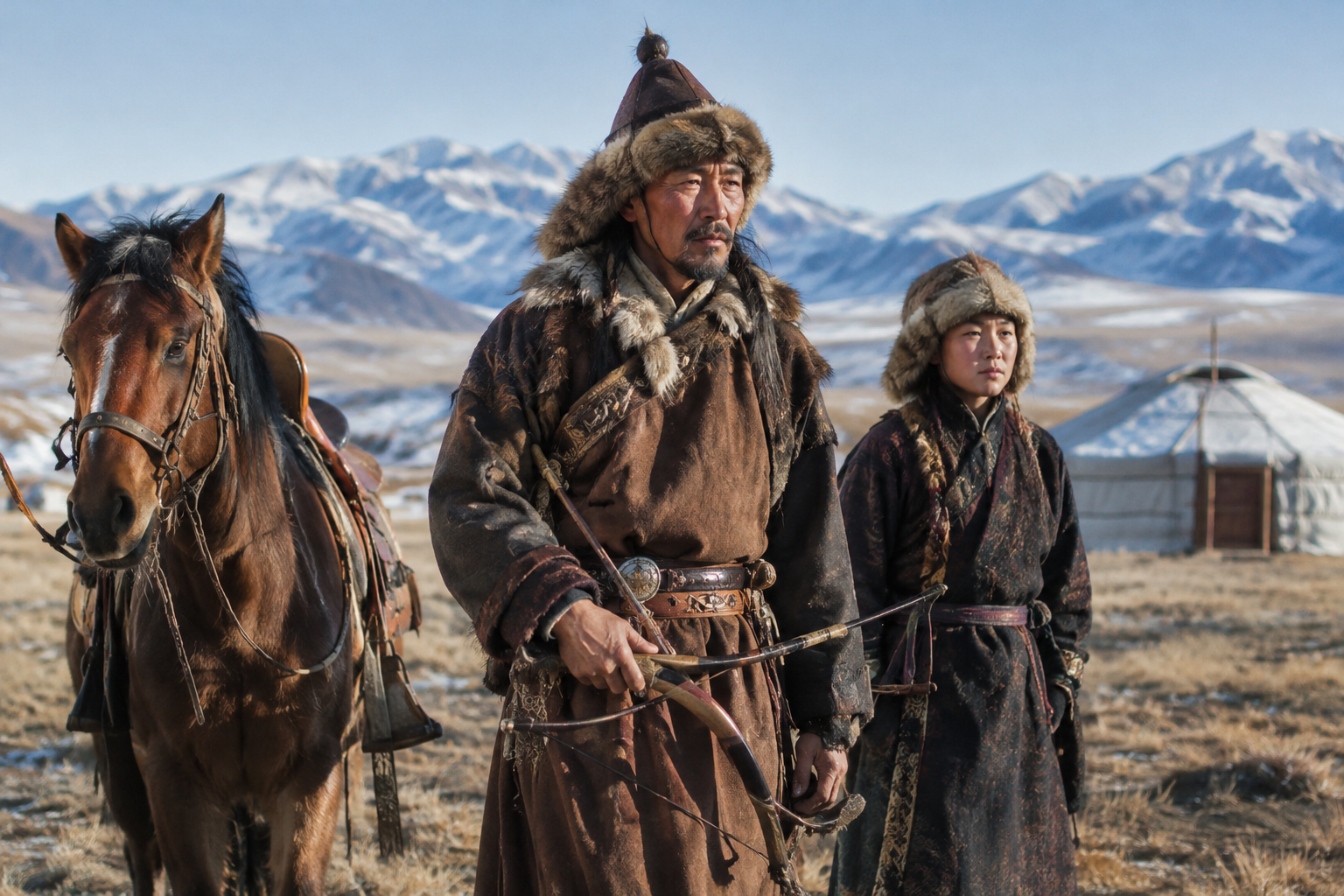
One of the few ancient individuals here linked to haplogroup D1a1a1a1 is a man labeled TSA004, dated to around 1350 AD and described as a Late Medieval Mongol from Tsagaan Chuluut. That is already enough to make him interesting. This is not a deep-prehistory cave burial or a grand imperial tomb with a name attached, but a medieval person from the Mongolian world whose paternal line belongs to a branch more often discussed in East Asian and Inner Asian population history than in the better-known steppe lineages of popular imagination.
That matters because Y-DNA follows one very narrow line of descent: father to son, and then father to son again. It does not tell us a person's whole ancestry, social rank, or language by itself. But when a lineage like D1a1a1a1 appears in an archaeologically dated Mongol-period individual, it gives us something solid and refreshingly specific: one documented paternal thread inside the human complexity of the late steppe empires.
The setting is the Mongolian steppe in the centuries after the rise of Chinggis Khan, when the political world of Inner Asia had been transformed by conquest, alliance, movement, and the reshaping of old tribal landscapes. By around 1350 AD, the Mongol Empire had fragmented politically, but the social and biological consequences of the imperial age were still very much alive. Cemeteries and human remains from this period help show that the steppe was never genetically uniform, however often later myth tries to flatten it into a single "Mongol type."
TSA004 sits in precisely that more interesting reality. His classification as a Late Medieval Mongol places him in the cultural horizon of post-imperial Mongolia, while his association here with D1a1a1a1 points to a paternal lineage that is relatively uncommon in broad Eurasian discussions but highly relevant to East and Inner Asian population history. In plain terms: the medieval Mongol world included men whose paternal ancestry came from different older streams, and this sample preserves one of them.
A useful wider introduction to the region's ancient population history can be found in MyTrueAncestry's piece on Ancient DNA and Genetic History of the Mongolian Steppe.
Haplogroup D is one of the old and geographically distinctive Y-chromosome lineages of Asia. Some of its branches are especially associated with populations in East Asia, the Tibetan Plateau, Japan, and parts of the wider Himalayan and Inner Asian world. That does not mean every downstream branch has the same story, and it certainly does not let us assign a single origin narrative to D1a1a1a1 without sample-by-sample evidence.
What we can say responsibly is narrower and better. The presence of D1a1a1a1 in a Late Medieval Mongol individual shows that this branch formed part of the paternal diversity present in Mongolia during the late medieval period. It complicates any lazy assumption that medieval Mongol paternal ancestry can be reduced to one dominant lineage or to one famous imperial family.
That point is worth stressing because popular accounts of Mongol genetics often leap straight to elite descent claims. Archaeology is usually less theatrical and more revealing. Most excavated individuals are not emperors. They are the people who actually make history visible on the ground: buried men, women, and children whose bones preserve the demographic reality beneath dynastic legend.
At first glance, a single sample may seem meagre evidence. In fact, one well-dated individual can be quite informative when the haplogroup itself is uncommon in public discussion and when the historical setting is as important as the lineage. TSA004 gives us a fixed point: by the mid-14th century, a man in Mongolian context carried this paternal branch.
That is valuable because the 13th and 14th centuries were an age of extraordinary mobility across Eurasia. Armies moved, merchants moved, captives moved, brides moved, and political federations absorbed older local groups. In such a world, the survival of a particular Y-line in a Mongol-period burial may reflect deep local continuity, more recent incorporation into steppe confederations, or both. The evidence here does not let us choose among those possibilities with certainty, but it does place D1a1a1a1 inside that documented historical landscape.
Research connected with these Mongolian ancient remains is linked through this supplementary research source, which is relevant as background for the genetic study of ancient individuals from the region. Without over-claiming details for TSA004 beyond the information provided, the broader value lies in anchoring the lineage to a real archaeological context rather than to modern frequency maps alone.
One of the best lessons from ancient DNA on the steppe is that political labels and genetic lineages do not line up neatly. "Mongol" in the late medieval period could describe a cultural, political, and historical world that included substantial biological diversity. That should not surprise us. Steppe polities were built through alliance, conquest, fosterage, clientage, and incorporation of older populations across vast territories.
So TSA004 is useful not because he stands for all Mongols, but because he helps resist the urge to reduce them to a single paternal signature. A medieval Mongol burial carrying D1a1a1a1 reminds us that the empire and its successor societies gathered together many different paternal histories. Some lineages may have been locally rooted in Mongolia for long periods; others may have circulated through the broader east Eurasian zone before appearing in this burial record.
For readers interested in wider East Asian paternal history, another relevant MyTrueAncestry article is the overview of Ancient Y Chromosomes Reveal Coastal and Inland Migrations that Shaped East Asian Paternal History.
There is also a methodological point here. Steppe history is often told through chronicles of rulers, campaigns, and tribal names recorded by outsiders or by later court historians. Ancient DNA changes the scale of the story. It lets us look not only at empires, but at individuals. Instead of asking only who ruled, we can ask who was actually buried in these landscapes, and what kinds of paternal and genomic diversity they carried.
That is where a sample like TSA004 earns its keep. He is a modest but important piece of evidence from a period when Mongolia sat at the centre of a continent-wide network. His Y-line does not identify a dynasty. It does something better: it captures one authentic paternal lineage present among medieval people of the steppe.
That broader theme of integrating archaeology and genetics is explored in MyTrueAncestry's introduction to Archaeogenetics: Using Ancient DNA to Decode Human History.
For someone who carries haplogroup D1a1a1a1 today, the most responsible historical takeaway is not a grand claim of descent from a conqueror, but a more interesting and evidence-based one. This branch was present in the Mongolian world by the late medieval period, documented here by TSA004 from Tsagaan Chuluut around 1350 AD. That places your paternal line, or a close sister line to it, within the real human diversity of Inner and East Asia's historical populations.
In other words, D1a1a1a1 points toward a paternal heritage with genuine depth in Asia and a documented foothold in medieval Mongolia. Even a single burial can do that much: not solve the whole past, but pin one line of ancestry to one place, one period, and one excavated human life.
Comments