Haplogroup D1

– 4 min read


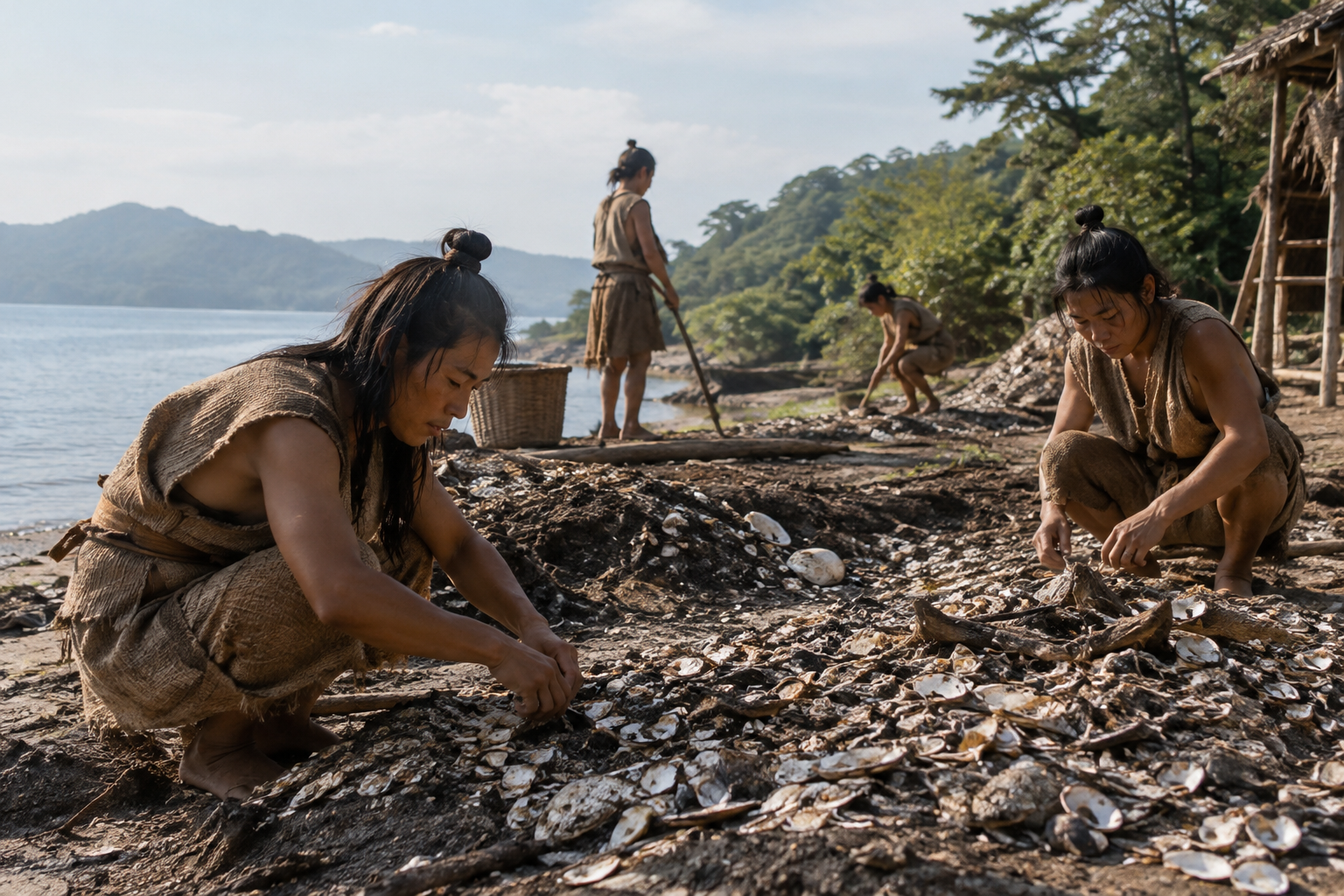
At the Rokutsu shell midden in ancient Japan, one male individual dated to around 1250 BC, sample I6341, gives us a particularly sharp glimpse of haplogroup D1. Shell middens are wonderful archaeological places precisely because they are not grand monuments. They are the accumulated remains of ordinary life: food waste, settlement debris, traces of people who lived close to coasts and estuaries. When a Y-chromosome lineage such as D1 turns up in that setting, it anchors the haplogroup not in legend or later identity claims, but in a real human community.
D1 is a paternal lineage, meaning it tracks one direct male line out of the many thousands that make up a person's ancestry. Even so, lineages like this can be historically revealing. In the case of D1, the ancient evidence supplied here points toward a story centered on East and Southeast Asia, with one especially important association in Jomon-period Japan and another intriguing appearance in ancient Malaysia.
The Jomon period of Japan is often introduced through its pottery, but its archaeological interest goes far beyond ceramics. These were long-lived foraging societies, regionally varied and highly skilled in making use of marine, riverine, and woodland environments. The Rokutsu shell midden belongs to that wider world. Sample I6341, dated to about 1250 BC, places haplogroup D1 within a late Jomon context in ancient Japan.
That matters because the Jomon were not simply a vague "prehistoric" people. Ancient DNA has increasingly shown them to be a distinctive population with deep roots in the Japanese archipelago. A major genetic study of ancient Japan, published in Nature, helped clarify how Jomon ancestry persisted and interacted with later arrivals. Within that larger picture, a Y-lineage such as D1 becomes part of a much more grounded historical discussion: not an abstract branch on a chart, but a paternal line carried by a man living in a specific coastal community.
We should be careful here. One individual does not stand for all Jomon men, still less for all of Japan. But I6341 does show that D1 belongs in the conversation about ancient Japanese paternal diversity. It gives the haplogroup a secure archaeological foothold in the archipelago during the late second millennium BC.
Shell middens can sound humble beside tombs and palaces, yet they are often better witnesses to long-term continuity. They accumulate where people returned again and again to live, eat, discard, and bury their dead. That makes them especially valuable for studying communities whose history was not written down in chronicles.
For Y-DNA, this is important. A paternal lineage found in such a place is not automatically a marker of elite rule, migration conquest, or political identity. It may instead reflect something quieter and older: the persistence of local male lines within communities that maintained their own traditions over long spans of time. In the case of D1 at Rokutsu, the archaeological setting encourages exactly that kind of interpretation.
It also helps explain why D lineages have attracted so much attention in Japanese prehistory. They appear in discussions of older population structure rather than only later state formation. If your own paternal line falls under D1, the archaeological resonance here is strongest with deep time in East Asia, especially in settings where local continuity matters more than dynastic glamour.
The second sample in this article is geographically striking: Ma911, from ancient Malaysia, dated to around 2330 BC. The date makes it older than the Japanese individual, and the location broadens the map considerably. Whatever the exact downstream placement may have been, the association with D1 tells us that this paternal branch, or a classification connected to it, was not confined to the Japanese islands.
That wider distribution fits a broader pattern seen in discussions of early East and Southeast Asian population history. Ancient paternal lineages did not obey modern national borders, and prehistoric coastlines, islands, and peninsulas often supported movements and contacts that written history never recorded. A landmark ancient DNA study in Science explored the deep population history of Southeast Asia, showing just how layered and complex the region was. Even without forcing Ma911 into a neat migration tale, the sample supports the idea that D-linked paternal ancestry belonged to an older and more regionally varied human landscape.
This is exactly where caution improves the history rather than weakens it. Ancient Malaysia in the third millennium BC was not a single culture, and a lone Y-chromosome assignment cannot tell us language, ethnicity, or a precise route of descent. But it can tell us that D1 is relevant to an area that is often overshadowed by later historical narratives about trade kingdoms, Indian Ocean exchange, or much more recent ethnolinguistic identities.
Ancient Indonesia's Genetic Divide
Taken together, I6341 from Jomon Japan and Ma911 from ancient Malaysia do not tell a simple story of one people moving in a straight line from one place to another. They tell a better story than that: one about depth, regional diversity, and survival of paternal branches across very different archaeological worlds.
At Rokutsu, D1 appears in a coastal forager context in late prehistoric Japan. In Malaysia, it appears in a much earlier Southeast Asian setting. Those are not interchangeable cases. The value lies precisely in their difference. One shows D1 embedded in the Jomon world of the Japanese archipelago; the other hints at a wider eastern distribution of related paternal ancestry in prehistoric Asia.
For readers used to Eurasian haplogroup articles dominated by steppe expansions, medieval dynasties, or Roman frontiers, D1 is a useful corrective. It draws our attention to a part of the human past where local archaeological sequences, island histories, and coastal populations matter enormously. The evidence is sparse, yes, but it is not trivial. Sparse evidence is often where the most interesting questions begin.
East Asian Y-Chromosome Migrations
So what can someone with haplogroup D1 reasonably take from this? First, the ancient cases here point to a lineage with real prehistoric depth in East and Southeast Asia. Second, the clearest archaeological anchor in this set is the Jomon-associated individual I6341 from Rokutsu, which ties D1 to a concrete community in ancient Japan rather than to a vague modern label.
That does not make every D1 line "Jomon," nor does it collapse Malaysia and Japan into one population. But it does suggest that D1 belongs to an old eastern paternal landscape whose traces survived in very different places. In ancestry research, that is often the most valuable kind of result: not a fantasy pedigree, but a firmer sense of where one branch of your family tree enters the human story.




Comments