Haplogroup C2b1b1b

– 5 min read


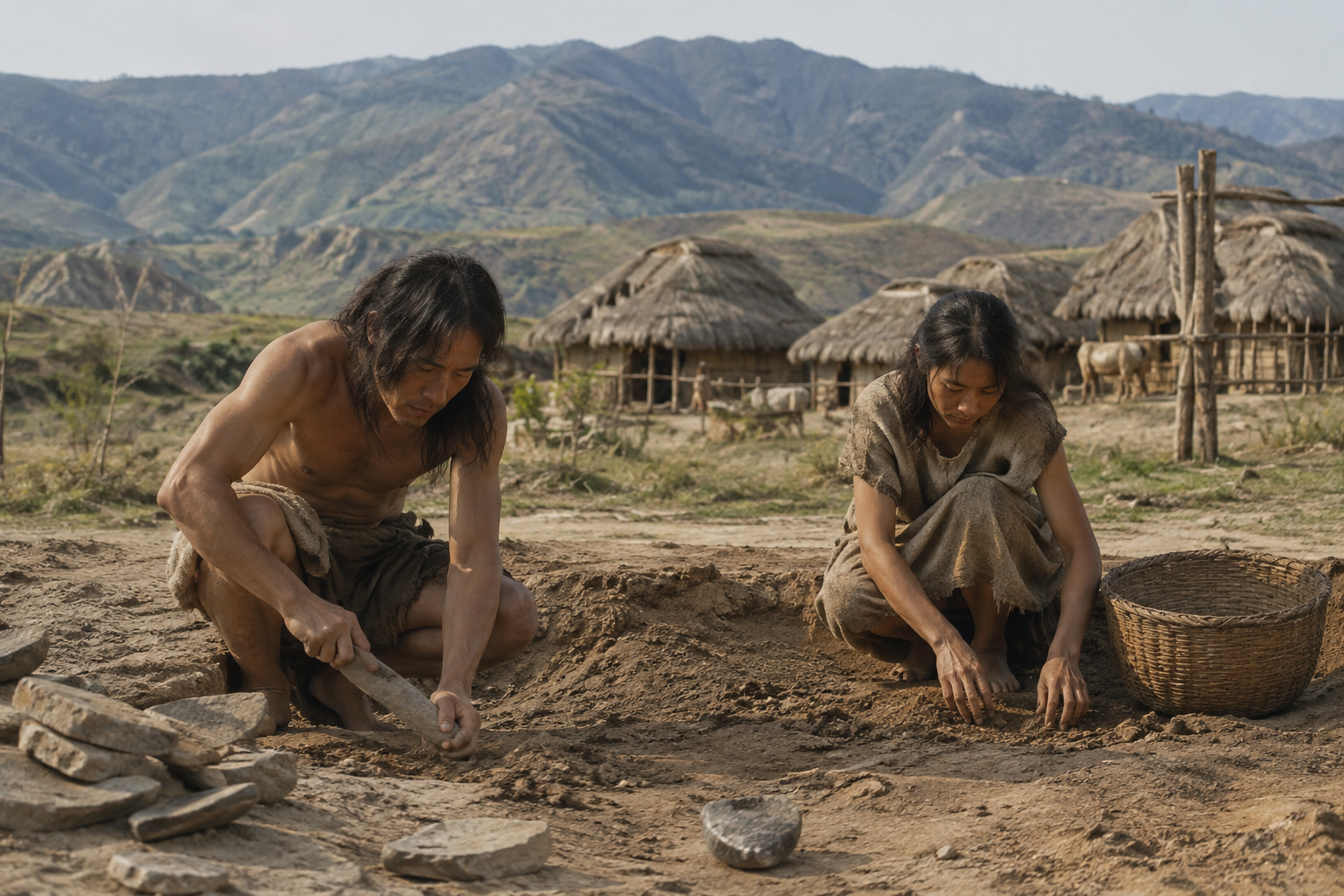
At Wuzhuangguoliang in northern Shaanxi, two men dated to around 2700 BC - Wuzhuangguoliang_6 and Wuzhuangguoliang_7 - carry a paternal line assigned here to C2b1b1b. That is a striking little cluster. We are not looking at a famous king or a richly documented tomb, but at something more useful for deep ancestry: an early snapshot of ordinary male lines present in Neolithic communities on the loess lands north of the middle Yellow River.
The importance of that finding lies in its setting. Northern Shaanxi, by the later Neolithic, was not an isolated backwater. It sat in a zone where farming communities, frontier contacts, and regional population shifts all mattered. When the same Y-DNA branch appears in two individuals from one site, it suggests that this paternal line was part of the local social world there, not a one-off curiosity. Y-DNA traces one direct male line only, of course, but that single line can still tell us where a branch had taken root.
Wuzhuangguoliang belongs to the wider archaeological story of northern China in the late Neolithic, when communities across the middle Yellow River region were already living in landscapes shaped by farming, settlement, and long-term regional interaction. The two men from this site are dated to about 2700 BC, a period when northern Shaanxi was part of a changing frontier between the core farming zones farther south and east and the steppe-facing regions to the north and northwest.
That matters because haplogroup C2 is better known today across parts of northern and eastern Asia, especially among populations historically linked with the steppe, forest-steppe, and northeastern Asian worlds. But one must be careful here. C2b1b1b is a much narrower branch than the wider C2 family, and these Wuzhuangguoliang individuals do not give us license to project the whole later history of C2 backward onto one Neolithic village. What they do show is that a branch within that broader paternal tradition was present in Neolithic northern Shaanxi well before the great historically documented empires of East Asia.
A major ancient DNA study of long-term population history in this part of China has helped place such individuals into a larger regional frame, showing how the middle Yellow River was both a center and a corridor in prehistoric population history. The relevant research can be found here: https://www.nature.com/articles/s41586-025-09799-x.
Ancient DNA articles often dazzle readers with vast maps and sweeping arrows. But sometimes the smaller pattern is the revealing one. Here we have two separate individuals - Wuzhuangguoliang_6 and Wuzhuangguoliang_7 - from the same Neolithic site, in the same broad period, associated with the same paternal branch. That does not automatically prove a father-son relationship, a clan genealogy, or a hereditary ruling lineage. It does, however, make the branch archaeologically real in this community.
And that is an important distinction. One isolated Y-chromosome result can always be explained away as an outlier. Two men from the same site begin to look like a local pattern. The branch may have been circulating among related households, neighboring lineages, or a wider male community embedded in that settlement's history. We cannot reconstruct the family tree from these two samples alone, but we can say that C2b1b1b was present in this Neolithic population in northern Shaanxi in a way that deserves attention.
It is also worth noticing what is not supplied here. We do not have grave inventories, osteobiographical detail, or explicit kinship analysis for these two men. So the historical value lies not in invented personality but in context: a repeated paternal signal in a key prehistoric region.
Northern Shaanxi often appears in later Chinese history as a hard-edged northern zone - strategically important, environmentally demanding, and closely connected to frontier politics. In the Neolithic, though, it was already part of a broader story of movement and mixture. The loess plateau and adjacent regions linked communities of the Yellow River basin with populations farther north and west. That is exactly the kind of setting in which a branch like C2b1b1b becomes historically interesting.
Rather than imagining a neat boundary between "core China" and "outer Asia," archaeology increasingly shows a mosaic of interacting populations. Farming expanded, local societies differentiated, and regional contacts mattered. A paternal lineage found in northern Shaanxi around 2700 BC may therefore speak not to a single dramatic migration, but to the long, cumulative formation of northern East Asian populations.
This is where genetic caution becomes historical clarity. It would be wrong to claim that these two men were "proto-Mongols," "steppe invaders," or founders of any named later people. None of that follows from the evidence. What does follow is more interesting in its way: by the late Neolithic, paternal lines later associated with northern Asian population history were already part of the human landscape of the Yellow River borderlands.
For anyone researching this haplogroup today, it helps to separate the branch in the article from the wider tree above it. C2b1b1b is not the same thing as all of C2. The broader C2 haplogroup has a wide and complicated history across Asia, and many of its branches spread in very different times and places. A match to C2b1b1b is therefore not a shortcut to every famous episode involving later C2-bearing populations.
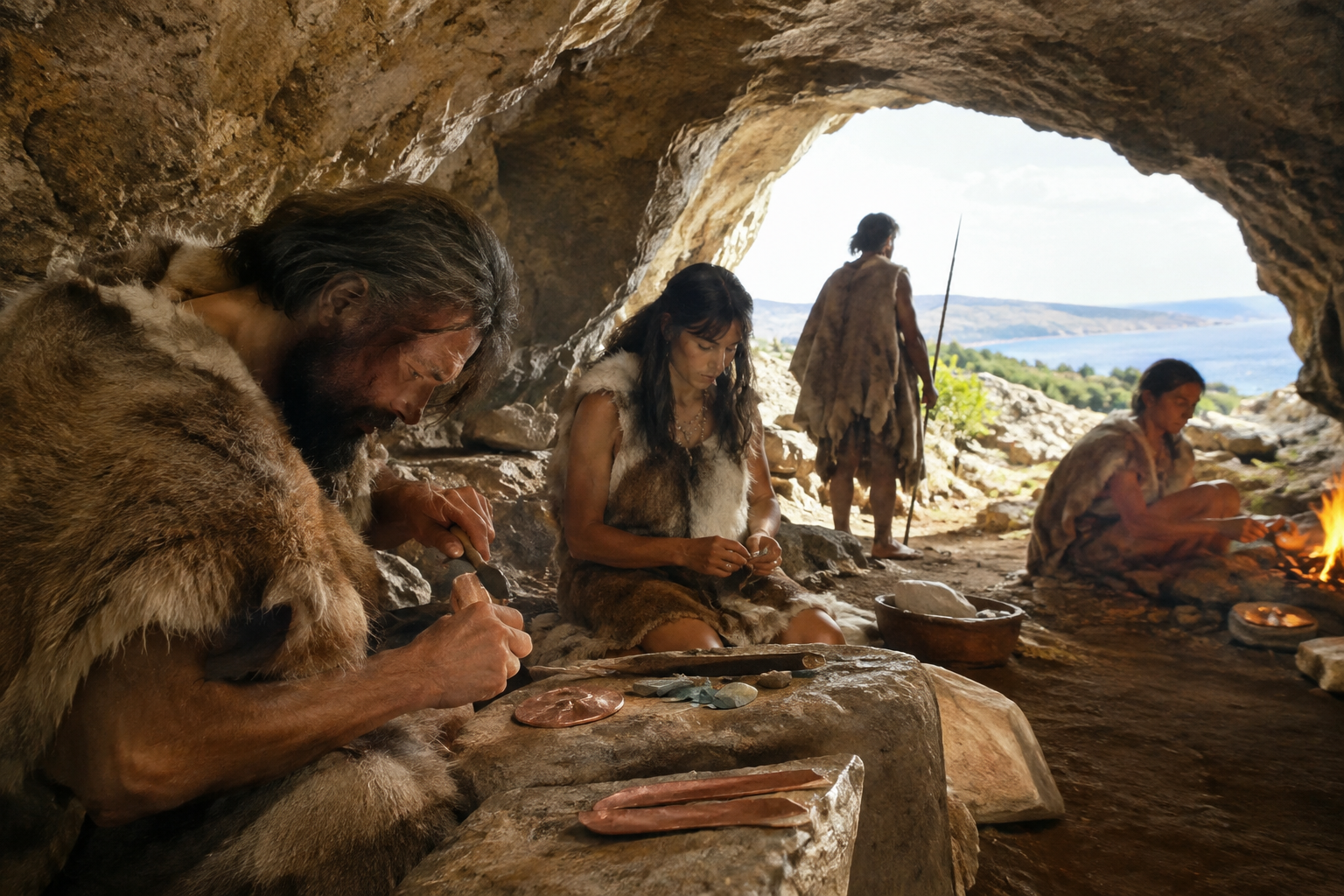
What these Shaanxi samples give you is something more grounded: an attested Neolithic presence for this paternal branch, or a very closely associated line, in northern China around 2700 BC. That pushes the story far earlier than medieval imperial genealogies or later steppe confederations. It places the branch in the world of prehistoric villages, long before written history began to name the peoples of the north.
That broader East Asian and northern Eurasian background is worth keeping in view when reading other archaeogenetic work on the region. For comparison with later developments across the steppe and neighboring zones, this related piece offers a wider frame:
One of the pleasures of ancient DNA is that it makes prehistory less anonymous. Not because it tells us everything, but because it pins real lineages to real places. In this case, Wuzhuangguoliang_6 and Wuzhuangguoliang_7 show that the paternal branch C2b1b1b was present in a Neolithic community of northern Shaanxi around 2700 BC. That is a concrete foothold in time and space.
For modern testers, the sensible takeaway is not a fantasy pedigree but a historical horizon. If your direct paternal line belongs to C2b1b1b, these ancient Shaanxi men suggest that one part of your lineage's story may lie deep in the prehistoric populations of northern China and its frontier zones. It is a reminder that the roots of many modern paternal lines run back not to courts and chronicles, but to villages, landscapes, and communities that archaeology is only now beginning to recover.


Comments