Haplogroup C2b1

– 5 min read


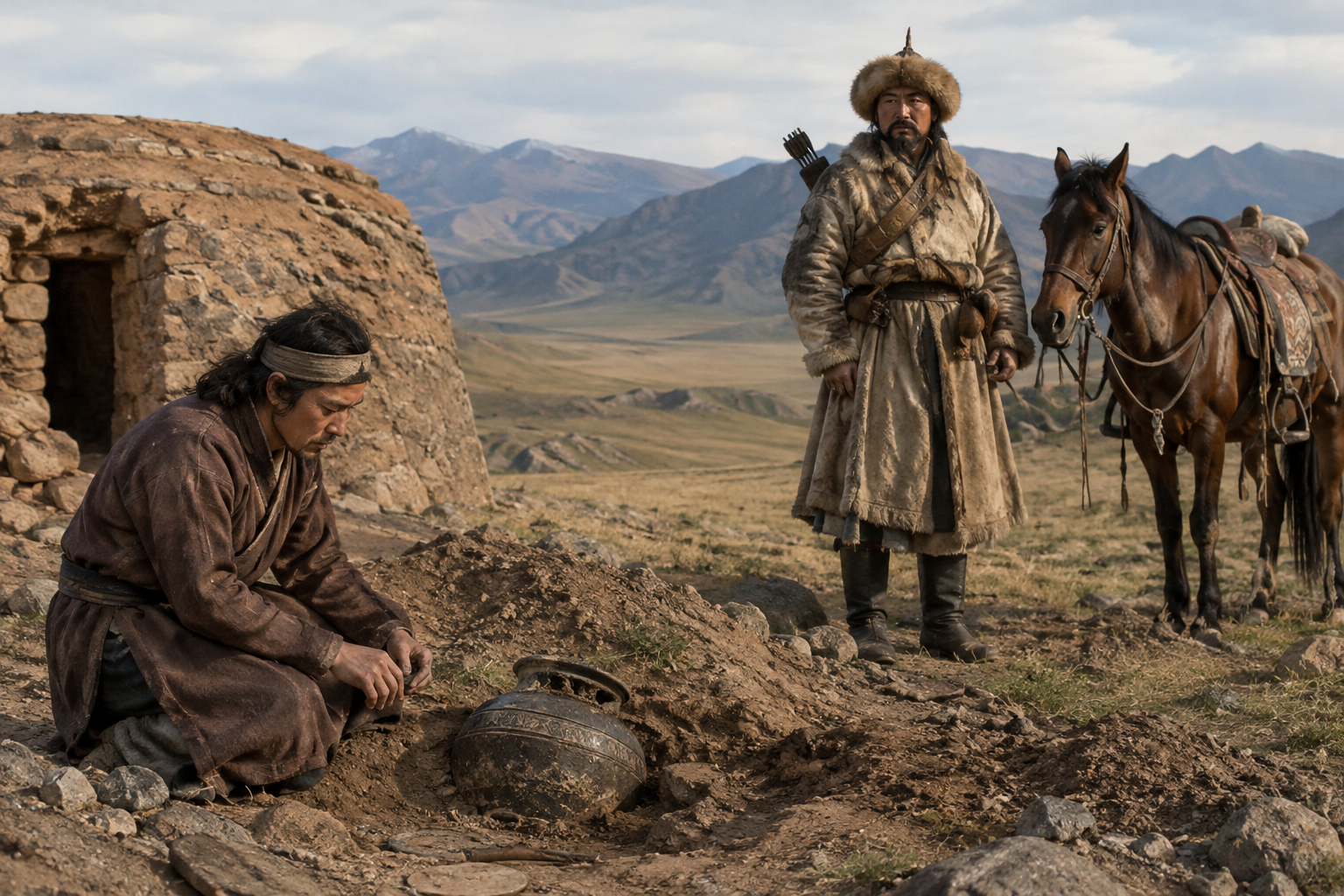
At Qijiaping in Guanghe, Gansu, one Bronze Age man has become unexpectedly important for the history of Y-DNA haplogroup C2b1. He is listed as sample QijiapingM108_2, dated to around 1650 BC and associated with the Qijia cultural horizon of northwestern China. That is a useful place to begin, because Qijia was not some vague "ancient East Asia" label: it belonged to a real frontier world of river valleys, uplands, and exchange routes where farming communities met wider Inner Asian networks.
The significance of C2b1 here is not that one burial can explain an entire lineage. It cannot. But this sample gives us a firm archaeological foothold for a paternal branch later seen much farther north in a very different historical setting: a Late Medieval Mongol individual from Tsagaan Chuluut, sample TSA002, dated to around AD 1350. Between those two points lies a long and complicated history of movement, continuity, and reshaping across the steppe edge and the northern Chinese world.
The Qijia Culture has long attracted archaeologists because Gansu was never an isolated corner. It sat in a corridor zone linking the Yellow River world to the northeast Tibetan Plateau and onward toward Inner Asia. A man carrying haplogroup C2b1 at Qijiaping, around the middle of the 2nd millennium BC, places this paternal line in a landscape where populations were already mixing, trading, and adapting to very different ecologies.
That matters because Y-DNA follows one direct paternal line only. It does not define a person's whole ancestry, language, or identity. Even so, when a lineage appears at a site like Qijiaping, it tells us that C2b1 was part of the male-line diversity present in Bronze Age northwestern China, not just something to be discussed later in connection with medieval steppe empires.
A MyTrueAncestry article on this same regional context is worth reading alongside the evidence here: Bronze Age Gansu is emerging as one of the key meeting grounds in East Asian archaeogenetics.
Research connected to ancient individuals from this region has been made available through a genetic study of ancient populations in Bronze Age Gansu. Without inventing details that are not in the burial summary here, we can still say something important: QijiapingM108_2 anchors C2b1 in an archaeological culture known for standing at a crossroads, where local continuity and wider contacts both mattered.
It is easy to overstate a haplogroup, especially one linked in the public imagination to northern and Inner Asian populations. So it is worth being precise. C2b1 is the branch named for this article; it should not automatically be treated as identical with the full history of broader haplogroup C or even every branch of C2. Different daughter lines can have very different geographical and historical stories.
With the evidence here, the safest reading is modest but still interesting. By the Bronze Age, C2b1 or a closely associated reported branch was present in northwestern China, and by the Late Medieval period it also appears in a Mongol context in Mongolia. That does not prove an unbroken line between the two sampled men, nor does it mean every carrier belonged to one people. It does suggest that this paternal lineage belonged to the wider human background of the eastern steppe frontier over a very long span.
The second key data point is TSA002, a Late Medieval Mongol individual from Tsagaan Chuluut, dated to about AD 1350. By then, we are in a wholly different political world from Bronze Age Gansu. The Mongol Empire had risen and fragmented; power, mobility, and exchange stretched from East Asia deep into western Eurasia. Yet a paternal line associated with C2b1 appears again in this northern setting.
That is precisely the kind of pattern ancient DNA is good at revealing. Not a neat tale of one tribe marching in a straight line across millennia, but the persistence of male lineages across changing cultural worlds. A lineage can survive through farmers, herders, soldiers, camp followers, local elites, and ordinary households, passing from father to son while languages, states, and material culture change around it.
For readers interested in the broader genetic setting of Mongolia and the steppe, this related overview helps place a sample like TSA002 in a much larger historical frame.
One relevant research lead for medieval and steppe-connected material is an ancient DNA study examining populations of the Mongolian steppe. Even without forcing that paper to say more than we can verify here, the general point holds: Tsagaan Chuluut places C2b1 within the historical orbit of the late Mongol world, where paternal lines from earlier northern East Asian and steppe populations were still very much alive.
If there is one historical lesson in these two samples, it is that the old frontier between agricultural China and the eastern steppe was not a wall. It was a belt of interaction. Gansu, Ningxia, the upper Yellow River, and Mongolia were linked by shifting networks of pastoralism, farming, trade, marriage, and migration. A lineage found at one end in the Bronze Age and another in medieval Mongolia belongs naturally in that connected zone.
But "connected" is not the same as simple. Qijia communities were not medieval Mongols in embryonic form, and a Mongol-period burial does not retroactively define Bronze Age identity. Archaeology keeps us honest here. These are different societies, separated by roughly three thousand years, with their own material culture, political structures, and historical circumstances.
What ancient Y-chromosome evidence can do is show that some paternal lines persisted across those transformations. It can also hint that northern East Asian male-line diversity had deep roots before the famous imperial expansions of later history.
A useful companion piece on this wider frontier zone is the article on Ningxia, another region where the meeting of steppe and Yellow River populations becomes visible in ancient DNA.
Two ancient occurrences may sound slight, and in one sense they are. No serious researcher would claim that QijiapingM108_2 and TSA002 alone map the full distribution of C2b1. Yet small datasets can still be historically important when they are well placed. Here they bracket two major worlds: Bronze Age northwestern China and the Late Medieval Mongol sphere.
That gives C2b1 a more grounded archaeological profile than a bare modern frequency map ever could. We are not just looking at present-day testers and trying to imagine the past. We are seeing this paternal branch attached to actual ancient individuals from named sites, one in a Bronze Age corridor culture and one in a medieval Mongol context.
Readers following East Asian paternal-line research more broadly may also want this overview of how ancient Y chromosomes are clarifying inland and coastal patterns across the region.
Ancient East Asian Y Chromosomes
For someone who carries Y-DNA haplogroup C2b1 today, the most defensible takeaway is not a claim to one empire, one ethnicity, or one famous ancestor. It is something subtler and, in truth, more interesting. This paternal line is visible in the archaeological record of the eastern Inner Asian world from at least Bronze Age Gansu to a Late Medieval Mongol burial in Mongolia, suggesting deep roots in the long-connected zone between northwestern China and the steppe.
That is a lineage history shaped less by a single dramatic origin story than by endurance across changing cultures. C2b1 appears, on present evidence, as one of the paternal lines carried through the making and remaking of northern East Asia over many centuries.
Comments