Haplogroup C1a2b1b1

– 4 min read


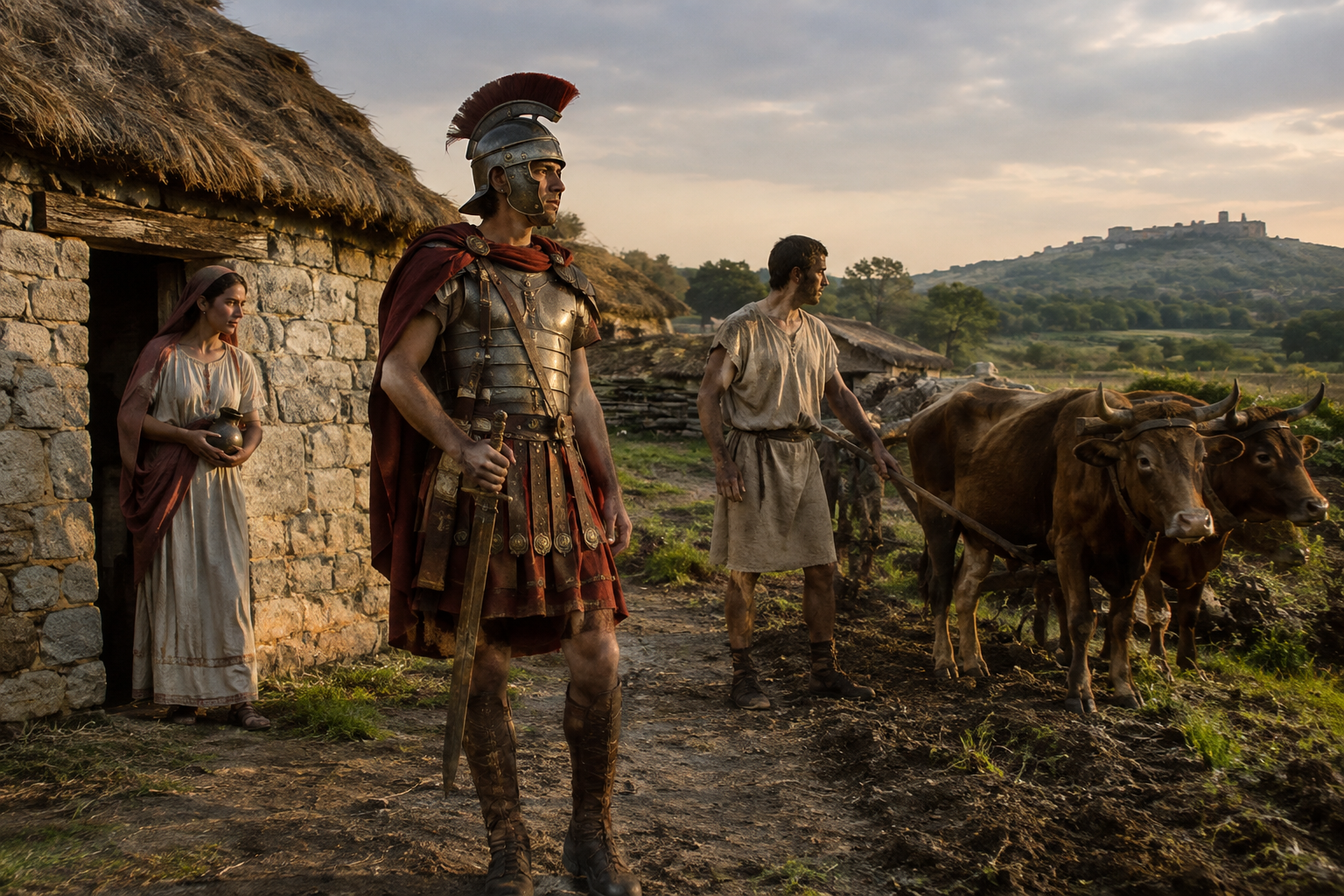
At Rakoczifalva-Szolnok in late Roman Hungary, one excavated man has ended up carrying a surprisingly deep paternal signal. The individual labelled RKF262, dated to around AD 250, has been associated with the Y-DNA haplogroup C1a2b1b1. That is immediately striking, because this is not one of the lineages people usually expect to encounter in discussions of the Roman-period Carpathian Basin.
And that is precisely why this sample matters. A single Y-chromosome does not tell us a person's whole ancestry, language, or identity; it traces only one direct paternal line. But when a rare branch such as C1a2b1b1 appears in a Roman-era burial from Hungary, it becomes a useful reminder that the late Roman world, especially along and beyond imperial frontiers, was full of small-scale movements, mixed communities, and lineages that do not fit tidy modern expectations.
Rakoczifalva lies in the Great Hungarian Plain, within a region that sat close to the shifting edge of Roman influence. By the mid-3rd century AD, this was not a quiet, sealed cultural zone. It was a contact landscape: imperial power nearby, local communities adapting, trade routes active, and people moving for reasons that could include military service, marriage, exchange, displacement, or inheritance.
That makes RKF262 more interesting than a bare haplogroup label might suggest. His reported paternal lineage, C1a2b1b1, is rare in the context of later European historical populations. So rather than reading him as an isolated oddity, it is better to place him in the kind of world late antiquity repeatedly reveals to us: one where a burial in Hungary could preserve a paternal line with a much deeper and less locally obvious history than the surrounding archaeological label alone might imply.
A major ancient DNA study of populations connected to the wider region and period has helped show just how varied these communities could be, and how misleading it can be to imagine neat blocks of "Roman" and "barbarian" ancestry where the archaeology shows long contact and mixture. Research on ancient genomes from the Carpathian Basin and neighboring areas has repeatedly pushed in that direction, including work published on ancient populations of this broader historical landscape.
C1a2b1b1 is a very specific branch within the wider Y-chromosome haplogroup C, a major paternal macro-lineage with an ancient and geographically wide history across Eurasia and beyond. But one must be careful here: the grand antiquity of haplogroup C as a whole does not automatically explain the history of this exact sub-branch. Narrow lineages can survive in scattered pockets, reappear in unexpected places, and pass through many populations without mapping neatly onto one people or one migration.
In practical terms, the appearance of C1a2b1b1 in RKF262 suggests the survival of an uncommon paternal line within a late Roman-era man buried in Hungary. That does not mean the population around him was defined by this branch, nor that everyone at the site shared the same ancestry. What it does mean is that the male line preserved in this one burial adds another thread to the documented paternal diversity of the Carpathian Basin during a period of major political and demographic change.
Archaeologists are often wary of over-reading single finds, and rightly so. Yet there are cases where one individual matters because he widens the range of what we know existed. RKF262 is one of those cases. When rare Y-lineages appear in securely dated ancient burials, they help break the illusion that past populations were genetically uniform or that unusual paternal lines must be recent arrivals in any given region.
Late Roman Hungary is especially fertile ground for this sort of correction. The region stood between worlds: Roman provinces to the west and south, Sarmatian and other groups in the plains, and the longer-term pull of mobility across the Danube frontier. In such a setting, unusual paternal lineages are not historical noise. They are evidence that communities were being formed from many different family histories, some visible in texts and artifacts, others surviving only in DNA.
If there is one historical lesson to take from C1a2b1b1 in RKF262, it is that the Carpathian Basin was never a dead corner of Europe. It was a corridor. Long before the medieval kingdoms of Hungary, and long after the first Roman interventions, the basin connected the Balkans, the steppe, Central Europe, and the lower Danube. People did not all move at once in great textbook migrations; often they moved in families, in military units, in marriage networks, or in much smaller streams that archaeology struggles to name.
This is where Y-DNA becomes useful in a very particular way. Material culture can change quickly. Political loyalties can shift in a generation. Burial customs can be adopted, adapted, or abandoned. But a paternal line like C1a2b1b1 can persist quietly through all that, turning up centuries later in a context where no one would guess it from the grave alone.
That broader picture also fits what many recent MyTrueAncestry readers will already have noticed in other frontier-zone studies: Roman-period and post-Roman cemeteries across Europe often reveal mixed origins rather than simple ethnic blocks.
We can say that RKF262 provides an ancient attestation of the haplogroup C1a2b1b1 in late Roman Hungary, at Rakoczifalva-Szolnok around AD 250. We can also say that this fits a historically plausible setting of mobility and mixture in the Carpathian Basin. Those are solid, useful points.
What we should not do is build a melodrama around him. There is no basis here for inventing his tribe, profession, language, or personal route into the region. Nor should we pretend that one Y-line proves a direct connection to a famous dynasty or an entire archaeological culture. Ancient DNA is most valuable when it narrows possibilities without pretending to finish the whole story.
For someone researching the haplogroup C1a2b1b1 today, RKF262 offers a modest but important insight: this paternal branch was present in the late Roman Carpathian Basin, in a region where imperial systems, frontier societies, and local communities overlapped. That does not hand us a ready-made family saga, but it does place the lineage inside a real historical landscape of movement and mixture. In other words, this is the kind of haplogroup finding that encourages good history: less myth, more evidence, and a sharper sense of how unexpectedly connected the ancient world could be.
Comments