Haplogroup C1a2

– 5 min read


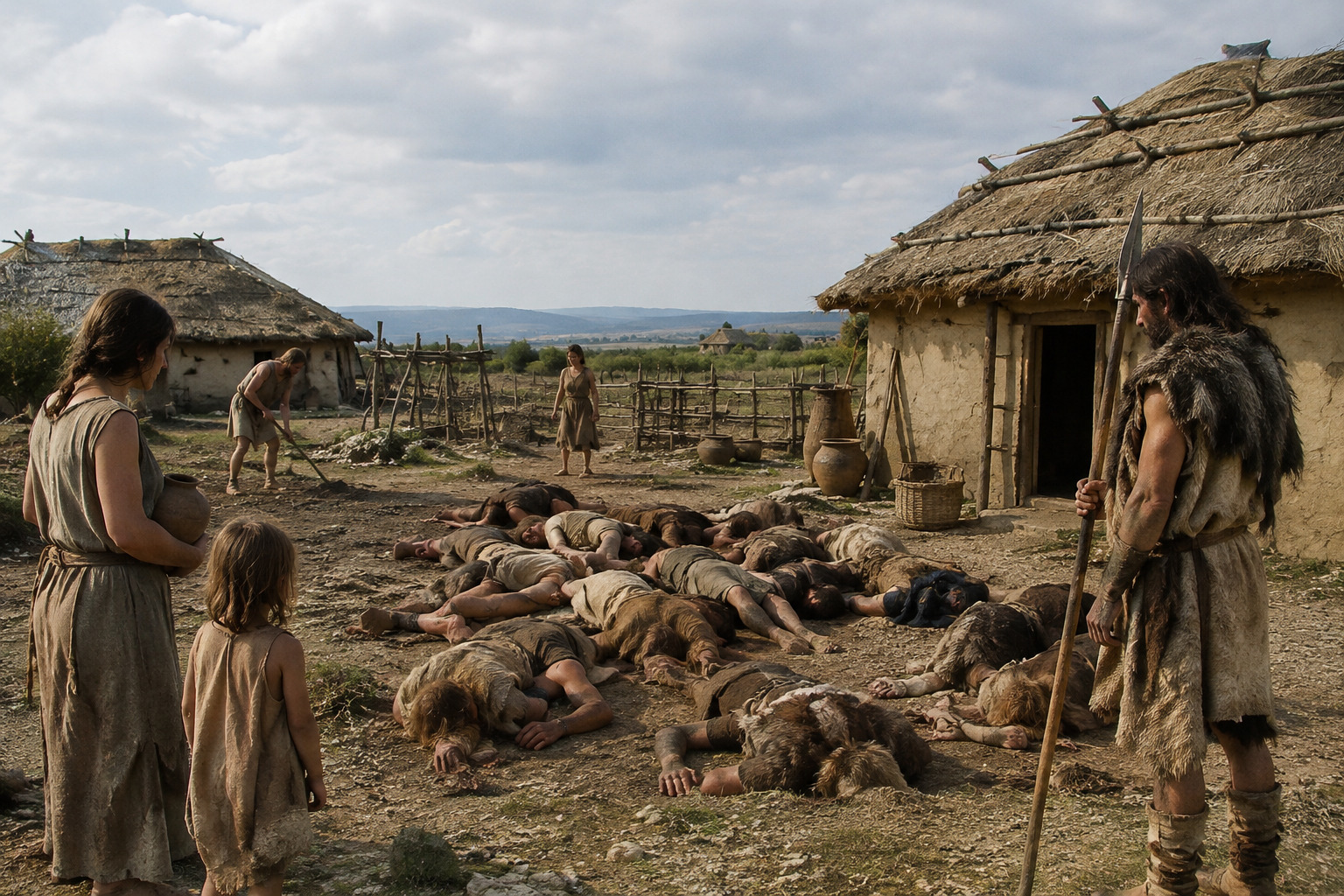
At Asparn-Schletz in Lower Austria, archaeologists uncovered one of the most disturbing villages of the European Neolithic: a settlement edge filled with the dead, dated to around 5000 BC. Among the men identified there are several carrying Y-DNA haplogroup C1a2, including samples I24897, I24907, I24277, I24028, I24279, I24904, I27805, I27771, I27773, I27787_d, I27772, I24884, I24898, and I5070. That concentration is striking, because C1a2 is not one of the paternal lineages most people associate with later European prehistory.
That immediately makes C1a2 interesting. Y-DNA follows one direct paternal line only, not a person's whole ancestry, but it can show us where particular male lines were present and, just as importantly, where they were not. In the case of C1a2, the ancient evidence here points less to medieval dynasties or famous warrior houses than to an older and rather more revealing story: early farmers, settlement frontiers, and a paternal lineage that appears in several corners of the Neolithic Mediterranean and southeast Europe before becoming rare in later periods.
The Asparn-Schletz cluster matters because it is not a lone burial with an exotic lineage. It is a repeated pattern within a real community, or at least within a local population caught up in violence. The site belongs to the early farming world of central Europe, and the number of C1a2 males there suggests that this paternal line was genuinely established among Neolithic groups in the region rather than appearing as an isolated outsider.
What we can say safely is that C1a2 was present among multiple men at the site, in a context of settlement collapse and mass death. What we cannot do is turn that into a neat clan saga. Shared haplogroups do not automatically mean all these men were close relatives, and a massacre deposit is not a census of the whole Neolithic world. But the repeated appearance of C1a2 at Asparn-Schletz does show that this lineage had real demographic weight in at least some early farming communities north of the Balkans.
Research on early European populations has repeatedly sharpened this wider picture, with ancient DNA transforming how we understand the spread of farming and the people involved. A well-known study of the first farmers in the Aegean and surrounding regions helped establish the close relationship between Anatolian and European Neolithic populations, providing the broader setting in which lineages like C1a2 appear in early agricultural expansions: https://www.nature.com/articles/s41559-020-1102-0.
If Asparn-Schletz shows C1a2 deeply embedded in central Europe's Neolithic, the earlier samples from Anatolia and the Balkans help explain why. One key case is I1102 from Barcin in the Marmara region of northwest Anatolia, dated to around 6300 BC. Another is I11949, also from ancient northwest Anatolia, dated to about 6350 BC. These are exactly the sorts of places archaeologists watch closely when tracing how farming communities moved into Europe.
Then there is I8105 from Starcevo-Grad in Serbia, around 5300 BC, linked to one of the earliest farming horizons in the Balkans. Put together, these samples suggest that C1a2 was present among some of the populations involved in the Neolithic spread from Anatolia into southeast and central Europe. That does not mean every early farmer carried it, nor that it was the dominant lineage. It means the branch was part of that expansionary world.
The important historical point is that early farming was not a single biological package with one male line attached to it. The first agricultural societies reaching Europe contained several paternal lineages. C1a2 seems to have been one of those lineages that were more visible in some early communities than their later rarity might lead us to expect.
The C1a2 story is not confined to the western edge of Anatolia. Two later Neolithic individuals from Çatalhöyük in central Anatolia, cch282 and cch300, dated around 5000 BC, also connect this haplogroup to one of the most famous settlement landscapes in prehistory. Çatalhöyük has long stood at the centre of debates about early town-like living, household continuity, and the social worlds of farmers.
Now, one must be careful here. A Y-haplogroup does not tell us how Çatalhöyük society worked, and it does not reduce that enormous site to one paternal thread. But the presence of C1a2 there helps place the branch firmly within the broader Anatolian Neolithic rather than treating it as a purely European oddity. In other words, this is a lineage found both in the source regions of early farming and in the farming societies that later flourished in the Balkans and central Europe.
That broader pattern also fits with more recent ancient DNA work on west Eurasian prehistory, including studies exploring regional adaptation and population change among early farmers and their descendants: https://www.science.org/doi/10.1126/science.abm4247.
C1a2 does not stop in the Balkans or the Danube zone. The sample Sch72-15 from Neolithic France, dated around 5000 BC at Schwindratzheim, shows the lineage had reached far into western Europe. So do the Trebur Grossgartach individuals TR67 and TR79 in Germany, around 4800 BC, within an early farming cultural context west of the Rhine-Main region.
Even more revealing is I4064 from Neolithic Sicily, dated to around 4850 BC. Sicily matters because islands are often awkward for simple migration stories. Their populations can preserve old patterns, absorb newcomers in uneven ways, or reveal maritime connections that tidy land-route models miss. A C1a2 individual there suggests that this paternal line was part of the wider seaborne and overland world of Neolithic expansion into the central Mediterranean.
This is where the haplogroup becomes historically useful. Rather than pointing to a single kingdom or later ethnic label, C1a2 seems to turn up in some of the places where Europe's first farmers settled, fought, built villages, and crossed water. It is a reminder that lineages now rare were once quite at home in major prehistoric transformations.
Most of the evidence for C1a2 in this dataset is Neolithic, which is itself telling. But the lineage does not vanish immediately from the record. XAN035 from Chania on Crete, dated to the Minoan period around 1575 BC, and AID002 from Mycenaean Aidonia in Corinthia, around 1500 BC, show that the branch or an associated reporting level linked to C1a2 still appeared in the Bronze Age Aegean.
There is also I7136 from Chalcolithic Romania at Urziceni, around 3985 BC, sitting between the first farmers and the Bronze Age examples. And much later still, I10381 from Govrlevo-Skopje in North Macedonia, dated around 627 BC and associated in the record with the Triballi region, hints at the long survival of an old paternal strand into the Iron Age Balkans.
These later appearances should be handled with care. They do not mean cultural continuity in any simple sense, and they certainly do not mean that Minoans, Mycenaeans, or Iron Age Balkan groups were defined by C1a2. What they show is persistence: an early Neolithic paternal line could survive, sometimes faintly, through major social and linguistic changes.
C1a2 is unusual not because it belongs to some lost royal house, but because the ancient record places it so clearly in early farming worlds stretching from Anatolia into the Balkans, central Europe, western Europe, and even Sicily. The cluster at Asparn-Schletz gives it a human scale: this was not just a branch on a tree, but a lineage carried by real men living in a vulnerable Neolithic frontier community. For someone researching this haplogroup today, the best-supported insight is that its deep ancient visibility lies above all in the first agricultural societies of Europe and their long afterlives in the Aegean and Balkans.


Comments