Haplogroup C1a

– 4 min read


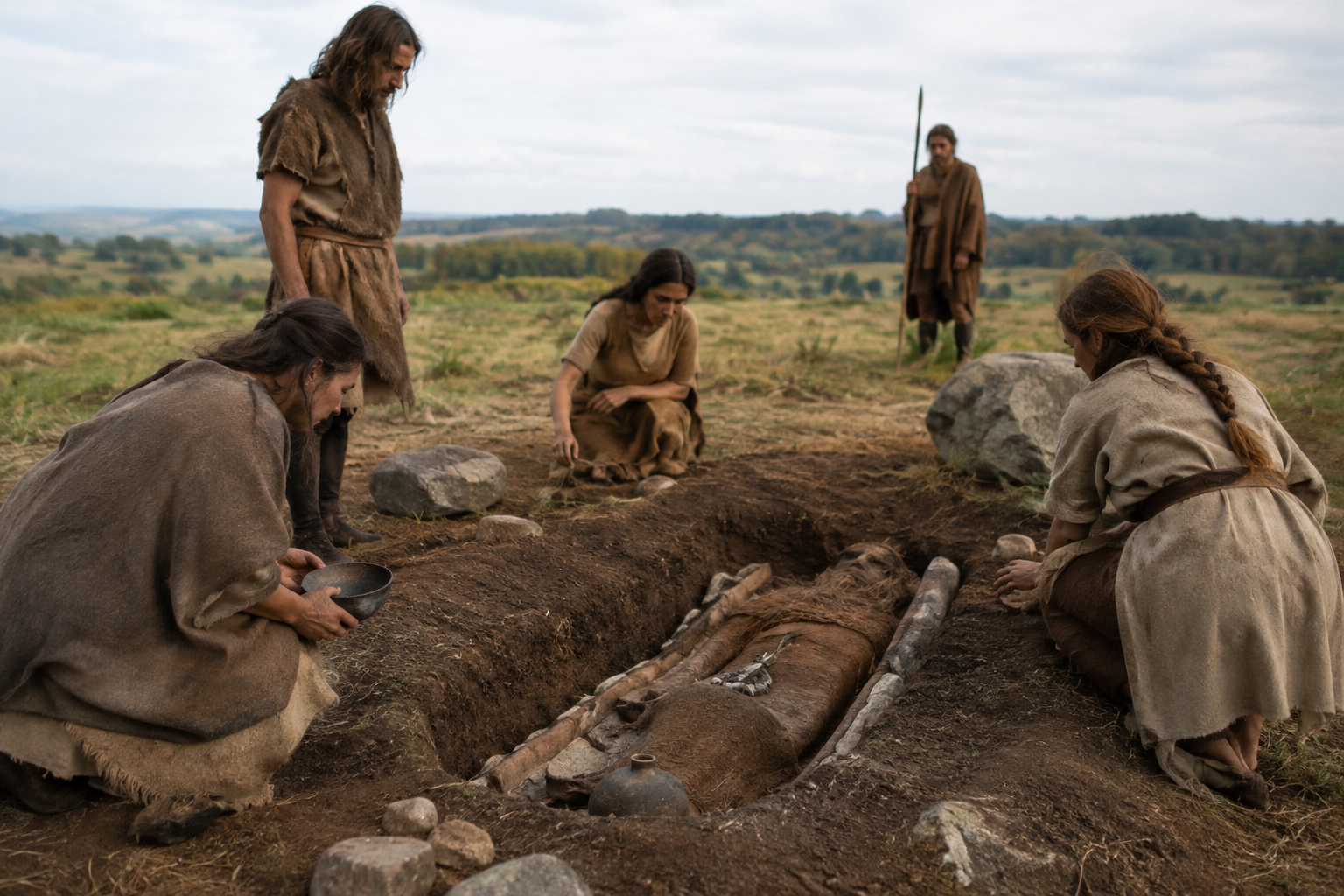
At Bury in the Oise region of northern France, a Neolithic gallery grave stayed in use for a remarkably long time. One of the later individuals associated with that burial sequence, sample BUR241, dated to around 2400 BC, has been linked on the paternal line to Y-DNA haplogroup C1a. That is the arresting part of the find: not simply a man in a grave, but a rare paternal lineage turning up in a monument that had already lived several archaeological lives before he was buried there.
C1a is not one of the Y-chromosome branches most people expect to meet in later prehistoric western Europe. Y-DNA tracks one direct paternal line only, not a person's whole ancestry, but it can still be very revealing when a rare branch appears in a well-dated archaeological context. In the case of Bury, the interest lies in the combination of rarity, place, and timing: a late Neolithic or Chalcolithic burial in northern France, inside a monument with a deep ritual history.
The Bury monument is important before we even get to genetics. It belongs to the world of Neolithic collective burial, where tombs were not single-use graves but places revisited, reworked, and reinterpreted over generations. Research on the site describes a long sequence stretching from the fourth to the second millennia BC, which is precisely what makes Bury such a useful stage on which to watch continuity and change in burial practice. A study of the monument's long use-life can be found here.
Sample BUR241 belongs to the later part of that story, around 2400 BC. By then, northern France was not frozen in some timeless "Neolithic" condition. Communities were living through the end of the great megalith-building age and into a period of changing contacts, changing burial customs, and shifting population patterns. So BUR241 matters not because he stands alone, but because he appears at a moment when old monuments were still meaningful even as the wider human landscape was changing.
Haplogroup C is a very old and widespread macro-lineage in the human past, but that broad fact should not be lazily transferred onto every smaller branch. C1a is a much narrower paternal lineage, and in ancient European discussion it is notable precisely because it is uncommon. When it appears in an archaeological context like Bury, it raises a sensible historical question: are we seeing the survival of a once wider paternal line, or a local remnant preserved within a changing population?
That question matters because late prehistoric Europe did not move in neat blocks. Different ancestry layers, family lines, and local traditions overlapped. A rare Y-line can persist long after broader population change, especially in communities where burial monuments anchored memory and identity. BUR241 does not prove a dynasty, a tribe, or a language. What he does show is that an unusual paternal branch was still present in northern France at the end of the Neolithic world.
Gallery graves and other megalithic tombs often outlasted the people who first built them. Later communities could return to them, add burials, alter their use, or reinterpret their significance. That is one of the most interesting parts of the Bury evidence: the monument's history is not a single episode but a sequence of ritual decisions made over centuries.
BUR241 therefore sits in a wider archaeological pattern seen across parts of Atlantic and northwestern Europe, where ancient tombs were not simply abandoned ruins. They remained places of importance. Sometimes that suggests continuity; sometimes it suggests appropriation; sometimes, rather awkwardly for our desire for tidy answers, it may suggest both at once. A reused tomb can preserve the memory of older landscapes even while the people using it are themselves genetically and culturally mixed.
Paris Basin population turnover
The date attached to BUR241 places him close to a major threshold in western European prehistory. By about 2400 BC, the societies of northern France were connected to broader developments that included changing burial customs, new material styles, and substantial demographic shifts visible in ancient DNA across nearby regions. None of that means every individual burial can be neatly assigned to a single migration event. It does mean that BUR241 belongs to a landscape in motion.
This is where the Bury context helps. A rare paternal lineage found in a long-used monument suggests that beneath large-scale regional change, some local male lines persisted. The archaeological record in northern France and the Rhine-Meuse zone increasingly shows that population turnover was real, but not always total or uniform. Some families, some places, and some practices endured. That is a more interesting and more human picture than any simple replacement story.
For comparison with nearby regional processes, the Lower Rhine-Meuse evidence is particularly useful, especially where forager ancestry and Bell Beaker-era shifts overlap in complicated ways rather than cancelling each other out. MyTrueAncestry has covered part of that story in its discussion of the Lower Rhine-Meuse region.
With a lineage as rare as C1a in later prehistoric western Europe, there is always a temptation to make the single sample do too much work. Better not to. BUR241 is valuable because he is securely tied to a known region, a broad period, and an archaeologically important funerary site. He gives us a real data point for the survival of this paternal branch in Neolithic northern France.
But one paternal line is not the whole population. It does not tell us that most local men belonged to C1a, nor that everyone buried at Bury shared one father-line. Nor does it convert the site into a genealogical shrine of one clan. Ancient DNA is strongest when it is put back into its archaeological setting, and Bury gives us exactly that: a rare lineage embedded in a long-lived monument whose meaning changed over time.
For people researching C1a today, the Bury evidence is suggestive in a careful way. It places this paternal branch in northern France in the late Neolithic, within a community that still engaged with older monumental burial traditions. That does not mean every modern C1a line descends from Bury, or even from Neolithic France. It does mean the branch was part of Europe's deep prehistoric patchwork, and not merely an exotic footnote elsewhere.
In practical terms, BUR241 offers something rather valuable: a historically grounded example of C1a in a real archaeological setting. Not a legend, not a heraldic fantasy, but a man buried around 2400 BC in Oise, in a monument already heavy with centuries of ritual use. For anyone carrying C1a today, that is a sober and fascinating reminder that rare paternal lines can survive through periods of enormous cultural change.
Comments