Haplogroup B2b1a

– 4 min read


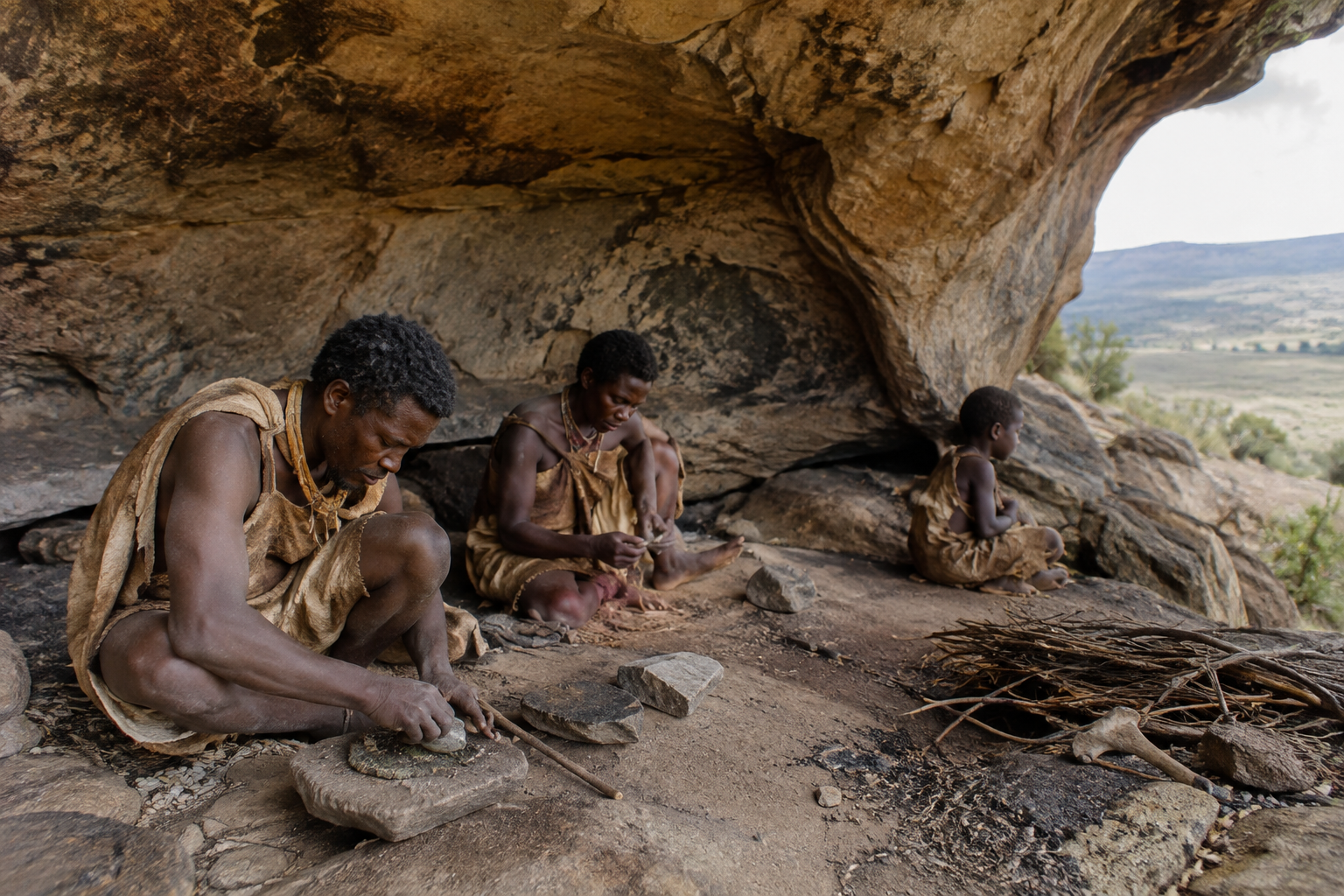
At Kakapel Rockshelter in western Kenya, one ancient male sample dated to around 1900 BC, identified as KPL001, gives us a rare and rather grounded way into haplogroup B2b1a. Kakapel is not a royal tomb or a famous imperial cemetery. It is something archaeologists often find more useful: a lived-in place at the edge of changing worlds, where foragers, herders, and incoming food-producing traditions met across eastern Africa.
That makes B2b1a interesting straight away. This is a Y-DNA lineage, so it traces one direct paternal line only, not the whole ancestry of a person or a population. But when a lineage like B2b1a appears in an ancient man from a well-placed site such as Kakapel, it helps anchor paternal history in a real landscape and a real period, rather than leaving it floating as a modern genetic label.
Kakapel Rockshelter lies in a region that became a major contact zone in later prehistory. Western Kenya sits between the Lake Victoria basin, the eastern African highlands, and routes leading north and south through the Rift and beyond. By the second millennium BC, this was not an isolated backwater. It was a place where older local lifeways and newer economic systems could overlap.
The sample KPL001, dated to about 1900 BC, belongs to that setting. Even with sparse details at sample level, the combination of site, date, and lineage matters. Haplogroup B lineages are among the deeply rooted paternal branches in Africa, and the presence of B2b1a here suggests continuity of local or regionally established male ancestry during a period when eastern Africa was already seeing important demographic and cultural shifts.
A broader ancient DNA study of this region, published in Science Advances, helped bring eastern Africa's deep population history into sharper focus. For readers tracing African paternal lines, Kakapel matters because it places one branch associated with B2b1a in a prehistoric community from Kenya long before later historic states, colonial borders, or modern ethnic labels.
With haplogroup articles, there is always a temptation to make the Y chromosome carry far too much historical weight. Better to be careful. B2b1a is a specific paternal branch within the wider haplogroup B family, and the ancient appearance of that branch in Kenya does not mean everyone at Kakapel shared it, nor that it defines the site's language, culture, or complete ancestry.
Still, one ancient Y chromosome can do something valuable. It shows that a paternal line linked to B2b1a was present in eastern Africa in the late Stone Age horizon represented at Kakapel. That is a firm chronological anchor. For men who carry this lineage today, that sort of evidence is far more useful than vague claims about timeless tribes or sweeping migration stories.
It also reminds us of a basic archaeological point: population change is rarely a neat replacement. Sites like Kakapel are important precisely because they sit in zones of contact. Ancient genomes from such places often reveal a mixture of persistence and change, rather than a tidy before-and-after.
To understand why KPL001 matters, we need to think about eastern Africa around 1900 BC. This was an era when food production, livestock herding, and older foraging traditions were not arranged in a simple sequence. Different communities could adopt, resist, or mix practices in different ways. Archaeology across Kenya and neighboring regions shows that technology, subsistence, and mobility were being renegotiated over long periods.
In that context, a paternal lineage such as B2b1a surviving in a rockshelter individual is historically suggestive. It points to male-line continuity within a region undergoing cultural change. That is not the same thing as stasis. Continuity in one paternal line can coexist with movement, intermarriage, new economies, and shifting social identities.
This is where ancient DNA is at its best when handled sensibly. It does not flatten the past into a single migration arrow. Instead, it lets us ask whether local lineages remained present as new ways of life spread. KPL001 suggests that, at least in one case, they did.
Africa, settlement, and disease
There is a pleasing irony here. Many DNA stories gravitate toward kings, noble houses, and famous graves, but the real backbone of human history is often found in humbler places. Kakapel Rockshelter was not built to advertise prestige. It preserves something better: evidence for ordinary prehistoric life in a region where long-term African population history was unfolding.
That matters especially for lineages such as B2b1a, which are easy to overlook in narratives dominated by later state formations or by Eurasian comparisons. The ancient sample from Kakapel keeps the focus where it should be: on African landscapes, African time depth, and the complexity of local histories before written chronicles begin.
There is also a methodological lesson. A single sample should not be inflated into a whole people, but it should not be dismissed either. When a well-dated individual is tied to a clear archaeological site, even one paternal lineage becomes part of a larger map of evidence. KPL001 is one point on that map, but it is a meaningful one.
For someone researching haplogroup B2b1a, the most responsible conclusion is also the most interesting. This lineage is not just a modern testing result; it is now tied, through KPL001, to an ancient male living in western Kenya around 1900 BC at a site positioned within a major prehistoric contact zone. That does not provide a family tree back to one named ancestor, but it does place the lineage in a credible archaeological world.
In other words, B2b1a can be read not as an abstract code but as part of eastern Africa's long human story: local paternal continuity, cultural transition, and survival through change. That is a modest claim, but a solid one, and in ancient DNA solid claims are always the most worth having.
Comments