Haplogroup A1b1b2b1

– 4 min read


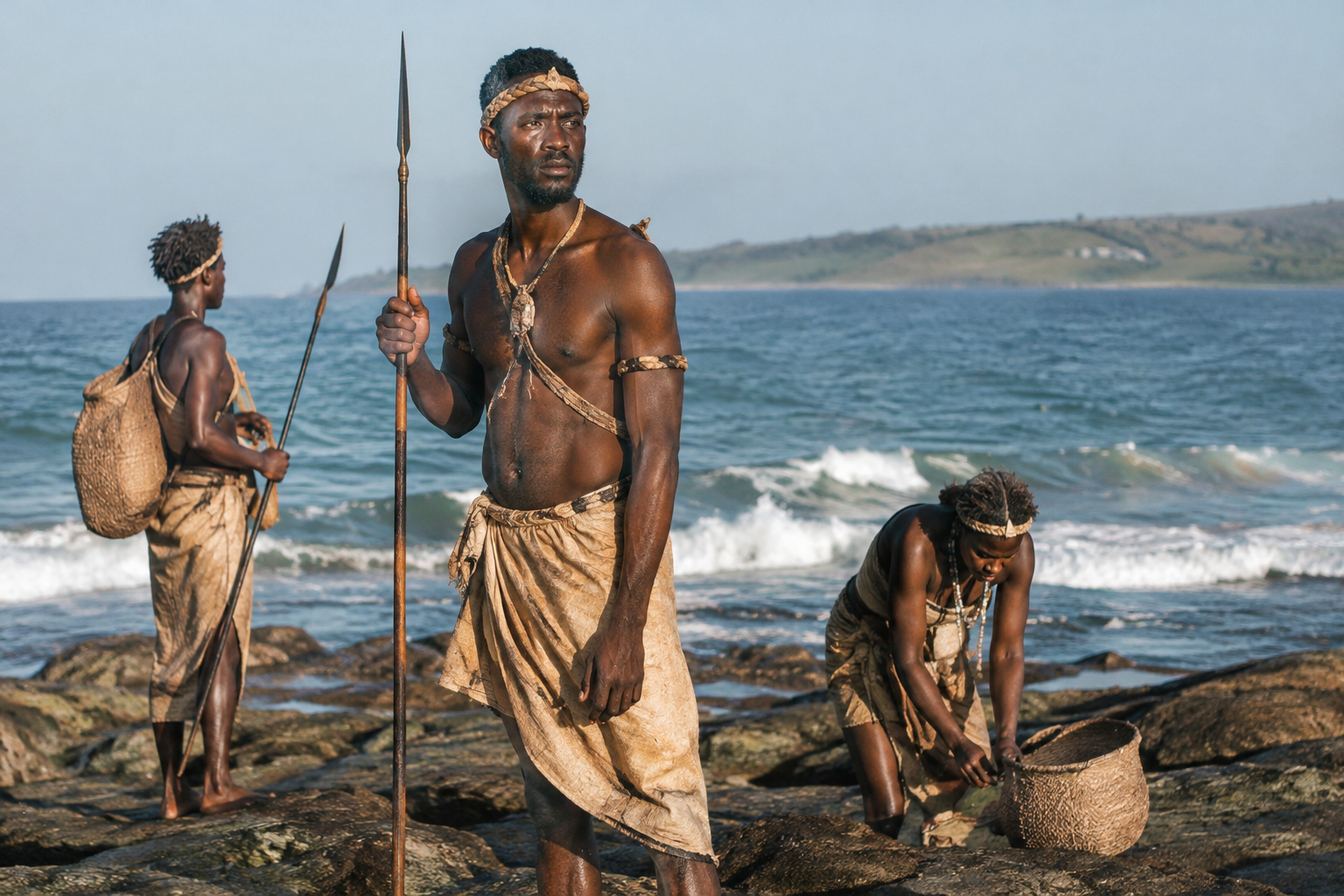
At Ballito Bay on the coast of South Africa, one ancient genome has become unexpectedly important far beyond its burial context. The individual known as bab001, dated here to around AD 110, is associated in MyTrueAncestry's records with the Y-DNA haplogroup A1b1b2b1. That matters because this is not one of the lineages that usually turns up in popular discussions of ancient DNA. It belongs to a very deep African paternal branch, and even a single ancient result from southern Africa can illuminate a great deal about the long history of men, families, and populations in the region.
For anyone tracing this haplogroup today, the first point is simple but essential: Y-DNA follows one direct paternal line only. It does not describe a person's whole ancestry, language, identity, or culture. What A1b1b2b1 offers, especially in an African context, is a rare glimpse into an old male lineage surviving within a landscape that has seen repeated episodes of movement, mixture, and cultural change.
Ballito Bay is already well known in ancient DNA because remains from the site helped transform debates about the deep population history of southern Africa. Research on ancient individuals from the region, including work published in Science, showed just how valuable southern African genomes are for reconstructing population splits and later admixture. Even when a particular article or database entry gives only limited archaeological detail for one person, the broader significance of the site is clear: these are not casual data points, but part of a region central to human prehistory.
That wider setting matters when considering bab001. A date around the early second century AD places this individual in a southern Africa that was already historically dynamic. Communities across the subcontinent were not frozen relics from a remote Stone Age past. They lived in landscapes shaped by local continuities, regional exchange, and, in some areas, encounters between foraging, herding, and farming populations.
Haplogroup A sits very near the base of the Y-chromosome tree and is especially important in discussions of African population history. But one has to be careful here. Saying that A1b1b2b1 is a branch within this deep African framework is sound; claiming a neat migration map or a single founding people for the exact subclade would go well beyond the evidence provided.
Still, the broad implication is striking enough. A lineage like A1b1b2b1 reminds us that southern Africa preserves paternal diversity of exceptional antiquity. In historical writing, Africa has too often been treated as if its genetic past were either unknowable or overly simple. In fact, the opposite is true. Ancient Y-chromosome branches from the region show long-term continuity combined with later reshaping, and that is precisely why a sample such as bab001 deserves attention.
A date around AD 110 can sound deceptively early or late depending on where one's imagination begins. In Mediterranean terms, it is the age of the Roman Empire. In southern Africa, it belongs to a period before written local archives but certainly not before history. Archaeology shows that by the first millennium AD, different lifeways overlapped across the region, and communities adapted in varied ways to coast, grassland, and interior environments.
So the significance of bab001 is not that he represents some untouched human origin point. Rather, he shows that an ancient paternal branch associated with A1b1b2b1 was still present in southern Africa in a historically meaningful period. That is a rather different and more interesting claim. It places a deep Y-lineage inside a living, changing social world.
Readers sometimes assume that one individual cannot tell us very much. In one sense that is true: no single man can stand in for all southern Africans, all coastal communities, or all carriers of a haplogroup. But ancient DNA works cumulatively. A securely placed sample can anchor a lineage in a time and place where modern DNA alone might leave too many possibilities open.
That is especially important for African paternal lineages, which remain underrepresented in published ancient DNA compared with Europe and western Eurasia. A sample like bab001 helps correct that imbalance, however modestly. It gives genealogists and historians a fixed point: whatever later expansions, disruptions, and mixtures followed, this paternal branch was present on the southern African coast in the early centuries AD.
There is also a broader methodological point here. Ancient DNA from Africa often survives poorly, and successful results are disproportionately valuable because they help test models built from present-day populations alone. Modern distributions can be misleading; they reflect recent bottlenecks, expansions, and colonial-era upheavals as much as deep ancestry. Ancient individuals provide something more stubborn: evidence from the past itself.
The deeper lesson of A1b1b2b1 is not a romantic tale of isolation. Southern Africa's past is full of movement. Hunter-gatherer populations, herding groups, and later farming communities interacted over long periods, and genetic studies of the region have repeatedly shown that continuity and admixture belong together. A very old paternal lineage can survive through all that, passing from father to son while the rest of a population's ancestry changes around it.
That is why Y-DNA can be so evocative when handled properly. It preserves a narrow line of descent, not the whole social story, yet that narrow line sometimes reaches astonishingly far back. In practical terms, someone matching A1b1b2b1 should think less in terms of a single tribe or recent ethnic label and more in terms of long-lived regional ancestry within Africa, especially southern Africa, where ancient diversity was both deep and persistent.
With A1b1b2b1, the most defensible insight is also the most powerful: this is a paternal lineage tied to one of the deepest branches of African Y-chromosome history, and bab001 shows it present in ancient southern Africa around AD 110. That does not make every modern carrier a direct representative of one ancient community, and it does not supply a ready-made ethnic identity. What it does offer is something rarer and better: evidence that your direct paternal line belongs to an old African story that was already ancient long before most written histories begin.

Comments